AI generated summary, newsroom reviewed
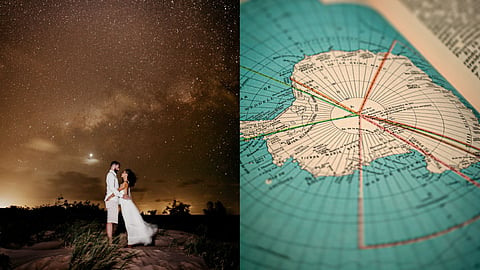
Look up on a star-studded night and you'll find the twinkling canopy above to be mesmerising! On a clear night, you can spot the Big Dipper which looks like a giant ladle or Orion’s belt with twinkling blue lights. Or just look for a red spotlight, which is fiery Mars.
The solar system, inclusive of the planetary bodies which are millions of miles from Earth, shape human life in a magnitude of ways through gravity, tidal effects, etc. While these scientific concepts are universally accepted, astrology experts believe that the planets, the sun and the moon, can also influence our minds, moods and the very course of our lives. “It’s about energetic patterns tied to the five elements,” explains Mumbai-based celebrity astrologer, Pallavi Shinde.
She adds, “The Universe and everything in it—including human beings—have the same source of creation. We are all composed of the panch mahabhutas.”
She explains by means of an example—71 percent of Earth’s surface is water, and about the same per cent of our body is also made up of water. Shinde continues, “We are a tiny speck in this vast cosmos, and are made up of the same elements. Every shift in the elements thereby affects us.”

It’s surreal to think that we quite literally are made up of stardust. But that’s exactly what we are, asserts Mumbai-based veteran astrologer and vastu consultant, Amarr Gandhi. “Cosmic energy came together to create this physical vehicle—the body—so we could experience human birth, to allow our soul to evolve.” While many schools of astrology see individual human life as a journey towards the soul’s purpose, the mechanism behind creation overlaps loosely with scientific theories; the big bang is widely recognised as the singular event defined by a massive energetic shift which marked the birth of the Universe itself.
Sounds too woo-woo to connect serious sciences with astrology? Gandhi admits many are dubious about astrology. Affirms Gandhi: “The youth are particularly sceptical, and I respect and invite their questioning nature. I win them over by studying their birth chart and mentioning exact timelines where they faced a particular challenge. Then I explain that it’s not magic; it's an accurate mathematical calculation with age-old knowledge of the cosmos.”
He explains that just because we can’t see something—like energetic patterns—doesn’t mean they don’t exist.
Gandhi explains that the map of the sky, at the exact time of our birth, at the location where we were born, constitutes our birth chart. Both Gandhi and Shinde insist there are no coincidences; that the time and place of our birth are pre-ordained by a higher power. Therefore the chart is a road-map of our very lives.
“When it comes to some of the most important decisions in our lives—such as marriage and choosing the right destination to tie the knot—astrology can be invaluable,” says Shinde.
With two decades of experience in astrology, Gandhi explains the finer details of the process: When a couple approaches him to help them choose a wedding destination, he studies their birth charts. He cautions, “Many a time, people come to me with their charts which are prepared on the basis of an incorrect time of birth. At the initial consultation, I ask questions and figure out timelines of major life events, so as to arrive at an accurate birth time.”
He explains that this is a crucial first step to get an accurate reading.
The birth charts are studied individually, then together, to see the world they will create together. Thereafter the charts are studied against the cosmic alignment expected at the time and place of the destination chosen for the big day. Based on this in depth study of the stars, Gandhi looks at whether the wedding destination is auspicious. He explains, “It’s not about that one day; it’s about the beginning of a new life together. The place where they tie the knot will affect the union itself.”
Gandhi explains, “When mapping the destination, I study the planetary alignments of that place at the chosen time for the marriage. Many factors have to be taken into consideration, but some of the main planets that I study are Venus which represents luxury and the pleasures of life including the joy derived from a happy marriage; Moon which rules over the mind and emotions; Rahu which represents illusions and obsessions, which are known to surface in intimate relationships.” Gandhi elaborates, “There is no one-size-fits-all. So while these three are vital planets in choosing a wedding destination, there are many other nuances to consider.”
He also cautions against widely-held erroneous beliefs. He says, “Some people believe that the influence of Saturn on a destination will ruin the marriage. This is not so. It all depends on how this aspect interacts with the couples’ individual charts. It may even be auspicious for some.”
While jyotish is associated with Hinduism, both astrologers state that they see clients from a variety of religions. Tina (name changed) says, “I’m not pious, but astrology appeals to me. The way I understand it, at the core of astrology is the premise of interconnectedness of all beings. That makes sense to me. In fact I find comfort in it. I turned to astrology when I faced relationship challenges in the wake of health issues. Astrology worked for me. I was lucky to come across an astrologer who was honest yet sensitive. The readings helped me confront an uncertain future with hope.” She admits that astrology wasn’t a magic bullet, as she simultaneously worked on her relationship, and her health.
But if everything—including failed relationships—are written in the stars, how can astrology help; how can choosing an auspicious time and place, for a wedding, change what the stars have foretold? “It’s not written in stone,” says Gandhi. “Think of it as a map, where you get to choose when there’s a fork in the path.”
Gandhi continues, “Even if the stars tell of a bleak relationship, there’s always the element of grace (or what some call luck) that can change your fate. Astrology can help you find the path to grace,” he says.