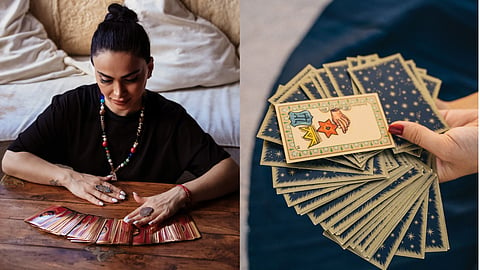
For years now, a tarot reading revolved around the usual questions: When will I get married? Will this relationship work? Will I have children? Particularly for women, these reflected uncertainties they were expected to quietly carry.
However, those questions have not disappeared. Love, marriage and family are very much a priority, but experts reveal that the conversation in tarot is changing. Today, readers are just as likely to hear: Should I continue in my place of work or find a new job? And 'Why do I keep attracting the same people?'
The shift is subtle but significant. It tells us that tarot is no longer approached only as a way to predict major life events. Increasingly, it is being used as a tool for reflection, guidance and understanding ourselves more clearly.
Traditional fortune-telling placed the future outside the individual. The cards were expected to reveal what would happen, while the seeker received an answer and waited for life to prove it true.
Modern seekers often want something different. They are less interested in being handed a fixed reading and are more interested in understanding their choices and getting remedies for their problems. Instead of asking, Will I get promoted? they may ask, “What is holding me back professionally”? Instead of “This is the right person for me”? the question may become, Is it worth investing my time and energy in this relationship?
The cards become a mirror rather than a map carved in stone, revealing fears, patterns and contradictions that can be difficult to name. The future becomes something shaped by awareness, decisions and action.
Coming to relationships, even romantic questions have evolved over the years. Earlier, the focus was often on securing a relationship: Will I marry this person? When will they commit? Today, many clients are equally concerned with the quality of the connection. They ask whether they feel emotionally safe, whether their boundaries are respected and whether the relationship truly supports the life they want.
That change matters. It moves the centre of the reading from the other person’s intentions to the seeker’s own experience. Questions such as Does he love me? can give away power because they place attention on a mind the seeker cannot control. Questions such as What do I need to see clearly in this relationship? return that power.
The best contemporary tarot practice encourages this reframing. It does not claim certainty about someone else’s private thoughts. Instead, it helps the person examine patterns, choices and standards, not telling a person whom to love, but helping them hear what they may already know.

The language of therapy has also entered everyday life. Terms such as boundaries, attachment, burnout, inner child and people-pleasing are now part of mainstream conversation.
Tarot questions naturally reflect this greater psychological awareness. People ask why a situation triggers them, which belief keeps them stuck, or what they need to release before beginning again. Tarot is not therapy, and an ethical reader should never present it as a substitute for professional mental-health support. Yet it can complement self-reflection.
The cards create a symbolic language through which complicated emotions can be approached. Sometimes a card provides clarity or even helps someone reconsider a decision through meaningful, practical guidance.
This is why people often return to tarot during transitions. A breakup, career change, move or identity shift rarely comes with a neat explanation. The cards slow the moment down, inviting the seeker to consider what is ending, what is emerging and what remains within their control.
The quality of a tarot reading often depends less on the cards drawn and more on the approach taken towards answering the question. Not every question has to sound profound. People come to tarot because they are worried, hopeful or simply looking for reassurance, and there is nothing shallow about wanting love or security. But a thoughtful reader can help them frame their questions in a way that gives them greater clarity.
When will I get married? can become: Is this a good time to get married, and is my partner the right person for me?
The second question does not simply ask tarot to predict the future. It invites the seeker to participate in creating it.
The evolution of tarot questions mirrors a broader change in how people understand their lives. We are moving from asking, What will happen to me? towards asking, How do I want to perceive what happens?
We are less satisfied with simply reaching socially approved milestones. We want work that feels meaningful, relationships that feel healthy and choices that feel genuinely our own.
Perhaps that is why tarot continues to remain relevant in this fast-paced, progressive and competitive world. It does not always offer certainty and responsible tarot should never pretend that it can. What it offers is a pause: a space between confusion and action where intuition can be heard.
The questions may have changed: from marriage to careers, from prediction to purpose, and from fate to freedom. But beneath them lies the same want and longing: to understand ourselves well enough to choose our next step with courage.