
AI generated summary, newsroom reviewed
For most Indians, facials meant a thick mask slathered across your face, an aggressive scrub, and the familiar blast of steam — all while cold AC air fought with the squeak of a ceiling fan overhead. In a floral wallpapered room that looked the same as it had for years, your local parlour lady would offer you a ‘clean up’ as a freebie, and somehow your skin felt refreshed and renewed.
Then facials got a little serious. Parlours became medi-spas where scrubs made for acids, peptides, and other dermat-approved actives, while machines promised to do what hands couldn’t. And now, with the world moving towards biohacking, it’s hard not to perceive skincare and maintenance in the same manner. Moving beyond what your skin looks like today to how it might function, repair, and age tomorrow, facials are evolving toward a long-term approach.

“The skin is a metabolically active organ and often reflects what is happening internally,” explains Dr Chytra V Anand, celebrity cosmetic dermatologist and founder of Kosmoderma Clinics. “Chronic inflammation, oxidative stress, hormonal and metabolic health, circulation, nutrition and sleep can influence pigmentation, collagen loss, barrier function, and ageing. This is why modern dermatology is increasingly looking beyond the surface towards skin health and healthy ageing.”
It is a shift that mirrors the beauty industry’s growing obsession with longevity. We are moving away from ageing as something to correct and towards maintaining skin resilience over time.
Dr Rashmi Ambastha, senior director of spa, wellness, and recreation at Fairmont and Roswyn Mumbai, sees this shift as part of the broader longevity conversation. “We’re no longer looking at longevity simply as adding more years to life, but as maintaining the quality, vitality, and resilience of those years,” she says. Recovery — through sleep, stress management, circulation, and reducing chronic inflammation — is increasingly becoming part of that equation. And unsurprisingly, your skin is also a part of that equation.
What people often forget is that beauty is also biological. Sleep, stress, circulation, inflammation, and even mitochondrial health are equally important. “Sleep is when much of the body’s repair and recovery takes place, while chronic stress can keep cortisol and inflammatory pathways elevated, affecting the skin’s barrier, hydration, and ability to repair itself,” says Dr Ambastha.
Circulation too plays a supporting role, helping deliver oxygen and nutrients to the skin, while chronic inflammation can contribute to tissue damage and collagen breakdown. Then there are mitochondria, the energy engines of our cells, whose efficiency can decline with age. What happens beneath makes the notion of a ‘good skin day’ far more nuanced.
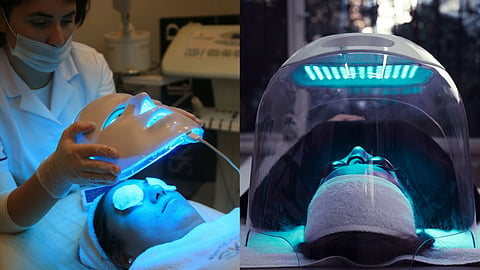
The new generation of beauty treatments—red and near-infrared light, hyperbaric oxygen therapy, cryotherapy, infrared saunas, and lymphatic compressions—all throw light on how facials have evolved beyond the in-salon chair. What was once firmly filed under recovery or wellness is increasingly finding its way into luxury retreats, longevity clinics, and high-tech beauty menus.
Red and near-infrared photobiomodulation currently has some of the strongest dermatological evidence, particularly around inflammation, wound healing, and potentially collagen and photageing. Regenerative treatments such as PRP and polynucleotides also have growing evidence for improving tissue repair and skin quality, while exosomes remain an exciting but evolving area.
HBOT has established medical applications, particularly for certain wound-healing indications, and is also being explored for recovery and healthy ageing, although its use as a cosmetic ageing treatment is considerably less established. Infrared and traditional saunas may support circulation and cardiovascular health, while cryotherapy and lymphatic compression can have more obvious applications around recovery, fluid movement, and overall recovery that direct skin rejuvenation.
Dr Ambastha is cautious about putting every new technology in the same bracket. “The science behind each one is different, and what works best also depends on the individual and what they are looking to achieve,” she says. “I see these as tools that complement the bigger picture, rather than miracle treatments.” The bigger picture being good sleep, nutrition, movement, stress management, and proper recovery.
That said, Dr Anand believes that the technology may be moving faster than the actual evidence. “Claims such as ‘detoxification’, dramatic collagen regeneration or reversal of skin ageing are often overstated,” she warns. “A biological effect is not necessarily the same as a proven clinical anti-ageing benefit.”
Perhaps. According to Dr Ambastha, we are moving in that direction. The traditional facial will always have its place, but the next generation thinks less about treating the surface in isolation and more about supporting the systems beneath it—circulation, relaxation, recovery, and cellular health.
Dr Anand, however, sees these technologies as adjuncts rather than replacements for established aesthetic treatments. “I see the future as combining evidence-based skincare, lasers, injectables and regenerative procedures with appropriate recovery technologies.” Photobiomodulation, for example, may support recovery and help control inflammation around certain procedures, while skincare, lasers, injectables, and regenerative treatments continue to do their jobs.
“No technology can compensate for consistently poor sleep, an unhealthy diet, lack of movement or inadequate sun protection,” adds Dr Ambastha. “Ultimately, longevity is about building sustainable habits and then using the right therapies to support and enhance those efforts.”
As the experts note, the future of beauty biohacking should be evidence-led, not trend-led. It’s not about doing more, but about choosing the right technology, for the right patient, at the right dose to support the body to recover, function, and age well.