
Subscribe
- Sanskaar 101
- Spotlight
- Wedding Diaries
- Fashion & Beauty
- Trends & Culture
- Astrology
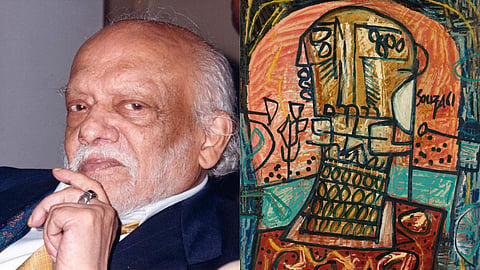
Hailed as the ‘enfant terrible’ of Modern Indian art and renowned for his provocative and boundary-pushing style, Francis Newton Souza shaped the trajectory of Indian art with his bold experimentation and critical engagement and his ability to capture raw emotion and present it in a visually striking and unconventional manner. As we celebrate 100 Years of his legacy, distinguished art curator and consultant Farah Siddiqui takes through his journey of becoming 'India's most prominent modern art painter'.

As a child, Souza, with his mother, relocated from Goa, then a Portuguese Catholic colony, and finally to Bombay. During his school days, he developed an interest in drawing, oleographs, prints and European art. Subsequently, Souza enrolled at the Sir J.J. School of Art in Bombay. His academic journey there was short as he and his fellow students got suspended for participating in Gandhi’s Quit India movement.
On the day of his suspension, Souza paintedThe Blue Lady(1945), a groundbreaking work created by applying pigment directly from the tube and spreading it with a palette knife. British art critic and novelist Edwin Mullins described Souza's piece as a dramatic departure and an angry, impulsive picture" which later marked a turning point in his artistic style. Post this, Souza chose not to return to complete his studies at the art school, marking the emergence of his rebellious spirit.
In 1949, a scandal erupted during an exhibition at the Art Society of India in Bombay. A life-size canvas depicted a six-foot-tall, fully nude man holding a paintbrush and staring directly at the viewers. The provocative piece led to the police being summoned, and the painting was swiftly covered up. All of Souza’s works were removed, and his studios were searched for ‘pornographic material’.
Souza profoundly influenced his peers in the Progressive Artists Group, which was established in 1947 in Bombay, and comprised of artists who would go on to revolutionise the country’s modern art landscape. Mulk Raj Anand, the esteemed author, aptly described the founding members as ‘heralds of a new dawn in the world of Indian art.’ They confronted the conservative artistic norms of their era, advocating for a more global perspective. This led to a compelling fusion of traditional Indian art with modernist movements like post-impressionism, cubism, and expressionism.
Souza’s vibrant and expressive style produced compelling visuals that invited deep contemplation. His body of work over six decades, encompassed a range of subjects, including landscapes, still life, nudes, and religious icons, all rendered with a distinctive distortion of form. Souza's paintings reflect his discontent with the ordinary and his challenge to societal norms. His Goan Roman Catholic background is subtly alluded to in a sketch depicting Mary nursing Jesus, However the provocative juxtaposition of this with a sketch of a couple engaged in sexual activity would have likely shocked a more traditional audience in the 1940s. Souza’s tumultuous personal life, characterized by two marriages, two partners, and several children, was looked upon as a mix of bohemian excess and reckless behaviour. This often led to financial difficulties, leaving him dependent on the women around him. Despite the ups and downs in their relationships, they reliably supported him.
Souza arrived in London in 1949 and endured years of severe poverty until 1954. ‘These were years marked by starvation, tattered clothing, and scavenging for discarded cigarettes’ as he mentioned in an interview by Barrie Sturt-Penrose in 1966. Yet, despite these hardships, Souza continued to paint and never took a conventional job. His fortunes changed with a chance encounter with leading gallerist Victor Musgrave, leading to a successful solo exhibition at Gallery One in 1955.
The success of subsequent exhibitions featuring Souza by Musgrave provided the artist with financial stability, and he was fortunate to encounter an American businessman named Harold Kover in Paris, who became his primary patron until 1960, earning Souza admiration from the "Pope." Drawing inspiration from a variety of artistic movements and traditions, Souza produced some of his most significant works in the 1950s and 1960s. During this time, he integrated elements of classical Indian painting, African tribal art, and Western modernism. His creative range expanded beyond landscapes and portraits to include striking religious scenes like the Crucifixion and the Last Supper, as well as provocative, sexually charged images that occasionally bordered on the violent.
In 1966, Souza presented a collection of the iconicBlack on Blackpaintings, showcased at the Grosvenor Gallery, which included two versions of the catalogue. The concept of a black-on-black series was avant-garde and provocative. Souza drew inspiration from Yves Klein, who had also exhibited at the Iris Clert Gallery in Paris.
Souza also delved into a significant new medium involving the chemical effects on paper. In the late 1960s, he found that chemical solvents could dissolve portions of the photographic image he was working on. In these pieces, Souza integrated printed images that he altered through techniques such as burning or scratching, often reflecting intimate themes between men and women. His paintings of women are noted for their deep sensuality and striking appeal, exemplified by their curvaceous forms.
Ebrahim Alkazi considered the pioneer of modern Indian theatre, remarked in his essay about the artist, "Souza's work does not focus on representation or truthfulness, nor does it engage with themes of style, tradition, nationalism, or modernism. His main aim is to deconstruct art as it is traditionally perceived and to recreate it as a Black Mass, in which the living God is worshipped. Through this primal and visceral ritual, humanity may participate in and embody the resurrection of the eternal spirit.”Souza drew substantial influence from classical Indian art, especially the erotic sculptures of temple dancers depicted in the Khajuraho and Mathura temples. The female nudes featured in his paintings, frequently decorated with necklaces and bangles, can readily be seen as embodiments of these temple dancers. The poses of the women in his artwork are intensely provocative, as they engage the audience with seductive glances while simultaneously unsettling them with their conspicuously lascivious behaviour.
Souza depicted female figures in an exceptionally distinctive and powerful manner. His artistry significantly contributed to reshaping Indian art and pushing its modernist boundaries. Over his career, Souza produced thousands of sketches and paintings featuring women in various stages of nudity, yet his methods were unlike those of his contemporaries. He intentionally shunned conventional ideals of feminine beauty and grace, opting instead for fierce and twisted portrayals. The nudity and erotic charge in Souza's paintings of women are stark; however, these works also offer ironic and satirical commentary on societal norms, which often leave viewers unsettled.
Many of Souza's artworks were profoundly influenced by celebrated Western artists associated with the Paris School, with a pronounced impact from Pablo Picasso visible throughout his oeuvre, particularly in his portraits. The fragmented and distorted facial features typical to Picasso's female portraits can be clearly identified in Souza's creations.
New scientific explorations regarding DNA's structure, The White Flag Revolution, and the Sanford Redmond Theory of infinity sparked Souza's imagination and significantly shaped his artistic endeavors during the 1970s and 1980s. This influence is clearly reflected in his works, which feature a series of interlinked dots and dashes that encircle various forms and objects, thriving throughout his landscapes. He articulated, “Death occurs when Nature requires one’s atoms elsewhere! Nature is a hustler and shuffler of atoms. It is incorrect to equate death with ‘nothingness’ since no individual has truly known or experienced what nothingness entails. Nothing ceases to exist. Everything is repurposed into the ongoing cycle of Life.”
In 1993, Souza’s piece “Crucifixion” from 1959 was acquired by Tate Britain in London. The artwork presents a striking, jagged portrayal of Christ. As described in his collection "Words and Lines" (1959), the figure is illustrated as "scourged and dripping, with tangled hair intertwined in a crown of thorns." In 2005, he received significant recognition with a major retrospective at Tate Britain.
Bold and uncompromising, Souza was one of the earliest Indian artists to gain considerable acclaim in the West after India gained independence. His extraordinary path in the art scene has been characterized by creativity, controversy, and an unwavering commitment to expanding the boundaries of artistic expression, cementing his status as a true pioneer in the art community. As his creations continue to inspire many, Souza's legacy remains a powerful reminder of the lasting influence of artistic exploration and imagination, particularly during the year marking his centenary.
I treat you like a lady
And I know what’s good for you…
But your face is missing-
And you have no body,
Only a girlish outline
In a dreamy landscape
Which smells of your fine scent!
And when I close my eyes,
You are there in flesh and blood,
With children and flowers; and your clean hair
Blowing in the breeze and your bright eyes
Shining in the night sky
Streaked with rainbows!
But when I open my eyes
You’re gone like the illusion of thin air,
And I am rudely awakened by the reality
Of your not being there!
– F.N. Souza (Published under the title ‘The Ultimate Paradigm in Seven Statements for the Perfect Civilization’ in ‘New Poems by F.N Souza, Dedicated to Women', Published in London, 1985 to coincide with his exhibition at the Pundole Gallery, Mumbai)