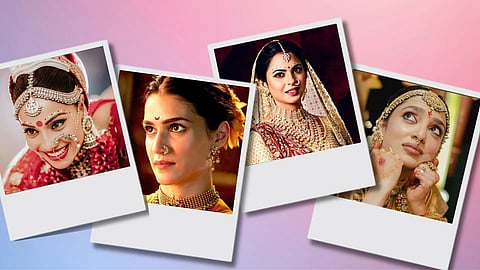
While a Bindi—or the traditional motif that adorns the forehead—is worn for aesthetic purposes, its symbolism runs much deeper than that. In Indian culture, Bindi is believed to be auspicious, and seen as a symbol of a woman’s marital status. It is also a part of the Solah Shringar, or the sixteen ornaments that a married woman must adorn herself with. When one mentions the word 'Bindi', the first image that pops up in your head might be a round circular motif, but the styles of bindis seen across the different states of India are more complex than that. Here are our favourite kinds of bindis from different states of India that you can take inspiration from, for your bridal look.
Kalyanam Tilakam, or the traditional bridal bindi of Telugu brides is not only worn for aesthetic purposes, but is also believed to be auspicious. This type of bindi has a distinct motif, with a tiny teardrop-like shape, with a little curve under it, and finally, a tiny dot under the curve. As the name suggests, the traditional Kalyanam Tilakam is supposed to be in the form of Tilak, or a paste applied in the shape of the motif; however, they also come in as sticker bindis.

Alpana Bindi, also known as Kolka or Kopaler Alpona is the traditional bindi style of Bengali brides. This is an extremely intricate style of bindi applied using kumkum (vermilion) paste and chandan (sandalwood) paste. The red vermilion paste is used to draw a big, round bindi at the centre of the forehead, which is surrounded with intricate designs made in the sandalwood paste, which is white in colour. These are beautiful, intricate flowy patterns that are drawn over the eyebrows, and are often extended all the way to the cheeks.
Much like the Bengali-style bindi, the Gujarati Peer bindi features designs drawn along the eyebrows, in sandalwood paste, with the center of the forehead adorned with a round red bindi. Although this is also done in the colours white and red, this style usually includes little dots drawn along the eyebrows, unlike the very intricate, complicated designs of the Bengali Alpana bindi. While traditionally drawn in paste, this is often achieved with bindi stickers.
The Chandrakor bindi, or the traditional crescent-shaped bindi from Maharashtra is not only worn by Maharashtrian brides, but is also a staple of the Maharashtrian attire, and is worn on festivals and important occasions. It features a half-moon motif, sometimes paired with a little dot underneath.