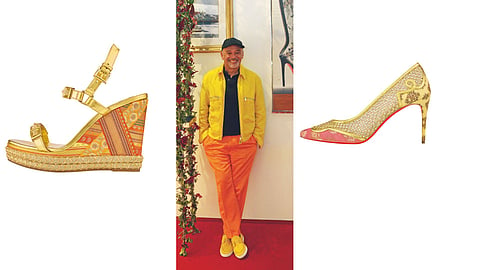

Christian Louboutin was undoubtedly an Indian in his past life. This heated debate begins our Zoom conversation as we convene across continents (me in London and Mr Louboutin in one of his favourite cities in the world — Mumbai), to discuss his Diwali shoe edit coinciding with the exhibition Salon L’Inde in Mumbai.
The much-anticipated exhibition is a celebration of all the shoes and accessories that Christian
Louboutin has been made with India at the heart. As the story goes, Louboutin grew up watching
Bollywood films as a young boy in Paris. Today, he has probably seen more Indian cities, towns and villages than some of us collectively (this guilty writer included!), and his collections prove his affinity for the colourful and exciting country.
Plucked from the red-lacquer-soled archives of his decades-long journey as a designer spanning 1995 to 2014, the exhibition chronicles his creations such as the Pilotin Maharaja bag, a deep purple evening bag with ornate embroideries recalling something from the hallowed halls of the Victoria & Albert Museum in London, the Henri flat that marked the designer’s first brush with an Indian wedding in 2014, where he created a shoe for a very important groom (whose name will remain undisclosed), as well as the Jhansi collection from Spring/Summer 1995 inspired by Rani of Jhansi, the Shiva line from Spring/Summer 2003, and the Bengali series from Fall/Winter 2012.
Another iconic shoe style inspired by the designer’s love for Mumbai, the Lady Bombay makes a return as part of the new Diwali edit. Reimagined in pink silks, some more ‘rani’, others more pastel and peach, the rhinestone and fishnet shoe style comes in vertiginous stilettos as well as grounded ballet flats.
Either way, they are the perfect addition to lehengas and saris come wedding season. Where one shoe style patches Indian textiles sourced by the designer during his travels through the South Asian subcontinent, another brings the colours of India — like saffron (borrowing from the spice) and blue (typically worn to ward off evil) — onto wedges and flatforms. Ahead, we speak to the designer about why India recurrently makes it to his subtle nuances at play during an Indian wedding.
Akanksha Kamath (AK): The collection is stunning. I’m intrigued to know what was on the mood board as you designed the Diwali edit.
Christian Louboutin (CL): The mood board has a common thread, which in French is described as ‘la ligne rouge’. For this Diwali edit, ‘the red thread’ is gold. India has a deep love story with gold, which is culturally and visually significant. I focused on gold, incorporating it in various forms, even using ribbons sourced from India, Sri Lanka, and Pakistan. The ribbons have multiple colours, but the unifying element is a gold thread. This gold vein runs through the collection, symbolising the interconnectedness of the pieces.
AK: That’s a beautiful analogy. This isn’t your first experience with Indian textiles. We loved your collaboration with Sabyasachi. How have you extended that this time with the fabrics you’ve used?.
CL: It’s not just about fabric; it’s also about material density. For example, I used a specific button that resembles a square pyramid — nothing is flat in India. This concept reflects the country’s rich diversity, from its landscapes to conversations and outfits. India has many layers, and my collection aims to express that.

AK: You’ve travelled extensively in India. I think it might be your spiritual home. Which trip has been your favourite, and why?
CL: Choosing a favourite trip is complicated, but I fondly remember a journey with my Brazilian friend who loves India. We explored Bijapur, known for its stunning mosque with one of the world’s largest cupolas, and travelled through Mysore, Hampi, and down to Kochi. We also stopped in small villages. So unlike in Mumbai or Chennai where there is the sea, lots of partying and lounging, this was different but at the same time, it was not exhausting. And because there isn’t much tourism in these parts, it felt like the kind of trip that you could still do in the late ’70s.
The sensations, the food, the smells — this was a cultural trip that allowed us to connect deeply with India, visiting temples and villages while creating unforgettable memories.
AK: To see different parts of India must have been incredible. How would you describe Indian weddings, especially in the context of your collection?.
CL: For a French person, Indian weddings are the ultimate exotic experience. Unlike weddings in France, which often last a day, Indian weddings span multiple days filled with various rituals and celebrations. It changes based on if it is a Sikh wedding or if it’s a Hindu wedding or if it’s a Muslim one. This multiplicity is a beautiful aspect of Indian culture. I recall attending a wedding in Coimbatore that began at 4:00 a.m. at a temple, highlighting the deep cultural significance of these events. The combination of religious seriousness and joyous celebrations creates a rich tapestry of emotions, colours, and experiences.
AK: You captured that beautifully. Coming to the retrospective, I read about the Henry flat, designed for a wedding in 2014 in India. What’s the story behind it?
CL: It’s a bit delicate to share specific details about bespoke orders, much like a doctor keeps a patient’s secrets. However, I can say that creating something for a wedding involves a community — everyone from family members to the bride and groom participates in the decision-making. It’s about collaboration and shared joy, reflecting the generosity of Indian craftsmanship. This sense of community enhances the emotional depth of the occasion.
AK: It’s wonderful that you highlight the community aspect. The names of the shoes in the edit are intriguing — Lady Bombay, Kate, Diwalina. How did you choose these names, and dare I ask, who is Lady Bombay?
CL: Lady Bombay embodies the essence of the city. The name reflects the inspiration I found in Mumbai. The shoe names represent imaginary figures, similar to a diary of moments. For instance, the name Jhansi references the Rani of Jhansi, a legendary warrior whose story captivated me. The names are not generic but crafted around the idea of people and stories.
AK: If Lady Bombay is an imaginary character, what would her day look like?
CL: Lady Bombay would plan a trip to Alibaug, navigating the traffic caused by a new tunnel. She’d forget her favourite pair of Louboutin sandals and meet an old friend on the boat back — her sister’s best friend whom she had a crush on. This unexpected encounter leaves her contemplating a rekindled friendship, reflecting her whimsical, yet relatable, character.
AK: You should be in the movies! Thank you for taking us through the collection. I hope we can follow you on one of your next Indian adventures and travels next time!.
This has been adapted for the web from an article published in Manifest’s December 2024-January 2025 issue that is now on stands. For more stories like this, subscribe here!