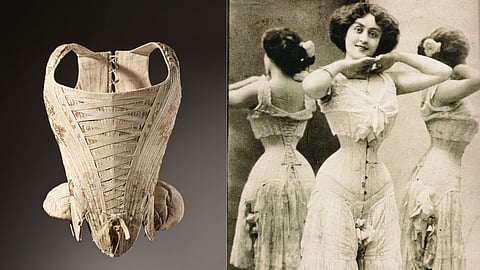

Now seen as a beautiful piece of garment with boning that accentuates a woman’s natural curves, corsets were once the bane of a woman's existence. Corsets gained popularity during the 16th century, particularly in the Renaissance period, and went on to remain relevant for a long time after that.

They were used as a tool to give the desired figure to a woman, which was problematic, to say the least. As opposed to accentuating a woman’s natural curves, they were used to achieve the hourglass silhouette. For the longest time, this now harmless piece of clothing was feeding into the society’s unrealistic beauty standards for women, and it came to a point where achieving the desired silhouette after wearing the corset became a matter of pride. Particularly in the Victorian Era, the waist of the corset was cinched to an unhealthy extent. So much so, wearing it for prolonged periods would often result in respiratory issues.
There are even theories that suggest that "fainting rooms"—which were common during the Victorian Era, as rooms where women could go and rest when they felt dizzy—came into existence because corsets would often restrict blood flow, making them feel dizzy.
Apart from being a patriarchal tool, corsets were also seen as a status symbol, and were only worn by wealthy women in the Victorian Era, further perpetuating the class divide.
Lucky for us, we have moved way past the time where corsets perpetuated archaic beliefs, and are fortunate enough to appreciate corsets for what they should be—stunning pieces of clothing that accentuate a woman's natural body, as opposed to forcing her to fit into a mould.