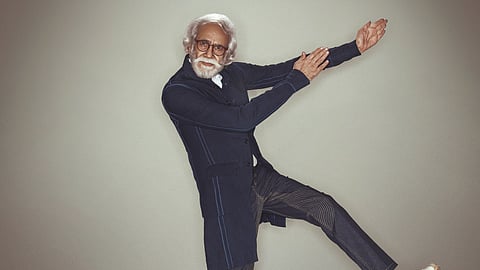

It was a regular afternoon at the FDCI. A large team of young workers had come back from a spectacular fashion showcase in Ludhiana and were gearing up for one in Hyderabad. Amidst this madness, the man who is the ‘real slim and not so shady’ of the fashion industry walks in for what he thinks is a serious interview.
He takes a seat, greets us all with a lot of warmth and coconut water, and asks the attendant if he served us bad coffee or a good one while we were waiting for him. Not like the attendant was ever going to say, “ Sir I served the bad coffee but now that you mention it, let me get the good coffee!” Our team gently pointed that out to him and he laughed. What happened then was a mood that got set of radical candour! Now what it would lead to is anyone’s imagination.
Our first question to him was on the changing face of fashion weeks in India. Before he
could answer…we immediately realised he was in a mood for mischief and shenanigans.
Bravely enough and paradoxically so — we asked if we were still a relevant lot! He said
NO. And that started a whirlwind of an interview where Sethi just couldn’t keep calm.
“My young team at FDCI insists social media influencers are the new fashion editors.
However, my old-school mentality also insists on the strength of traditional media. The hard work, editorial gravitas, and depth of content exist with journalists and not influencers. But let’s be practical. The influencers these days have better outreach vs the traditional magazines,” said Mr Sethi, who reads seven national dailies in a day and every fashion magazine more keenly than their promoters probably are.
Mr Sethi personally believes that though this “trend” is exciting for the audiences, “it’s crucial to maintain a sense of loyalty and authenticity. Influencers should carefully consider their choices, ensuring they genuinely appreciate the designer’s work. Over-reliance on paid promotions can diminish the value of wearing a designer’s creation.” He believes that a balance is necessary. “Influencers should have the freedom to choose what to wear, but they should also be mindful of the impact their choices have on the fashion industry and its stakeholders.”
He does admit that it was always the fashion editors who brought the fashion industry to a space that has given birth to social media influencers. “Today the game of fashion weeks has changed. Nowadays almost every designer wants an influencer or a person of society to wear their outfits to the fashion weeks. I feel there should be loyalty where the wearer has to decide what they want to endorse as opposed to changing their clothes after every show. This is where and why I respect fashion editors. They don’t carry the paid biases of social media influencers and realise that fashion week is a serious business. To me, it is the buyers who should be in the front rows with the editors/journalists who are there to report objectively. And the next rung is social media influencers followed by people of society ideally."
These days the designers and their publicists take matters into their own hands and the FDCI has even had instances where invites were printed out with overlapping seat numbers. “One of my important title sponsors was left out because of this confusion and then we have to take strict action to maintain the hygiene and restore the status quo that we feel is appropriate for the front row. Let me add, the front row etiquette is passé for more than a decade because being there is more important than how you got there!” he smirks.
So what about this trend of hosting offsite shows and the fiasco that occasionally follows with a lot going out of whack (ACs not going, designers showcasing twice in the same day, over-inviting attendees, shows running as late as two hours, amongst many other peeves).
“You know I am glad you brought that up because the last offsite that was done in the spirit of what offsite shows should be was by Rohit Bal at Quila Khan at Qutub. It was the 2015 Wills Lifestyle Finale and also the end of their nine-year contract with FDCI. There was live music by Shubha Mudgal, a ramp that was longer than 180 feet, and over 120 models walking for the designer with Christian Louboutin and who’s who of the capital sitting in the audience. There was a passage connecting one tomb to the other tomb.
Now this is why you want to host an offsite show— I understand. Logistically we can’t manage this on site. Even recently for péro in 2024 when they collaborated with Hello Kitty — they required a larger than life set up and it made complete sense. But if the designer’s reason is one-upmanship, which it mostly is, then it makes no sense. Finally, they come back to me and admit they have made a mistake and realise the true meaning of why offsites are done and how doing it onsite makes more sense given the meticulous management by FDCI. The behind-the-scenes work of organising fashion weeks is often overlooked. While the media focuses on the glamorous fittings and shows, there are months of diligent planning and coordination involved. From creating the schedule to selecting designers, every detail is crucial,” notes Sethi.
He is 70-plus years old and runs around pillar to post to date holding the torch high
for the fashion industry in India. What makes him tick? “My family has been my fulcrum,”
he says this while doling out kadhi, multi-grain atta rotis, brown rice, bhindi and mattar and serving us copious amounts of healthy home-cooked food that wound up with sugar-free kheer with saffron, nutmeg, elaichi, and dry fruits.
“The support and trust from my board and the fashion fraternity keep me going. I think the people who are with you in the shadows but supporting you unflinchingly are the ones who matter. My dad would often say in Hindi, “Mare bina jannat nahin milte” which translates to, ‘Unless you work hard you won’t receive the fruits of success’. I’ve lived my life with this ideology. I don’t think I would have survived this long if I stopped romancing what I do. The key is to look past the troubles and focus on the good that helps you get by…” and then eats some (what we labelled) ‘couture paan’ that he makes us taste that comes specially wrapped from Connaught Place for him.
“I enjoy family time with my loved ones. I’ve bought a Charles Correa-designed property in Goa. I have been a big fan of Mr Correa’s works and this gives me a chance to develop it with his design philosophy. I have a huge interest in interiors and would like to do it based on my aesthetics and my almost four-decade-long sojourn in fashion and design which exposed me to this field. I am thrilled that my daughter Tanira who is herself a textile designer is assisting me in this and also the new home we are constructing in a quiet part of New Delhi.”
Do you think your current role needs to be redefined or say, the FDCI board needs to be changed unanimously? “I believe in my 15-plus years at FDCI we have managed to elevate the board into a thinking, acting and decision-making body which has benefited designers on more levels than one. My role has always been one of mentorship, looking out for the best interests of designers. The Board has been doing a fine job. I’ve seen many members change periodically, and each one has contributed enormously to its upliftment and the design community at large. Without their support, FDCI would not be able to achieve milestones and over 25 years become financially comfortable. What we need is younger, committed and creative key executives to run the organisation. It is about time we spend time revamping the secretariat,” he concludes indicating how he has miles and miles to still go!
Creative Direction: Chaiti Narula; Styling: Palak Valecha; Production Editor: Neha Ahuja
This has been adapted for the web from an article published in Manifest’s December 2024-January 2025 issue that is now on stands. For more stories like this, subscribe here!
