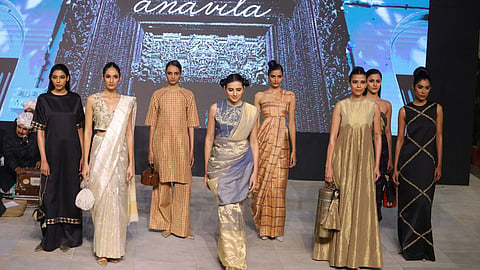

For the longest time, the Fashion Design Council of India (FDCI) has promoted the rich cultural heritage of India including their handloom. Handlooms continue to be important, even more today, in light of fast fashion and its onslaught on the environment. In India, we are spoilt for choice for handlooms. The warp and weft of India—her geography, her history, and her economy—can be seen in many a Indian weaves.
Needless to say, designers and weavers are interrelated to each other, andFDCIunderstands this dynamic earnestly.
And whether you’re a consumer, a fashion student, or even a bride-to-be it’s important to familiarise yourself with the history of Indian crafts.
The FDCI showcased various sustainable crafts present across the country in a showcase called My Craft My Pride, as part of the inaugural World Crafts Forum 2024. The event took place on November 23 at the National Crafts Museum, New Delhi.
Blending sustainability with contemporary design, My Craft My Pride was organised by the World Crafts Council (WCC) and supported by the Development Commissioner of Handicrafts, Ministry of Textiles.
In a press quote, Sunil Sethi, Chairman of FDCI shared, "We are grateful to DC Handicraft, Ministry of Textiles and WCF 2024 for giving us this platform.”
“With 'My Craft My Pride', FDCI showcases the beauty and versatility of India’s sustainable crafts, interpreted by some of the most talented designers. This event is a testament to our dedication to preserving tradition while paving the way for a sustainable future.”

The showcase featured collections from underrated designers like Anjana Bhargav for DHI, Payal Jain, Suket Dhir, Akaaro by Gaurav Jai Gupta, Anavila and Aidar Khan from Kazakhstan
Suket Dhir came through with his Panchatantra collection which showed how well-known characters such Ranga Siyaar, Monkey and the Crocodile, Lion and the Bull were illustrated on Banarasi brocades, Muga, and other silks. While Anjana Barbhav's Black & White collection soothed the eyes of those who appreciate timeless sophistication. Here, recycled fabrics take center stage, with clothes crafted from handloom cotton, khadi, silk, and mulmul.
On the other hand, Payal Jain showcased Rising Sun which was inspired by the grandeur of Uzbekistan, its architecture, enamelling, gold accents, and heritage. While Aidar Khan brought together a collection crafted from 100% handmade wool.
Anavila Mishra's collection focuses on the enduring legacy of Chettinad is a sum of many parts. The collection called Payanam, turned the spotlight on Athangudi tiles on the floors, Kolam adorning the doorsteps of homes, and more. Last but not the least, Akaaro's capsule collection was inspired by International Klein Blue created by the French artist Yve Klein. Showcasing some of their signature handwoven fabrics like stainless steel , merion wool , monofilament silk and cotton , each offering was as experimentative as it could get.
Lead image: FDCI