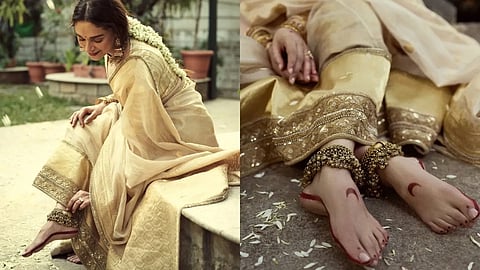

In India, the anklet was never merely a decoration. Long before it peeked out beneath bridal silk or chimed through corridors, the payal was rooted in something more intimate. Balance. In Ayurveda, the body is seen as a delicate play of energies—heat and coolness, movement and stillness, excess and depletion—all constantly adjusting to one another.

Metals are believed to carry energetic qualities, and, among them, silver holds a special place. Silver has cooling properties. In a country with a climate that can be intensely warm and humid, cooling elements are thought to help maintain internal equilibrium. The feet, always in contact with the earth, are regarded in Ayurvedic medicine as important channels for energy flow. To adorn them, therefore, was not merely aesthetic—it was purposeful.
It is believed that silver anklets help regulate body temperature, promote circulation, and stabilise energy in the lower body. In Ayurvedic mapping, the reproductive organs are energetically connected to the feet, and so silver is also thought to support reproductive health and hormonal balance. Its cooling quality is believed to calm excess internal heat—the kind that, in classical thought, could disturb menstrual cycles or emotional steadiness.
There is also a more tangible logic. Silver has long been associated with antimicrobial properties. Although ancient practitioners were not familiar with modern scientific concepts, the belief that silver supports hygiene and strengthens the body has persisted. Some traditions suggest that as a payal brushes gently against the skin, it stimulates nerve endings and acupressure points around the ankle, encouraging circulation and maintaining energetic harmony. Whether understood spiritually or physiologically, the anklet was imagined as something that grounds the body.
In India, the choice of metal is never accidental. Gold is associated with Lakshmi, the goddess of wealth and prosperity. It is traditionally worn above the waist, close to the heart, throat and head. Wearing gold on the feet has long been considered inappropriate within Hindu custom, almost irreverent. Silver, by contrast, is linked astrologically to the Moon, the keeper of emotion, intuition and the feminine principle. If gold radiates solar brilliance, silver carries lunar calm. It absorbs, reflects, soothes. For an ornament worn at the body’s lowest point, that symbolism feels deliberate. There was also a social dimension. Silver was more widely accessible than gold, allowing the anklet to become one of the few jewellery pieces that crossed economic boundaries. So, from rural households to royal courts, silver anklets became the norm.
In marriage, the payal takes on another layer of meaning. As part of a bride’s solaah shringaar—the 16 traditional adornments—the anklet marks transition. It signals the moment a woman steps into her new home. Historically, the soft music of ghungroos attached to anklets carried both symbolism and social grace. The sound announced her presence gently to family members, maintaining decorum without a word spoken. That delicate chime was also believed to attract positive energy and ward off negativity. A bride entering her marital home did so accompanied by music, as though each step carried a blessing.
The history of the anklet stretches back far beyond classical marriage rituals. Relics from the Indus Valley Civilisation (2500 BCE–1900 BCE) depict women wearing elaborate ankle ornaments, suggesting that the form was already established thousands of years ago. Early Vedic literature, including the Rigveda (3000 BCE–1000 BCE), references spherical foot ornaments known as patsu kaadayoh. Patanjali, in the Mahabhasya, mentions jewel-studded anklets called mani nupura.
The earliest anklets were, of course, more modest, crafted from beads, shells and clay. As metalwork advanced, silver and gold transformed them into markers of prosperity and rank. In Ancient Egypt, too, anklets indicated wealth, with royalty favouring precious metals while common women wore simpler versions. Across cultures, the ankle quietly reflected hierarchy.
But Indian craftsmanship reached extraordinary refinement during the Mughal Empire. Filigree, enamel work and gemstone embellishments elevated the anklet into the ornate paijeb, worn by royal women and court dancers. As noted in Indian Jewellery Ornaments and Decorative Designs by Jamila Brij Bhushan, traditional anklets were ingeniously constructed with sheets of silver hammered into cylinders, filled with clay and pewter, bent into shape and engraved with care.
By the 18th and 19th centuries, colonial trade introduced European minimalism into Indian design vocabulary. Anklets grew lighter, more chain-like…softer in silhouette, yet still carrying centuries of meaning.