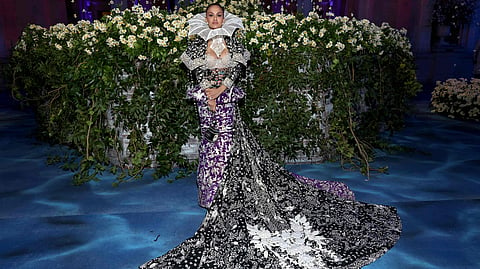

The annual Met Gala held at the Metropolitan Museum of Art in New York has a long history of giving us fashion moments that elicit all kinds of vehement feelings, and this year was no different. Amongst the pool of ostentatious looks, there was Natasha Poonawalla, who was dressed just as ostentatiously, but also paid homage to her Parsi roots.
She wore a custom Manish Malhotra look which consisted of an embroidered purple fishtail skirt made with two vintage Gara saris—one of them a centuries-old relic from Manish Malhotra's archives, a Parsi Gara embroidered cummerbund, and a lace bralette with scalloped strings of pearls. She also wore a dramatic Parsi Gara embroidered jacket with a long train.

What makes this look special is not only that she paid homage to her roots, but also that she chose to spotlight the dying art of the Parsi Gara embroidery. Here’s what makes the ancient art form truly special.
The Parsi Gara, which is an amalgamation of Persian, Chinese and Indian influences, traces its origin back to the 19th century, when Indian Parsis (Persians who migrated to India) would travel to China for trade. It is believed that during this time, they brought back with them a certain kind of fabric which had very unique embroidery. This embroidery included very intricate, realistic-looking motifs of animals and birds. The Parsi community found this embroidery very intriguing and adopted this style to make it their own. They combined the embroidery with sarees and gave birth to the Parsi Gara.
A quintessential Parsi Gara saree will include motifs like flowers, animals, and birds. Additionally, they would include motifs like pagodas, bridges, dragons, and endless knots, owing to the Chinese influence. Parsi Gara would traditionally be created in colours like maroon, dark green, purple, black, and wine. The embroidery requires painstaking attention to detail, and it can take up to two to three months to create a Parsi Gara saree.
The craft borrows from China, Persia (present-day Iran), Europe and India. So, apart from being beautiful, the art form spans multiple centuries, cultures, and parts of the World. The craft of Parsi Gara is dying, and today, there are only a handful of karigars who know the art. What was once a cherished heirloom is close to extinction.
It is our collective responsibility to preserve the dying art, and you can do your part by supporting designers like Ashdeen, who are trying to keep the art alive even today. Because our future generations, too, deserve to inherit this little piece of our heritage.