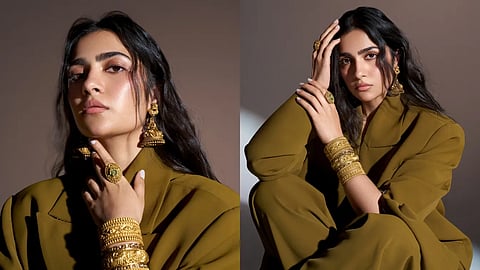

There is a certain sublimity to actor Rukmini Vasanth, a stillness that doesn’t demand attention, yet inevitably commands it. On the day of Manifest’s cover shoot in Mumbai, the 29-year-old, popular for her role as Kanakavathi in Kantara: A Legend- Chapter 1 (2025), enchanted us with her magnetic presence. Posing like a true diva, she moved with an ease that felt almost nonchalant; hands tracing the air, eyes holding the camera with a kind of unspoken conversation—her presence both delicate and deliberate. It was the sort of poise one associates with seasoned models, and yet, as she would later admit with a laugh, modelling is a craft she is still learning to navigate. “Actors get to hide behind dialogue,” she quips. “Models, however, don’t have that luxury.” There is an honesty in the way she speaks—forthright, thoughtful, and often punctuated with a self-awareness that makes her all the more compelling.
The shoot itself was a departure from the expected. Jewellery, often confined to predictable styling, was reimagined, worn in the hair, and paired with silhouettes that subverted the familiar. It was an ode to temple jewellery. For Rukmini, who has largely been associated with a more classical aesthetic, the experience was both liberating and quietly exciting. “I wouldn’t have said I was very experimental before this,” she admits. “But when you’re surrounded by people who encourage you, who see what you’re capable of, it becomes easier to take those chances.”
That idea of becoming, of evolving through collaboration threads itself through much of who she is, both as an artist and as a person. Off-camera, she is harder to define, by her own admission. “I’m not very good at describing myself,” she says, almost apologetically. And yet, in fragments, a portrait begins to form. A perfect day off, for instance, is not grand or performative—it is restful, restorative, and quietly grounding. There is comfort in stillness, in stepping away from the relentless pace of an industry that demands constant motion.
There is also a deep sense of rootedness in her story. Growing up as the daughter of an Indian Army officer meant a childhood shaped by movement largely across the states of Gujarat, Tamil Nadu, and Karnataka—each place leaving behind its own imprint. But it was also marked by absence and resilience. When her father was posted to conflict zones in Kashmir, the family stayed back. And in 2007, his loss in the line of duty altered the course of their lives irrevocably.
In the aftermath, it was her mother—dancer, caregiver, and co-founder of an organisation supporting families of fallen soldiers—who became a central force. “Her creativity and her philanthropy shaped me in a huge way,” says Rukmini. It is perhaps here that one begins to understand the quiet strength she carries.
Home, however, is less singular and more scattered. Bengaluru will always anchor her, Mumbai carries a spirit that feels familiar, Belgaum holds childhood memories, and London brings with it a sense of nostalgia from her years of study at the Royal Academy of Dramatic Arts. These fragments come together to form a deeply personal map of belonging.
Even her aesthetic sensibilities seem to echo this inheritance. She speaks of her fondness for temple jewellery—not merely as adornment, but as memory. “It reminds me of my mother,” she says. “There’s something nostalgic about it, something understated and classic.” It is a telling choice, especially in the context of a shoot that sought to reinterpret jewellery by bridging the past and the present, much like Rukmini herself.
When the conversation turns to cinema, there is a perceptible shift—an alertness with a clarity of intent. For her, a script is never just about the role; it is about the entirety of the story. “I don’t want to isolate my character,” she explains. “I need to understand the whole world it exists in.” It is an approach that feels both rigorous and intuitive, driven less by ambition and more by a desire for meaning. She recalls a pivotal moment in 2023, when she was offered a role in a two-part Kannada film Sapta Saagaradaache Ello, at a time when she was unsure of her place in the industry. “It made me want to keep acting, and it changed the way I approached my work,” she says. There is no grandiosity in the way she shares it, only a quiet acknowledgement of its impact.
And then, almost in contrast to this measured seriousness, comes her unreserved affection for love stories. “I’m a complete hopeless romantic,” she says with a laugh. “It’s disastrous.” It is perhaps the most unguarded moment in the conversation, and one that reveals a softer, more whimsical side. Ironically, many of her on-screen romances have leaned towards the tragic sad ending. And her mother has only one recurring question after every narration to her: does she end up with the hero this time?
Beyond cinema and fashion, her reflections on love itself are unexpectedly profound. Stripped of grand declarations, for her it is about “support and presence”—a lesson drawn not from fiction, but from the bond that her parents shared. “You don’t know what life will throw at you,” she says. “But as long as you’re there for each other, that’s what matters.”
It is this interplay of depth and lightness, of introspection and spontaneity, that makes Rukmini Vasanth such an intriguing presence at this moment in time. Rooted in the cultural textures of the South, shaped by personal histories that run deep, and now stepping into a wider, more visible cinematic landscape, she embodies a kind of transition. In the future, she aspires to work with the likes of ace filmmakers Mani Ratnam and Sudha Kongara.
Looking ahead, she’s not chasing just success, but significance—wanting to be a part of films that make people feel something, whether it’s joy, comfort, or even anger. For her, impact lies in emotional resonance; if a character provokes a reaction, it has done its job. That, she believes, is the true gift of storytelling. Off-screen, she’s returning to a more tactile, analog life—rediscovering painting, revisiting embroidery, and reconnecting with the kind of hands-on creativity she once loved. In a world increasingly dominated by screens, this shift feels both challenging and deeply rewarding.
Credits
Chairperson: Avarna Jain
CEO: Debashish Ghosh
Editor: Aindrila Mitra
Photography: Vaishnav Praveen
Styling: Mohit Rai
Fashion assistant: Shubhi Kumar
Hair: Rohit Bhatkar
Makeup: Riviera Lynn
PR Agency: Tree-Shul Media
Artist management: Benchmark Talents
Production: Studio Little Dumpling
