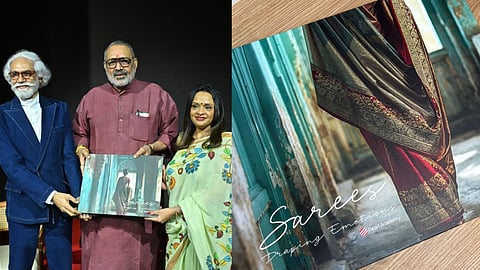

Saris have been a part of the Indian textile and fashion landscape since the beginning of time or civilisation itself. So it seems almost essential that we cement the beauty of the garment in literature. This is why Sarees: Draping Emotions, a collaborative project between Pearl Academy and the Fashion Design Council of India (FDCI), published recently on the 13th of October, is quite a momentous occasion for us. The coffee table book highlights and discusses the history and origins of the sari. From how our mythology depicts it, to its different draping styles and the designers that are furthering its innovation. As Mr. Giriraj Singh, Union Minister of Textiles, Government of India right said while unveiling the coffee table book, “The sari is not just a piece of clothing; it embodies our cultural ethos and the spirit of our artisans.”

The first instance of a sari, can be traced back to the Indus Valley civilization between 2800–1800 BC. Early on, the single fabric garment was dyed with natural materials such as indigo, lac, red madder and turmeric. But since then, the six-yarder has become more of a celebratory garment rather than an everyday outfit choice for many. And as tradition follows, newlywed women in our country are bound to make an appearance in a sari almost immediately after their wedding. It’s essential in the Indian woman’s bridal trousseau.
And for good reason, the versatility of the sari not only lies in its weaves but in its drapery. From the Madisaru drape from Tamil Nadu, Nauvari Drape from Maharashtra and Seedha Pallu drape from Gujarat to the Atpoure drape from Bengal, Kunbi drape from Goa and Gochi Kattu drape from Telangana, the garment can be draped in multiple different ways. The weaves of our saris, on the other hand, are a whole other category of aesthetic perfection; Whether it is the solidity and grace of Kanjivaram silk saris from Tamil Nadu and Uttar Pradesh’s Banarasi saris, or the ethereal elegance of the Muga sari from Assam and the Chikankari sari from Uttar Pradesh and the earthy allure of Bhagalpuri silk saris from Bihar, our textiles are a codex of civilisation’s brilliance.
But beyond its artistry, the sari is also about sentimentality. We’ve all worn our mother’s and grandmother’s saris with wholehearted fondness. So many of us have rummaged through our dearest fashion role model’s closets or suitcases filled with carefully assembled saris (also often accompanied by naphthalene balls or neem leaves to keep the creepy crawlies away). And it has often left us with nothing but a sense of inspiration and warmth.
Today, as the sari becomes a globally recognised phenomenon, we’re seeing the future of the garment and Indian textiles transform right before our eyes. Bollywood celebrities such as Yami Gautam, Deepika Padukone, Patralekha and Alia Bhatt chose to don a sari for their weddings. While Yami Gautam picked a stunning red, heirloom sari, Deepika Padukone wore a beautiful Konkani sari by K Radharaman-owned House of Angadi, Alia Bhatt gravitated towards an ethereal, organza Sabyasachi sari, and Patralekha wore a red, tulle Sabyasachi sari with a matching veil orodhani. Though at first, one may think that a sari for a wedding outfit doesn’t seem like something out of the ordinary, for the past few years, we’ve been witnessing most brides choose the lehenga over a sari, and for this reason, it’s refreshing to see celebrities choose a bridal sari.
“The sari is a timeless embodiment of India’s rich textile heritage, a garment that seamlessly weaves tradition with modernity, and legacy, and it honours the artisans and designers whose craftsmanship breathes life into each weave,” said Mr Sunil Sethi, Chairman of the Fashion Design Council of India during the unveiling of Sarees: Draping Emotions. Making it evident why even in the present-day scenario, it makes sense for brides to choose the sari. It’s timeless, it’s a classic, because of how it continues to combine tradition and contemporary design. Take for instance, designers such as Rimzim Dadu, and Shantanu & Nikhil, and how they’ve reformed the sari, and its structure without ever disconnecting from its traditional silhouette. Shantanu & Nikhil made saris easier to slip into by designing them as pre-draped garments, whereas Rimzim Dadu has given us a lot to think about in terms of how we can imagine a sari’s structure and what materials can be used to design one!
But, aside from memorable bridal looks centred around the garment, our favourite celebrities have also reminded us that saris are a fantastic outfit choice. Take for example how Taapsee Pannu paired a stark, white, corset-shirt and sneakers with saris on her trip to Russia and Paris in June and August, this year. This, just FYI has on some level, trumped the idea that the garment is difficult to carry, or be comfortable in, especially on casual occasions.
Even as we spoke to Gautam Gupta of Asha Gautam about the significance of saris, we’re affirmed that even while evolving, the sari has and will stay true to its traditional essence, “Saris have been one of the most relevant fashion statements in Indian fashion,” he tells us. “Today the sari has so many avatars, right from traditional weaves, to modern drapes, to engineered materials used to create a new age version of it. I have always said that sari is the most exciting silhouette and we are yet to see many more interpretations of it,” he continues to share with us.
But as we see the sari evolve right in front of us, we’re urged to ponder the future of the garment. With designers such as Amit Aggarwal and Gaurav Gupta who’ve given us saris with draping and fabric techniques that swiftly became trademarks for each of the designers, it’s hard to look away from how much we can do with the six-yarder. The signature micro pleating and moulding work of Amit Aggarwal (hello, can we ever forget how the designer worked withBanarasi sari for his collection Antevorta?), is a testament to how a sari is an evergreen garment that can be reinvented in many different ways.
As for Gaurav Gupta, his innovative insight led to the birth of the sari gown, “The sari to me, is an heirloom that embodies timeless beauty and tradition…When I returned to India after my higher studies I began experimenting with the sari–pleating it, draping it differently, and making it more alluring. This led to the creation of the sari gown.” the designer shared in theSarees: Draping Emotions.
The garment is undoubtedly an heirloom piece, and it’s simply fascinating how something can be so incredibly timeless yet still be refashioned in endless ways and remain a traditional closet staple. Aside from being designed with a unique structure, we’re currently seeing designers such as Tanira Sethi construct saris using textiles that are rarely heard of in association with the garment. For instance, Tanira’s first collection debuted a segment of cashmere saris in 2017.
The NIFT and Chelsea College of Arts alumnus went on to expand on the creative idea by creating handwoven, hand-painted cashmere saris. “I always wondered, if a seven-metre shawl can be woven, why not a sari? I combined four things I loved—art, design, fashion and heritage, for my first-ever collection. This was the genesis of the Cashmere saris, something that I have explored as a concept even as a student during my undergrad and master's and later technically developed to give it a distinct identity and launch my brand, Taani with this niche product. For me, the sari mirrors a blank canvas, you can paint it in any hue you desire. It’s almost a trompe l’oeil where exploration is the master key. The sari is six yards from a heritage code, where within its warp and weft lies a remarkable history. I've added a youthful edgy vibe to it using my admiration for geometry. My effort is to reveal this incredible textile through a modern template,” said the designer as she chatted with us.
So, it seems, the future of the sari is boundless, just like the garment itself. It can take multiple forms, whether that’s through draping, moulding or the textile of choice. With international designers such as Schiaparelli custom designing a sari for Isha Ambani (for Anant Ambani and Radhika Merchant’s sangeet ceremony), Naomi Campbell wearing a vintage piece from Chanel's spring/summer 2010 couture collection at the Met Gala 2023, which drew inspiration from the sari, and Zendaya wearing a Rahul Mishra sari at the opening of NMACC, we’re seeing the six-yarder finally receive the global recognition it has always deserved!