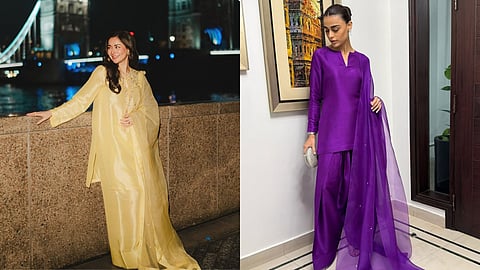

Every once in a while, something catches the fancy of the Internet, and it ends up blowing up big time. This time around, we’re seeing the revival of a long-forgotten South Asian garment:; the Farshi salwar.
The salwar, in itself, has not been seen in the Indian fashion scene for quite some time. We witnessed the earliest renditions of the salwar-kameez in pop culture in the 1980s and 1990s- Bollywood, before which the churidaar had briefly come into trend.
Think of Bollywood classics like Naaka Bandi, starring Sridevi and Dharmendra. Or, the 1998 release, Hum Aapke Hain Koun, where so many of Madhuri Dixit’s outfits were beautiful pairs of salwar-kameez that went on to set the tone for Indian street style.

Alternatively, the salwar was a default and classic for South Asian people of diaspora (even more than the churidaars, shararas or ghararas). In Gurinder Chadha’s 2002 film Bend it Like Beckham, or Mira Nair’s Monsoon Wedding (2002), which featured NRI lives, fashion sensibilities and characters, salwars were everywhere.
The next time we saw something similar was in 2007 during Imtiaz Ali’s Jab We Met. As the movie’s protagonist, Geet (famously played by Kareena Kapoor) made the patiala pants and harem pants a popular ethnic-wear demand. Almost every college kid wanted to pair a tank top or a long t-shirt with patiala pants. But since then, the salwar began dwindling, especially as palazzos became more popular. Though similar to and in the same family as a salwar, the Farshi salwar holds a different sentiment and aesthetic to a regular salwar, harem pants or patiala pants.
The Farshi Salwar is characterised by wide, dramatic, open hemlines that almost cascade to the floor, hence the name ‘Farshi’ salwar – to indicate how they touch the floor (farsh, or फ़र्श, meaning ‘floor ’ or ‘carpet’ in Hindi and Urdu). The garment oozes regal charm and elegance.
And rightly so, the Farshi Salwar has roots in the Mughal Era. It is said to have originated in the 17th century in Uttar Pradesh during British rule. Allegedly, the garment originated as a means to mirror the long evening gowns that the British wore and was often worn by privileged classes, royalty and nobility. After independence from colonial rule and partition, the garment was seen thriving for a while in Pakistan. The trend’s heritage and revival lies in the hands of Pakistan’s culture and inclination towards salwar-kameez sets.
Part of the reason the Farshi Salwar has risen to such prominence is how much Pakistani TV series are being recognised, watched and applauded right now. Because of this, the world has turned its attention towards many Pakistani actors and designers.
Designers such as Hussain Rehar and Zara Shahjahan have been doing excellent work in bringing the salwar-kameez and the Farshi Salwar to the forefront. Not only this, but actors such as Sadaf Kanwal and Hania Aamir have been seen donning the comfy and elegant salwar over the past few months and years.
“Today, (the Farshi Salwar) is primarily seen in formal wear, typically crafted in heavily embroidered or silk fabrics. Most people wear it for weddings and mehndi functions particularly. Women often opt for them, pairing it with shorter shirts and heels, moving away from its traditional angrakha or peplum top combinations,” tells us Mehek Saeed, a fashion stylist and influencer based in Lahore.
She also goes on to talk about how she grew up seeing the women in her family wearing it every once in a while. “Growing up in the 90s, I remember seeing older women in my family wearing it occasionally, but I believe it was much more popular in the 70s, when people wore it casually,” she said.
“While the Farshi Shalwar has resurfaced in fashion from time to time, with designers like Muse and Iqbal Hussain making their versions and, more recently, Sadaf Kanwal's and Hussain Rehar’s brands also creating ensembles with the Farshi Salwar, the garment has come back in style.”
So, if you’re looking for a comfortable, roomy, yet graceful ethnic outfit to wear this summer season. Then, perhaps, the Farshi Salwar should be your go-to.
“Farshi Salwars, or what we like to call the Pakistani-style suits, have been around for a very long time. I love the comfort it brings without it looking like a patiala or a flared pant, it’s somewhere in the middle of both. It’s perfect for the summer months! Designers such as Sheetal Batra and Heena Kochhar do a beautiful job with the garment, which is a timeless piece and can definitely be worn during the wedding season,” says Mumbai-based bridal stylist Shikha Dhandhia, “For day-to-day wear, you can take a look at Tara C Tara, which has a fantastic collection of printed and solid sets. It genuinely suits all body types and is here to stay!”