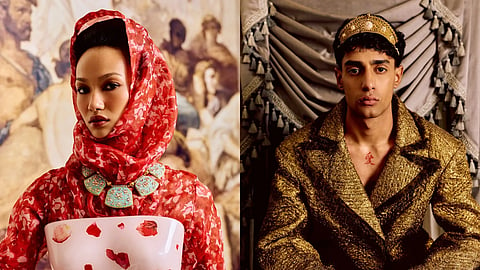

Some crafts quietly recede into history, and others continually reinvent themselves without losing their essence. Meenakari belongs firmly to the latter. Centuries old yet strikingly relevant, this intricate art of enamelling metal carries a timeless allure that feels both historic and refreshingly modern.

Its origins trace back to ancient Persia, where enamel work adorned royal vessels during the Parthian and Sassanian empires (247 BCE–651 CE). As trade routes expanded, so did the craft’s reach, eventually reaching India during the Mughal era. Under Emperor Akbar’s patronage in the 16th century, Meenakari began its Indian journey, one that would soon evolve into something distinctly its own.
The term Meenakari is derived from the Persian meena (heaven) and kari (craftsmanship), an etymology that mirrors its ethereal finish. In India, artisans absorbed and transformed the technique, infusing it with local motifs and richer palettes. Florals became more intricate, colours more vivid, and designs began to reflect a deeply Indian sensibility—lotuses, peacocks, and winding vines replacing Persian geometry with subcontinental storytelling.
Rajasthan, particularly Jaipur, emerged as the epicentre of this evolution. Under royal patronage, Meenakari flourished not just as ornamentation but as an art form. Jewellery pieces were often designed with dual beauty—the front set with gemstones, and the reverse adorned with delicate enamel work, a hidden artistry meant for the wearer alone. Motifs carried symbolic weight, evoking spirituality, prosperity, and cultural identity.
For generations, Meenakari remained synonymous with tradition—anchored in bridal jewellery and heirloom collections. Its ornate character was closely tied to occasion and legacy. Yet, as fashion evolved, so did the craft. Today, Meenakari exists in diverse forms—from khula and band meena to the vibrant panchranga and soft gulabi styles—each reflecting its expanding design language while preserving its meticulous technique.
What defines Meenakari now is thoughtful reinterpretation. Designers are translating its richness into lighter, more wearable forms—sleek earrings, delicate pendants, and refined rings. Softer enamel tones and cleaner silhouettes allow the craft to feel contemporary without losing its cultural depth.
Photographs by Amisha Gurbani; Styling by Palak Valecha & Akshay Kaushal; Hair and make-up: Nandini Arora; Models: Tenzin Chemi (Anima) and Anmol Bakshi; Fashion assistant: Khanak Kasana; Location courtesy: Begeterre, Gurugram