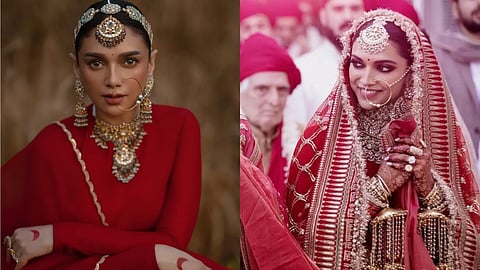
When Deepika Padukone appeared as Mastani wearing her iconic Maharashtrian-inspired nath, it sparked a renewed fascination with one of India’s oldest jewellery traditions. Years later, brides like Deepika herself, Anushka Sharma, Katrina Kaif, Kiara Advani, Yami Gautam and Aditi Rao Hydari would all choose distinctive bridal nose rings on their wedding day, proving that some traditions never really go out of style.
Yet the nath is far more than a bridal jewellery. Long before it became a carefully selected item on wedding mood boards and Pinterest saves, it was a marker of identity, status, region and culture. Its story stretches across royal courts, trade routes, spiritual beliefs and centuries of evolving fashion.
From the dramatic bridal naths of Punjab to Bengal’s statement floral nose ornaments and the maximal nathuli of Uttarakhand that Garhwali brides wear, every region has shaped the nath in its own unique way. And much like India itself, the ornament continues to evolve while staying connected to its traditional and cultural roots.
Here’s a closer look at the fascinating journey of the nath across India.
Contrary to popular belief, historians generally agree that nose piercing was not originally indigenous to India. Many scholars trace the practice to Persia and the Middle East, from where it is believed to have arrived in the Indian subcontinent between the 13th and 16th centuries through trade, migration and the spread of Persian cultural influence under various Islamic dynasties.
However, while the act of nose piercing may have foreign roots, India transformed it into something uniquely its own. Over centuries, the ornament became woven into regional customs, spiritual beliefs and bridal traditions.
The Sanskrit term nasika bhushana (nose ornament) appears in later Indian literature and texts, reflecting how completely the practice was absorbed into local culture.
The nath found particular favour among royal women.
In the courts of the Mughal Empire, elaborate nose ornaments adorned with pearls, emeralds, rubies and uncut diamonds became symbols of refinement and nobility. Rajput queens embraced grand circular naths that complemented the opulence of their poshak, while Maratha noblewomen developed distinctive pearl-studded styles that remain popular to this day — think Prajakta Kohli’s bridal look.
Over time, the ornament evolved into a visible marker of wealth and social standing. The size, materials and craftsmanship often reflected a family’s status within society.
One of the most widely cited beliefs surrounding the nath comes from Ayurveda.
Traditional Ayurvedic teachings associate the left nostril with female reproductive health through specific energy pathways. As a result, many communities preferred piercing the left nostril, believing it could help ease menstrual discomfort and childbirth.
While modern medicine has not conclusively established these links, the belief continues to influence piercing traditions across several parts of India.
Perhaps the most fascinating aspect of the nath is how every region interpreted the ornament differently, creating designs that reflected local craftsmanship and cultural values.

The Maharashtrian nath is arguably India’s most recognisable style. Known as the Brahmani or Peshwai nath, it is typically crescent-shaped and crafted in gold, adorned with pearls, rubies or diamonds. Its very unique silhouette emerged during the Maratha era and remains a beloved bridal choice today.
If there is one nath style that embodies royal grandeur, it is Rajasthan’s. Traditionally large, dramatic and heavily embellished, Rajasthani naths are encrusted with gemstones and connected to the ear or hair with ornate chains. As an important part of the solah shringar, they were designed to symbolise prosperity and royal stature.
Across Punjab, Haryana, Uttar Pradesh and much of North India, the bridal nath evolved into the large hoop style most commonly associated with Indian weddings today. Richly decorated with pearls, kundan work and dangling embellishments, it remains an essential part of bridal dressing. In Punjabi weddings especially, an oversized statement nath continues to be a cherished tradition.
In the hill regions of Uttarakhand, particularly among Garhwali communities, brides wear the iconic nathuli, a large and striking nose ring. Traditionally crafted in gold and sometimes embellished gemstones, the nathuli can be considerably larger than most Indian bridal nose rings, symbolising prosperity, family honour and marital blessings. Passed down through generations in many families, it is considered the centrepiece of a Garhwali pahadi bride’s wedding look.
In Jammu and Kashmir and broader Himaliyan heritage, traditional nose jewellery developed its own distinct identity, influenced by Central Asian, Persian and local artistic traditions. Known as the Balu, the Kashmiri nose ring features a big hoop, intricate chains, delicate kundan detailing and region-specific motifs. Some communities also wear a septum called the Bulak.
In Bengal, the nose ornament takes on a softer, more delicate form. The nolok and phul are among the region’s most recognisable styles. The nolok is a septum ring and the phul is often flower-shaped nose pin, both pretty native to the Bengali culture but the brides of Bengal are often seen wearing a full nath on their weddings.
Along India’s western coast, particularly in Konkani communities, the mukhutti developed as a unique expression of nose jewellery. Unlike many other regional styles, these are symmetrical floral studs worn on both nostrils. Usually crafted in gold and occasionally embellished with diamonds, they showcase elegance that defines much of Konkani jewellery design.
Across Tamil Nadu, Karnataka, Andhra Pradesh and Kerala, nose jewellery has traditionally leaned towards elegant minimalism. While simple hoops and balis remain popular, many communities also embraced dual-nostril jewellery and delicate gemstone-studded designs. Pearls, rubies and temple-inspired motifs frequently feature in South Indian nose ornaments.
For centuries, the nath represented marital status, family honour and regional identity. Today, its meaning is far more fluid.
Celebrity brides including Anushka Sharma, Deepika Padukone, Katrina Kaif, Kiara Advani, Patralekhaa and Aditi Rao Hydari have all contributed to the ornament’s modern revival, each styling it in ways that felt personal rather than strictly traditional.
At the same time, nose jewellery is no longer confined to bridal fashion. Musicians, actors and style-conscious men like pop star Zayn Malik and even Bollywood actor Aamir Khan have been seen embracing nose pins as expressions of individuality. That said, men’s nose jewellery has steadily entered mainstream style conversations, proving that the ornament’s appeal extends far beyond gendered traditions.
The adaptation, much like the nath itself, is constantly evolving.
Today, some brides wear heirloom pieces passed down through generations, while others choose lightweight detachable versions purely for wedding ceremonies and photographs. Tradition and personal expression now coexist more comfortably than ever.
Few pieces of jewellery carry the emotional, cultural and visual impact of the nath. Its relevance lies in its remarkable ability to evolve. Whether worn by a Mughal empress, a Rajput queen, a Maratha noblewoman, a Bengali bride, a modern groom experimenting with fashion or a contemporary bride walking down the aisle, the nath continues to tell stories of identity, heritage and self-expression.
In many ways, the history of the nath mirrors the history of India itself which is layered, diverse, shaped by countless varied cultures.