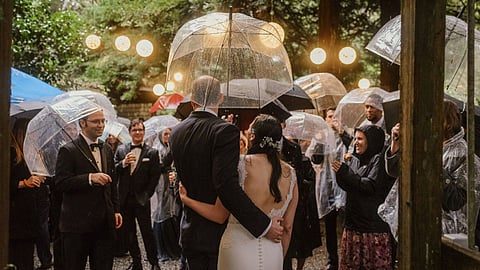

While some of us may not enjoy getting wet in the rain, you cannot deny their long association with romance. Who can forget Geet and Aditya’s romantic dance from Jab We Met, where the duo dance their heart out with the song 'Tum se hi’ being played in the background?

Cut to reality, it is not as romantic as Bollywood movies make them seem, especially when it pours incessantly on a meticulously planned occasion, like your wedding!. Even if your venue is indoors, rain can mean your best-laid plans can go awry. But did you know, many cultures consider it auspicious if it pours on the wedding day?
While many in the Hindu culture believe that rain on the wedding day could mean that the knot that ties the bride and groom together becomes harder to untie, it has several associations with the notion of fertility too. Their association with fertility goes back to the Medieval age when in certain Aztec folklore it was believed that the god of thunder, Tlaloc, impregnated the earth with his sperm which happened to be raindroplets which eventually gave rise to vegetation and crops to grow on the barren soil. In certain texts, the rain is also seen as a symbol of purity that cleanses the sins and the bad memories of the to-be-weds thereby providing them with a clean slate to write their life journey ahead. Though in some ancient Christian folklores, there is a vague reference to rain being the tears of the Virgin Mary and she cries to wash away your sins right before the wedding, there is no biblical reference for the same.
Father Binoj Mulavarickal says, “The fact that it rains during weddings is a mere superstition that has gained popularity through centuries. There are no biblical references for the same. The fact that rainfall during your wedding assures good luck are myths that have no biblical reference to support the same. According to Christianity or as per the bible, as a priest and having performed over numerous weddings all I can say is a downpour does not guarantee you a happy married life.”
While rains were considered across some cultures due to their association with harvest and agriculture were also seen as a symbol of good luck, rains as their nature were seen as a blessing from the Hindu god of thunder and lightning, Indra whose consort is also known as Lakshmi in some Hindu scriptures. As per the book Seven Secrets of the Goddess by mythologist Devdutt Pattnaik, “The Hindu goddess of wealth, Lakshmi is also known as the sister of the asuras or the demons of the underworld, the asuras are reluctant to let go of their sister which is why it is very difficult to extract wealth from the ground in the form of oil, vegetation or even gold. But when it rains, it is a call from her husband Indra, in some texts and the asuras(demi-gods) are then forced to let go of their sister who manifests herself in the form of crops and vegetation. Thus people believed that when it rained hard before a wedding it assured prosperity or the advent of the goddess of wealth into the couple's home.”
“Rains have always been considered auspicious in Hinduism because it assures the emergence of crops thus ensuring prosperity as people will benefit from the bounty, whether it is financial or personal, says, UK based Hindu priest Pandit Sundar Madhava Das, “As rains made the soil fertile and made it easier for the early humans to till the soil, people began to associate rains as a way of assuring that the goddess of wealth, Lakshmi would take care of the couple and provide them with security financially.” Pandit Arjun Pandey adds, “There is ample evidence in the Bhagavad Gita one of the shlokas that translates into ‘All living beings sustain on food, and food is produced by rains, rain comes from the performance of sacrifice which is Yagya and sacrifice is produced by performance of prescribed duties’. Entering into a marital union is one of the duties of a person’s life, which is also known as Grihastha (householder) in Sanskrit. Marriage is one of the 16 sanskaras of Hinduism which needs a yagna (altar) which is also known for conducting sacrifices, thus when it rains it means food and prosperity are assured.”
Certain Sikh and African myths also state that if you eat directly from the cooking pan or the Kadhai, then it is bound to rain on your wedding day, but again there is no historical, religious or spiritual reference to the same. As cooking pans were used to be mostly leftovers and it was unhygienic to eat from it hence people used rain as a reference to scare children and prevent them from eating directly from the cooking pot.
“I remember during my wedding it rained incessantly," says social media influencer Nikita Abrol, “I had deliberately chosen a date that was the end of January so that it does not rain, but then it was pouring cats and dogs, people around me began to joke that I have licked a lot of pots and utensils which is why this is happening. Luckily, my arrangement was entirely indoors, so the decor, the menu and nothing was hampered. My family people later explained to me that this tale was basically to scare people so that they inculcate manners because licking the plate clean is unconsidered uncivilized. But, I personally feel, that if you don't lick the plate clean, that's bad manners because it’s an insult to the food prepared or an indicator that the food wasn't good enough. So, I would say, rain or no rain if you like the food, go ahead and lick the plate clean,” she jokes.
While having an unexpected downpour on your wedding day can lead to disappointment one can always make the most of the tricky situation.
“We were all shocked when we first saw the sky getting cloudy," recollects Mukesh Agarwal, co-founder at Ties n Knots weddings, “But instead of panicking, we quickly focused on solutions. I assessed the situation, gathered the team, and began working to ensure that we could proceed smoothly to adjust the setup and décor to accommodate the weather. Staying calm and composed and thinking on our feet helped us immensely. Rather than rushing to move everything indoors, we explored ways to keep the event outdoors, such as adding covers, and umbrellas, and adjusting the seating arrangements to ensure that everything remains dry.
During the wedding festivities, the bride and groom’s response to the unexpected rain was nothing short of inspiring. The rain allowed us to turn things around differently than what we had planned. Rather than letting the weather dampen their spirits, the bride and groom embraced the situation and decided to play with water balloons instead, turning the rain into a joyful and spontaneous part of the celebration.”
So do you believe rains on the Big Day are a boon or a bane?