
Indian weddings, and the many rituals that are a part of the institution, have an incredible amount of cultural context, Ayurvedic science and social reasoning behind them. For instance, ever wondered why couples avoid seeing each other before the wedding? Or why are newlywed couples given a glass of milk on their wedding night?
You May Also Like: The Romance And Ritual Of A Varmala
The latter has been a staple of Bollywood movies from the 80s and 90s, where the bride’s or groom’s friends teasingly serve up a glass of warm milk to the couple before their wedding night.

From films such as Dolly Ki Doli (2015), Meenakshi Sundareshwar (2021), to popular OTT shows such as Girliyapa’s Arranged Couple, pop culture has pretty accurately mirrored the current generation’s relationship with the ritual. So, we decided to look into why it was selected as the beverage for newlyweds in our culture…
The question is not new and has plagued many a curious mind before. Milk symbolises purity and nourishment in our culture and traditions, it is often referred to as amrit (a sacred elixir). In the Bhagavad Gita, lord Krishna was observed mentioning milk as one of the food items that are ideal to use as an offering (along with fruits, vegetables and water). But the emergence of the word amrit as a way to describe milk may have, in fact, come from the Ramayana.
You May Also Like: From Blessings to Beginnings: Why Rice is Sacred in Indian Weddings
In the Ramayana, the iconic tale of the Sumudra Manthan, where gods and demons churned the milk ocean or the Kshir Sagar, led to the cultivation of two byproducts – nectar and poison. The Poison was consumed by Lord Shiva, while the nectar, which became known as amrit, was consumed by the devas or the gods.
In terms of modern-day rituals, many Haldi ceremonies involve the bride and groom being showered with milk and a Tamil housewarming tradition (known as the Pāl Kāṭṭu) involves boiling milk in a newly acquired house, which symbolises overflowing prosperity, abundance and warmth!
Different cultures have their own versions of what has proved to work for them in terms of food, sleep, and even the libido. According to a 2016 study conducted by Science Advances, the Netherlands is the most sleep-abundant country in the world. The Dutch sleep one hour more than the rest of the world (eight hours and five minutes on average).
You May Also Like: Blooming Love: Flowers in Indian Wedding History
That got us wondering, there must be some magic elixir (or elixirs) that they’re consuming to support such great sleep levels. Other than the fact that the country practices four-day work weeks, which may be directly related to their sleep quality, it seems most food that the Dutch consume consists of tryptophan, an amino acid which helps convert serotonin into melatonin, a natural hormone produced by the brain and magnesium (a mineral which is crucial for muscle and nervous system relaxation).
The Dutch diet is filled with items such as milk, turkey, and fish (rich in tryptophan) and nuts, avocados, and leafy greens (which are rich in magnesium). This points to one possibility of why milk is considered the ideal beverage for Indian wedding nights. Perhaps, it’s more about relaxation and ease rather than anything else. However, it has also been debated that full-fat dairy products before bedtime can lead to digestive issues and disrupt sleep. Perhaps, the idea is to stick to skimmed milk?
In Ancient Chinese culture, newlyweds were encouraged to drink honey and wine in goblets linked together with a red thread in the nuptial chamber While it’s unclear why the particular bevearge and food item were selected by ancient chinese folks, one explanation for the ritual could be that this could help build intimacy between the couple.
You May Also Like: The Heartwarming And Special Roles Brothers Play In Indian Weddings
And though food has been one way to create this vulnerability and relaxation between a couple. Music seems to have been the next best option (and probably, still is). In 16th-century Germany, rather than ambient music, it was common for the family and friends of the bride and groom to accompany the newlywed couple to their chamber while playing loud and boisterous music outside of their room!
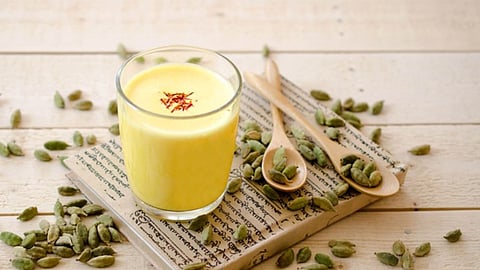
According to Ayurvedic science, milk is considered an aphrodisiac. More specifically, cow’s milk. Cow’s milk is considered nourishing to reproductive tissue and helps raise the libido. In fact, adding additional ingredients such as almonds, saffron, honey and ghee (clarified butter) can increase the aphrodisiac quality of the milk.
It is also believed that adding Ashwagandha to a glass of warm, cow’s milk is said to increase fertility for men.
But it isn’t only according to Ayurvedic science that milk is favoured as an aphrodisiac, the beverage was also mentioned in the Kama Sutra as the perfect libido boosting drink before an intimate encounter.
You May Also Like: Why Do We Steal the Groom's Shoes Before the Wedding?
The beverage is also said to signify relaxation and auspiciousness (owing to its definition as a pure food item). So, it isn’t only about how milk is seen as an aphrodisiac, but as a beverage to drink for a good start to something. To signal and wish for a good beginning for the newlywed couple!
So, it seems it would be wise to listen to your body before drinking up that glass of milk (plant-based, if you’re lactose intolerant or vegan). For some, a glass of milk before bedtime is the perfect way to unwind and head to bed. For others, the idea is daunting. We would go as far as to say it’s best to consult your doctor and maybe even look into how you process heavy dairy products, especially before bedtime.