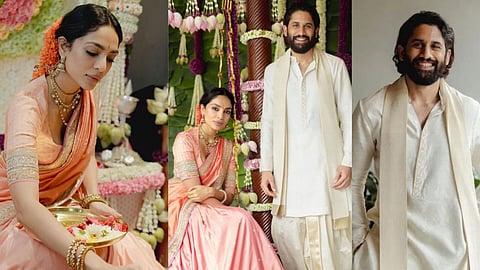

ICYMI, Sobhita Dhulipala and Naga Chaitanya recently announced their engagement, and now their wedding is just around the corner. If the recently gone-viral wedding card is to be believed, the couple is going to tie the knot as per traditional Telugu customs.

The wedding card, which includes elements like handmade Kondapalli dancing dolls, Nalla-Kaaram Podipowder, Sunnundalu (a Telugu delicacy), revealed that the couple is expected to get married at the Annapurna Studios, Hyderabad, which was inaugurated by the late legendary Akinneni Nageshwara Rao, Chaitanya's grandfather.
While we brace ourselves to catch real-time updates of the nuptials scheduled to happen on the 4th of December, here’s a quick breakdown of all the rituals that traditionally take place in a Telugu wedding…
Though all South Indian weddings have a lot of factors in common like the elements used in the design and decor, the ambience and the ingredients that go into menu planning, there are certain elements that remain specific to Telugu weddings.
Things like the mandapam, the usage of banana leaves in the decor and the presence of yellow flowers for prosperity are something that all of us can see in Malayali, Tamil and Kannada weddings, however, the manner of performing rituals is what proves to be a major differentiating factor. Although some traditions like the Kashi Yatra, Saptapadi (seven-step ceremony) and tying the sacred thread or the thalli remain the same, there is a difference in the Mahurutam, which is usually scheduled during midnight, sometimes during the afternoon and very rarely in the morning in Telugu weddings. Also, the post-wedding rituals and the ice-breaking sessions are largely different across the four communities.
“In traditional Telugu weddings, elements like the mandapam with intricate floral arrangements, sacred colours like yellow and turmeric, and traditional décor elements like banana leaves and marigolds remain customary. In comparison to North Indian weddings, which often lean towards grandeur and diverse themes, South Indian weddings, primarily Telugu weddings, prioritise simplicity and cultural authenticity, while each South Indian region in India brings its unique flavour, Telugu weddings stand out for their deep emphasis on tradition and a spiritual atmosphere that lingers during the wedding festivities. Certain customs are common across all the South Indian weddings, some things like pointing out to the Arundhati Nakshatram are centric to Telugu weddings only,” says Jueta Hemdev, founder of Mumbai-based wedding planning company, Yolo Entertainment and Weddings.
Telugu weddings include a lot of weddings and rituals performed across pre-wedding and wedding festivities along with a few games that are performed to break the ice and kindle the intimacy between the newly married couple, here’s how a Telugu wedding proceeds...
Nichithartham translates into confirmation of the marital bond. The ritual derives its name from the Sanskrit word ‘Nischay’ which means decided and confirmed, it is also the official engagement ceremony where the bride and the bridegroom confirm their marital union for the first time in public. Very similar to the ‘Mangni’ ceremony held in North India the ‘Wagdaan’ held in Western India and the ‘Nischchayathartham’ of Tamil weddings, this marks the beginning of a new relationship between the families. But the only difference between a Tamil engagement and a Telugu engagement ceremony is that in the former ceremonies, sandalwood paste and vermillion are applied to the bride's forehead, to symbolise her transition, whereas in a Telugu ceremony, the ceremony ends with an exchange of gifts between both the families.
Godhuma Rayi Pasuppu Danchadamis an official pre-wedding ceremony that kickstarts the beginning of the wedding ceremony which is performed at the bride and the groom's place of residence. It is a ceremony where all the sumangalis (married women ) of the family assemble and pound turmeric that is later on used to adorn the bride and the groom-to-be. Rayi translates into stone and Pasuppu Danchadammeans grinding of the turmeric, as turmeric is held highly auspicious in the Hindu culture due to its association with Vishnu, the turmeric pounded by married women is believed to contain their blessings to have a fulfilling married life.
Very similar to the Haldi ceremony that takes place in North India, this ceremony is when the bride and the bridegroom are dressed for the main wedding which is supposed to take place. To commence the ceremony, a pandiri (stage) is set up and is decorated with banana tree branches, because of its association with the planet of prosperity and abundance Jupiter. The decor usually includes yellow and orange marigold flowers to ward off negativity and attract abundance. During the ceremony, Naluga (a paste comprising of the turmeric obtained from the Passupu Danchadam ceremony and aromatic oils) is applied to the couple's skin. This ritual is followed by the Mangala Snanam where the water consists of turmeric pods and Tulasi leaves is poured over the bride and bridegroom as turmeric is a representation of an incarnation of the Hindu god, the creator, Vishnu, Balaji and Tulasi his consort who is also believed to be an incarnation of Lakshmi. The heads of the groom and the bride are adorned with the ‘Kalyana thilakam’ and the Dishti Chukka, two traditional Andhra styles of bindi by an elderly person of the family to ward off evil spirits. Finally, paarani (turmeric mixed with saffron) is applied to their feet, concluding the Pelli Koduku and Kuthuru ceremonies.
“The Pelli Koduku ceremony involves a lot of gifts being bestowed both on the bride and the groom. During one of the Pelli Koduku events that I was attending, the groom was so eager and happy to receive gold rings that he started opening the gifts and trying them on the spot, says Hyderabad-based celebrity wedding photographer, Ajay Patnaik. As gifts started coming in, the groom was eager to try all of them. To try new ones, he had to remove the old ones, and the funniest part was when one of the rings got struck and he could not remove them. After having washed his hands until they were red, he was finally able to get rid of all the rings,” he laughs recalling the incident.
Kashi Yatra usually commences before the wedding festivities begin where the groom announces his disinterest in the wedding and announces to go away to Kashi and spend the rest of his life in celibacy, the bride's father and the brother then coax him to return back to the venue and plead him to marry their daughter/sister. This custom focuses on the duties that a householder is expected to perform to attain ultimate enlightenment. The bride's father explains to the groom that renouncing worldly pleasures and opting for celibacy will not lead to enlightenment; he has to fulfil his duties as a householder to understand the functioning of the material world and then attain salvation.
Jeelakarra Bellam is the ceremony where the bride and the bridegroom catch a glimpse of each other before the main wedding rituals begin. It is conducted after the bride is brought to the wedding altar sitting on a woven basket carried by her maternal uncles. A paste consisting of cumin and jaggery is applied to the palms of the to-be-weds by the priest, which the bride and the bride-groom apply on each other’s post where the curtain creating a divide between them is removed and the bride and groom are allowed to see each other. Cumin is a strong spice and hence a representative of tough times and jaggery is an indicator of the easygoing times, by applying cumin and jaggery paste onto each other's heads the bride and the bridegroom make a promise that they will stick to each other during tough and easy times.
“Modern Telugu weddings are a perfect blend of deep-rooted cultural traditions and contemporary celebrations. In one of the weddings that I was doing I remember the bride and the groom tweaked the Jeelaakara Bellam ritual, instead of the priest or thePanthulu, applying it onto their palms, the bride and the bride-groom applied it mutually onto each other’s palms”, says, Jueta Hemdev.
The Mangalasutra, or tying of the sacred thread, or the thalli, is what happens after the Jeelakara Belam ritual is done. Themangalasutrais placed on a coconut and passed over to all members of the family so that they bestow their good wishes on to the couple. The thread is basically made of nalla possulu, or the black thread, known to protect the bride against the evil eye. After being passed over the all members of the family, the thread is tied to the bride's neck in three knots each knot. The first knot denotes a commitment to keep the bride happy through speech, the second through action and the third to remain committed and dedicated through duty or dharma.
In this ritual, the bride and groom exchange garlands and shower each other with pearls and rice mixed with saffron and turmeric. Rice is predominantly used because it is the staple diet of the state, and secondly because it is associated with the goddess of fertility and prosperity Lakshmi. The showering of rice and pearls over one another primarily served as an ice-breaker between the couple and also allowed them to engage in some playful banter, secondly showering each other with grains also indicated that the bride and groom promised each other prosperity physically, mentally and emotionally.
“During Talambralu, the grain shower sometimes turns into a hilarious mini-war, with the bride and groom mischievously competing to outdo each other. Once, a bride cleverly hid extra grains in her saree to ambush the groom later, leaving everyone in splits. These tiny moments make Telugu weddings so joyous and memorable”, recalls Jueta Hemdev.
Very similar to the Saath Phere (seven vows taken around a holy fire) ceremony carried out during the North Indian ceremony, the Saptaapadi ritual includes the bride and the groom taking seven steps across the fire altar and making seven promises to stand with each other during good and bad times. Another reason to take seven steps is because the bride and the groom make a complete circle which is 360 degrees, from the numbers 1 to 9, 7 is the only number that cannot divide 360 completely, so the number seven is opted so that nothing divides their relationship and their bond.
After the wedding festivities are over, the bride and the groom assemble outside in the courtyard and the groom points out to the Arundhati Nakshatram, which is also known as the star of Alcor. As Arundhati and her consort sage Vashista are considered the ideal couple, the groom points out to the Arundhati star and the newlyweds seek their blessings for the life lying ahead.
“When we were shooting for south superstar actor Kiran Abbavaram’s wedding, it was too late by the time the wedding festivities were done,” recalls Ajay Patnaik, “After the Arundhati Nakshatram ritual was over, I remember Kiran feeling exhausted and tired and his brother-in-law stepping in and carrying him on his back to his room”.
Like all the incredible wedding feasts across the country, Telugu wedding feasts are also incredibly well-thought out and delicious. The feast, also known as the Banthi Bhojanam, has a lot of similarities with the Tamil Virrundhu Sapudu and the Kerala Sadhya, like the style of service on a banana leaftain and the serving of the dessert first, and also the fact that it has to be purely vegetarian as non-veg is considered inauspicious or unclean by many South Indian communities.
The only difference between the Banthi Bhojanam, the Sadhya and the Virrundhu Sapudu is the desserts that are served at the end of a feast. While a Tamil wedding feast may include a Paal payasam (Kheer) and a Sadhya may have an Ada Pradhaman, a Banthi Bhojanam usually has a Killi (sweet pan) served at the end of a meal.
Though the Banthi Bhojanam may differ across the three major regions of Telugu soil which is Andhra, Telangana and Rayalseeema, there are certain elements that remain, certain commonalities that remain centric and very minor differentiators primarily consisting of the vegetation and the local spices grown across all the three regions that make all the difference.
“Across all Telugu weddings of Telangana, Andhra and Rayalseema, the wedding feast is called the Banthi Bhojanam,” says Chef Chalapathi Rao, chef and restaurateur at award-winning restaurant, Simply South, Hyderabad.
“The constituents of the Banthi Bhojanam, the primary vegetation of the regions is what makes the difference. Telangana was a very dry region for a very long time, hence the Banthi Bhojanam dishes served at a Telugu wedding in Telangana include dishes where a lot of millets are used because the water consumption of millets is comparatively less. Similarly, the wedding feast served at a Telugu wedding in Rayalseema is usually more spicy because it is more have spice and chilly in it because the region is very dry and there is not much moisture in the soil, so in order to make the dishes more tasty and flavourful just like in Rajasthani cuisine, the usage of chillies, particularly Guntur chillies, which are the spiciest chillies in the world are more prominent in the Telugu wedding feasts of Rayalseema.”
We can’t wait to see how these rituals and traditions play out during Sobhita Dhulipala and Naga Chaitanya’s wedding!