Long before it assumed its place on wedding mandaps or in puja thalis during festivals, the kalash already featured in the hymns of the earliest Sanskrit texts, such as the Rig Veda and the Atharva Veda. This vessel was more than a container, it was regarded as a microcosm of the universe itself. In the Atharva Veda, water is described as ‘Apo hi sthānam bhuvanasya’, which means ‘in the waters is the abode of the whole world’. The kalash, at its core, symbolises creation, fertility, and the eternal cycle of birth and death.
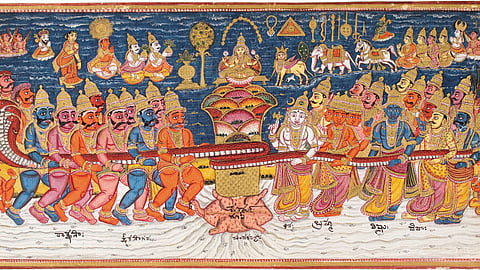
There are numerous historical references indicating the long existence of the kalash. According to art-historical scholarship, the motif appears in ancient temple architecture across India: it is described as “the seed-form of the temple” by scholar Stella Kramrisch in her seminal work The Hindu Temple [1946]. In these readings, the kalash is identified with the ghata [vessel] imagery used as finials on temple roofs. In Vedic rituals, the kalash was invoked as a living deity. During the kalasha sthāpanā ceremony [the installation of the pot], it was believed to become the seat of gods and goddesses. The water it contained symbolised the seven sacred rivers along with Surya [the Sun] and Chandra [the moon]. The kalash’s symbolism deepens in the Puranas. The Vishnu Purana describes a pot emerging during the Samudra Manthana [churning of the cosmic ocean] as the vessel of nectar of immortality…and, by extension, the kalash came to represent divine sustenance.

Every component of the kalash is laden with layered meaning. The metal pot, traditionally made of copper or brass, symbolises Prithvi [Earth] and the water inside signifies the life-giving principle. The mango leaves at its crown denote the five elements or the five senses. The coconut on top of the leaves signifies fertility, endurance, and divine consciousness. Ritual manuals like the Grihya Sutras instruct that the kalash must be declared sacred before any major ceremony, thereby transforming the simple vessel into one that holds divine power.
Over the years, the kalash journeyed from the Vedic altar into domestic and social ritual and has become an integral part of shubh karya [auspicious acts]—from laying a foundation stone to weddings and housewarmings to festivals. As a leading Indian scholar [late] Kapila Vatsyayan observed, the kalash symbolises mangalya [auspiciousness], a visual metaphor for prosperity and well-being that transcends generations and religious boundaries. In North Indian weddings, for example, the kalash—filled with water, betel nuts, rice and coins—is placed at the entrance of the mandap or near the sacred fire, invoking Goddess Lakshmi and Goddess Gauri. Its presence ensures that the union of two people takes place under the divine gaze, inviting prosperity, fertility and abundance in the couple’s new journey into married life.
Today, the kalash is regarded as one of the most resilient ritual symbols that has retained its ancient meaning…be it in urban homes, sprawling temple complexes, or at luxury weddings. Its presence marks a new beginning. At the same time, its form and aesthetic have evolved from motifs on lehengas to wedding decor centrepieces. Mythologist Devdutt Pattanaik calls the kalash “a vessel of potential”—its power lying in simplicity. That is what makes it a universal metaphor for receptivity and wholeness.