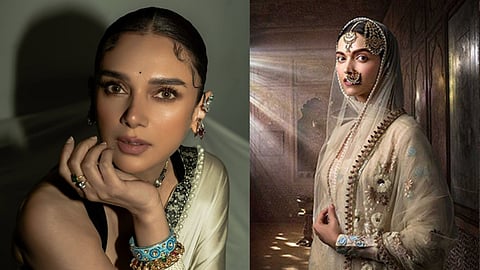

Of all the ways India has inscribed beauty onto the body, piercing remains one of its most intimate gestures—small in scale, immense in meaning. A pinprick of gold or diamond becomes a declaration: of where one comes from, of whom one belongs to, of the stories the body is ready to carry. Across centuries and geographies, piercings have travelled with the subcontinent’s shifting cultures, absorbing new purpose while never abandoning the old.
Long before modern notions of personal style emerged, Indian societies had already perfected the art of ornamentation. Anthropologist Nita Kumar describes such practices as “technologies of discipline and beauty”—rituals that shaped the body into its social form.
The Classical Brahmanical tradition codified ear piercing as karṇavedha, one of the 16 saṃskāras, a rite that welcomed a child into the culture. In South India, infants were often pierced before they could walk…their tiny gold studs glinting like a first language of identity. Sangam literature sings of jewelled ears, colonial photographs record the ritual’s continuity, and family albums today hold the same quiet moment of a child being readied for the world.
Ancient medical texts also left their imprint on the practice. In the Sushruta Samhita, ear piercing is both a scientific and symbolic practice. The lobe, believed to hold subtle marma points, was treated as a site where beauty converged with wellbeing—where a jewel could gently align the body’s energy with its destiny. Ayurvedic interpretations survived in oral traditions suggest that these marma points are also connected to reproductive health, along with neural pathways associated with hearing.

If ears carried the weight of childhood rites, nose piercings held the gravity of womanhood. The nath—delicate, dramatic, unmistakably Indian—became a cultural signature across Western and Northern India. The nath was symbolic of marital status, clan identity, and regional aesthetics. The curve of the ornament to the stone setting, and the even number of petals, tells the observer exactly where a woman came from. In Hindu traditions, the nose ring is also associated with Goddess Parvati, whose married form—Gauri—is depicted with a nose ornament in certain iconographies. This symbolic linking of the nath to marital auspiciousness transformed it into a mandatory element of bridal attire. In many regions, the bride’s nath is believed to invoke Parvati’s blessings for fertility, well-being, and a harmonious married life.
The tradition reached its artistic zenith under the Mughals with naths that looked like fragments of moonlight—crescents edged in diamonds, flowers strung with pearls. Descriptions in travelogues, such as those by François Bernier, note the richness of Mughal jewellery and the fondness for elaborate facial ornaments. Royal women, especially in Rajput and Deccani courts, adopted the ornament quickly, adapting it to regional aesthetics. Over time, the nose ring was reimagined in the form of nath, nathni, mookuthi, laung, bulak, among other forms across the subcontinent.
Interestingly, the nath isn’t just ornamental. Ayurvedic interpretations suggest that the left nostril is governed by the ida nadi, which governs feminine energy and is linked to the uterus and reproductive organs. According to a 2025 paper in the International Journal of Creative Research Thoughts, both in Ayurveda and in the broader cultural memory that surrounds women’s adornments, it is believed that a nose-piercing, especially on the left, helps with childbirth, and to this day, we find left-side nose piercings remain a norm in North, West, and Central India. Meanwhile, in South India, by contrast, people prefer the right nostril, creating a cultural map of piercings that mirrors linguistic and regional identities. And in some Tamil and Konkani traditions, the double-pierced mookuthi has been worn for centuries, while in some Himalayan communities, the septum’s bulak is pierced.
By the 19th century, court jewellery styles had begun shaping public taste. Miniatures from the Jaipur ateliers depict queens in crescent-shaped naths, while Deccan manuscripts show pearl-strung ear chains draped dramatically across the cheek. And the 20th century turned piercings into a site of negotiation. Reformist movements attempted to recast them as ‘superstition’, even as film actors re-normalised them through screen glamour. Legacy goldsmiths kept classic forms alive despite shifting attitudes, and by the late 1960s, Bollywood had already begun to recirculate older motifs—the full-nose ring, the diamond stud, the jhumka—as seen in films such as Mera Saaya [1966] and Palki [1967], positioning them as markers of contemporary beauty.
This looping of past and present shapes the way piercings appear today. One image captures it perfectly: Sonam Kapoor Ahuja at the 2013 Cannes Red Carpet in an Anamika Khanna sari paired with a polki nath, gleaming like a bridge between centuries. It was a reminder that Indian jewellery has always had dual desires—to celebrate heritage, and to reinterpret it to push its boundaries.
Today’s brides return to this lineage with renewed affection. They choose nose pins that honour ancestral rituals yet feel modern, ear studs inspired by ancient scripts but shaped for contemporary elegance. Every piercing becomes a quiet act of remembrance, a way of wearing history lightly on the skin.
It’s fascinating to think that something as small as a nose stud or an earring can carry so much history, meaning, and complete human persona. From a child’s first ear piercing to the bride’s ornate nath, these adornments are never just jewellery, but they announce identity, hold memory, and track the body’s passage through life stages. Each piercing carries a story that links the past and present, turning even the smallest hoop or stud into a fragment of living heritage
This story appears in Manifest India’s Issue 06. Subscribe here for more stories like this.