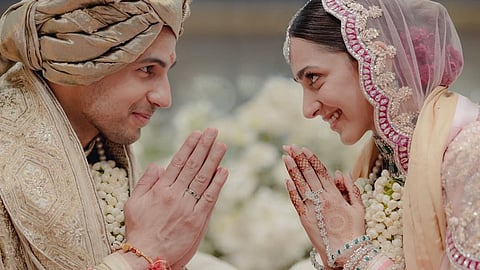

In the infinite sequence of Indian weddings, the ceremonies do not end with the final vows or the last Phera. The post-wedding occasions that occur after the wedding celebrations are some of the most culturally rich and symbolically profound traditions. The customs vary across religions and regions, offering a glimpse into how different communities honour the beginning of a shared life.
Whether it’s a ceremonial welcome, a spiritual home blessing, or a celebratory reception, all these ceremonies dwell on the foundation laid by countless centuries of heritage, changing perceptions, and the artistic character of a culture.
India has a diverse religious landscape, and each of the religions celebrates this homecoming of the bride after her marriage in beautifully unique ways. From stepping over pots of rice in the Hindu households to the concept of elegant Pag Pheras in Sikh families, or even the Walima ceremony in the Muslim traditions, each religion and its culture celebrate the bride’s arrival with distinct rituals that are ingrained not just in our hearts but also in our rich heritage. Here’s a closer look at how different Indian communities celebrate this sacred step into married life.
In a Hindu wedding, the Griha Pravesh and the Vidaai ceremony take place after the wedding and are the most emotional last few moments that a bride spends with her parents and family. During the emotional Vidaai ceremony, the bride bids a tearful goodbye to her parental home while tossing rice or coins over her shoulders. The Vidaai ceremony sees the bride’s father-and often her brothers-escorting her to the car
After her farewell, when she is welcomed into the new house, it is called Griha Pravesh- a ceremonial entry into the groom’s household. Stepping at the groom's entrance, just atop a pot full of rice or some vessel, she generally returns her right foot first on rice laden with vermilion, meaning that she is welcomed as a harbinger of prosperity and fortune.
These rituals symbolise her transformation from being a daughter to a daughter-in-law, marking her role in a new household and transferring blessings from the old family to the new lineage.
In Sikh tradition, the bride’s departure and arrival are embodied in the Doli-bride’s ride home-followed by Pag Phera, which is a customary return visit to her parents.
The Doli signifies the bride’s farewell from her family. She sits in a Prabhat or decorated palanquin- today, a car that escorts her to the groom’s home.
Two days later, the couple visits the bride’s parents' home, and this ceremony is called the Pag Pheras. She returns bearing gifts signifying ongoing ties and familial unity.
These rituals honour both the initial leaving and her continued strong bond with her birth family, emphasising balance between her past and future life. This gives the bride time to settle in, while giving her roots a chance to breathe.
Walima, when translated, means she belongs here now. It is intertwined with the bride’s homecoming and celebrates unity and the groom’s new responsibility as a husband and a host.
Typically, after Nikah seals the marriage spiritually in the Muslim culture, the Walima reception officially welcomes the bride into the groom’s household. It introduces the couple as husband and wife, often marking her formal entry into the new home.
The Walima banquet showcases joy, hospitality, and the groom’s responsibility for the household. Though not a direct mirror to Griha Pravesh, it plays a crucial role in presenting the bride to the broader community as part of her new family.

After a bride walks down the aisle and the wedding ceremonies in the church are complete, the bride is welcomed at the groom’s house, sometimes with a blessing or gathering.
In Christian-Indian weddings, the groom places a silk sari (manthrakodi) and ties a Thali or Minnu around the bride’s neck, marking her as married.
In Jainism, the bride is welcomed in the groom’s house, after the wedding ceremonies, by in-laws with grandeur and sometimes with aarti or blessings, a simple and chic ceremony called the Sva Graha Aagamana. This ritual often follows up with Jina Grahe Dhan Arpana, giving alms at the temple as an expression of gratitude.
After the wedding, the bride and groom receive sweet milk from their mothers, light lamps, and exchange blessed items—sometimes even arriving at the groom’s house with a traditional procession.
They also include chaining her in a manthrakodi, tying a cross-pendant—similar to the Hindu thali—and walking under cultural symbols like the Nilavilakku lamp. These ceremonies are a beautiful fusion—Syrian Christian rituals dancing with Kerala-Hindu customs—making the homecoming ceremony rich and layered.