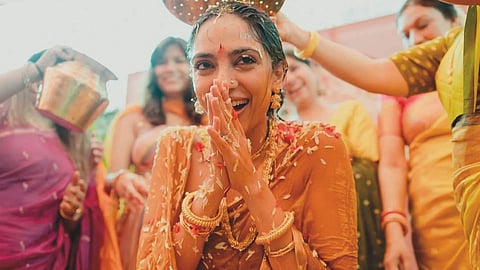

In South Indian weddings—where tradition is not ornamental but lived—there exists a moment of rare stillness before the wedding ceremony unfurls. Away from the music, the guest lists, and the visual spectacle, mangala snanam unfolds quietly at dawn. Known simply as the auspicious bath, it is one of the most intimate rituals of the wedding journey—less about performance, more about preparation.

The two words derived from Sanskrit offer clarity. Mangala means auspicious, and snanam means bath. Together, they describe a ritual that sits gently between who the bride has been and who she is about to become. Observed across Tamil Nadu, Andhra Pradesh, Telangana, and Karnataka, mangala snanam takes place early on the wedding morning, when the world is still hushed and the day feels untouched.
Its roots lie in the Hindu belief that water is transformative—a source of cleansing, renewal, and rebirth. Long before weddings became elaborate, this ritual existed as a spiritual reset. In fact, mangala snanam predates the now globally-known haldi ceremony seen across other parts of India, offering a distinctly South Indian approach to bridal preparation.
As the first light of day filters in, the bride retreats to a space prepared just for her—often adorned with fresh flowers, brass vessels, and soft lamps. Around her gather sumangalis: married women whose presence is believed to carry blessings of marital harmony and longevity. They apply turmeric, sandalwood, and kumkum—each element chosen with intention, each touch layered with quiet emotion. This is followed by the ceremonial bath, where water sanctified by prayers and herbs washes over her. The belief is simple yet profound: this moment cleanses not just the body, but the spirit—clearing anxieties, dissolving negative energy, and welcoming good fortune as she steps into marriage.
For today’s bride—whether she’s planning a temple wedding, a destination celebration, or something entirely her own—mangala snanam offers something increasingly rare: pause. As weddings are defined by packed schedules and constant motion, this ritual becomes a grounding force. A moment to breathe, to reflect, to arrive fully in the experience.
It is also deeply connective. Mangala snanam links a bride to generations of women who stood exactly where she stands—nervous, hopeful, on the brink of change. For many families, omitting it would feel like leaving the story unfinished. Without this ritual, the wedding may happen—but the transition feels incomplete.
When Naga Chaitanya and Sobhita Dhulipala shared glimpses of their mangala snanam ahead of their December 2024 wedding, it struck a chord. The imagery was simple yet powerful—turmeric-stained hands, soft smiles, family close at hand. It wasn’t about grandeur. It was about intention.
And, in the hands of thoughtful planners and filmmakers, mangala snanam has also emerged as a visual poetry of its own. Marigolds spilling over brass urns, water catching the early light, turmeric glowing against skin—these are moments that photograph beautifully because they are real. Increasingly, brides drawn to global aesthetics are rediscovering the quiet elegance of this ritual, weaving it seamlessly into contemporary celebrations.
Rituals like mangala snanam remind us that weddings are not merely events to be curated—they are rites of passage. No amount of decor, couture, or spectacle can replace the power of a moment that is felt rather than seen.