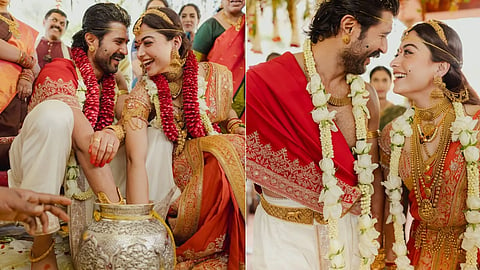

Actress Rashmika Mandanna and Vijay Deverakonda’s recent wedding was one of the most awaited and the most talked about weddings of 2026 and for all the right reasons. Steeped in traditions, their intimate wedding ceremonies had garnered widespread attention. But one ritual that especially stood out: the Jeelakarra Bellam ritual.
Every moment at an Indian wedding is grand and steeped in rituals and traditions but when it comes to the weddings in the Southern region of India, there is that one moment in a Telugu wedding that absolutely stands out. One where time pauses, the noises soften a little and the rituals converge into something rather beautiful and meaningful. The ritual that witnesses the quiet beauty of two people separated by a thin curtain as they reach out toward each other with something so simple as a paste of cumin and jaggery. The Jeelakarra Bellam ritual is deeply rooted in the Telugu marriage tradition and makes for the emotional and spiritual heartbeat of the wedding ceremonies.
Like poetry written in tradition, the name brings together Jeelakarra, or cumin seeds that are earthy and slightly bitter and Bellam, or jaggery which is warm and rich in sweetness. When crushed together, the two form a thick paste, representing the philosophy of the ritual-two contrasting flavours blending into something inseparable, much like a marriage. It reflects that a marriage is not just all about the sweetness of life but a merging of opposites to create the perfect balance and harmony.
It’s giving love, but making it real and absolutely dramatic. From the beginning, every step of this ritual is theatrical. Before the ritual begins, the bride and groom are seated facing each other, but separated by a cloth screen. They cannot see each other yet. This builds anticipation, like a slow burn before the big reveal. What follows is the thick mixture of cumin and jaggery, placed on a betel leaf, also known as tamalapaku, a sacred element in several of the Indian rituals. The priest then chants vedic mantras and at the precise auspicious second, both the bride and groom simultaneously place the paste on each other’s heads.
Once the ritual is complete, the curtain between the couple is removed and just like that, their eyes meet, making their first look at each other sacred and witnessed by everyone who are present during the ceremony.
Layered with meaning, this ritual hits deeper than one might think. It reflects the permanent nature of a marriage.
Once the cumin and jaggery are mixed, they cannot be separated, just like a married couple. And while getting married might sound like an exciting journey, marriage is not all pinterest boards and everything beautiful, it has its own set of sweet moments as well as bitter ones and this ritual acknowledges that.

Some traditions believe that when the couple touches each other’s heads during this ritual, their thoughts and life paths become intertwined. It’s not just a union of bodies or families, but a merging of destinies.
In many Telugu weddings, Jeelakarra Bellam is considered the actual moment of marriage, even more significant than tying the mangalsutra in some interpretations.
It happens at the sumuhurtham, the most astrologically powerful moment of the ceremony. Everything before it builds up to this, and everything after it flows from it.
Even modern couples are tracing their steps back and choosing traditions like the Jeelakarra Bellam ritual and Rashmika and Vijay’s wedding represented just that. Because honestly? The idea is universal.
Who doesn’t want a love that is about drawing a balance between partners where the couple chooses each other with all their sweetness and bitterness.
If you strip away the rituals, the mantras, the structure, what remains is something deeply human: two people, standing at the edge of a shared future, choosing to bind themselves not in perfection, but in acceptance.