
The idea of taking vows during weddings is not part of Hindu traditions. This idea comes to us from West Asia and the Middle East. In ancient Mesopotamia and Sumeria, marriage was a clear contract; this is seen in the famous Hammurabi code, dated to 1800 BC. And we find this practice continuing in the Christian and Islamic traditions, where marriage is a contract that demands the consent of the bride and the groom. And there is even a signing of the contract, the record of which is maintained by religious institutions.
In the Catholic Church, marriage becomes a sacrament in the presence of God. But in Hinduism, marriage is called a samskara or a rite of passage. It transforms the boy and the girl into householders, responsible for feeding family, children, elders, guests, strangers, sages, Gods, and ancestors.
An important ritual of the wedding is called the Saptapadi. It is first mentioned in the Grihya Sutras or the Vedic scriptures that describe household rituals, dated to 300 BC. And here, the man and woman are supposed to walk together, take seven steps together. And when they do that, they are bound together. Now, what these seven steps mean varies from text to text. But, basically, at the end of seven steps, you become friends and partners, responsible for each other, and you share things and do everything together as a unit.
The seven steps embody the seven things you share: nourishment, strength, pleasure, conversation, time, responsibilities, and children. The list is whatever you want it to be. But the point is, it is not a promise that you make to each other. It is an acknowledgement of walking together as partners throughout your life, as a unit. Each one is one half of this unit—ideally, left and right halves, sadly dominant and submissive halves.
The Saptapadi probably originated as women’s rituals, and only later became part of the Vedic world. The Vedic world was more patriarchal. In the Vedic world, the purpose of marriage was to fulfil one’s debt to one’s ancestors. All men and women had to repay the debt, and the only way to do it was by producing children. Therefore, producing and raising children was at the heart of marriage.
There are stories of Rishi Agastya going to Lopamudra and asking her to help him repay his debt to his ancestors. She responds by saying that he would be replacing his debt to his ancestors with his debt to her. So to be free of any debt, he had to provide her with the lifestyle of her choice. The Rishi agreed to, and thus, an agreement was made between the Rishi and his wife. This would be considered a contract.
But the Saptapadi doesn’t fall in this. The ritual of walking seven times around the fire became popular in many Hindu communities. Publicly, two people agree to share seven things, which makes them a couple. The key idea here is what you share. It’s not what you promise each other. The idea of keeping promises, of consent, of contracts, and of transgressions is an idea that came to India with the Christian and Islamic practices. They are not Indian.
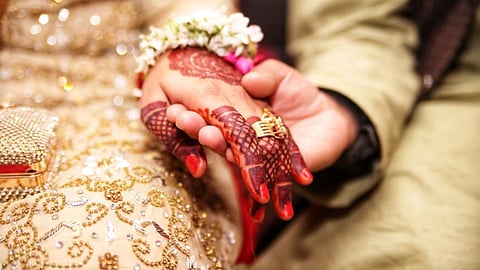
In a global world, when people plan Indian weddings, you must realise that these are ceremonies. They enact through a choreographed performance of what you desire. And that enactment is done in public. Walking together in seven steps, walking around the fire in seven steps, the knot tied publicly—these are all visual symbols of making two people one. Some steps are taken with the woman leading the man. At other times, it is the man leading the woman. There are no rules in partnership. You can walk ahead, behind, or side to side.
