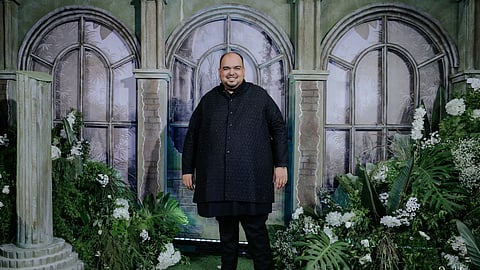
What began as a passion project, Kkings Events, today stands as one of the country’s leading names in luxury and experiential events but the journey into luxury weddings wasn’t a random one for Monil Shah, Founder and CEO of Kkings Events. Some people stumble into their calling, while others build it one perfectly planned celebration at a time. And for Monil it began with something deeply personal, planning his own wedding. Started alongside co-founder Karishma Mehta in 2014, Monil recognised an important gap in the industry that beautiful weddings often lacked structure, seamless execution, and a real understanding of what clients emotionally go through since they came from the very social circles they now cater to.
With that insight, he built Kkings Events on a foundation of precision, thoughtful planning, and strong systems. Today, while leading large-scale celebrations and sister concern Jackks Weddings & Events, Monil continues to shape memorable experiences, balancing creativity with calm leadership, something fatherhood has only strengthened over time.
Manifest: Kkings Events started while planning your own wedding. At what point did you realise this could become a serious business?
Monil Shah: We were earlier in the trade shows business, so events as a space were always familiar. The shift into weddings happened quite organically while we were planning most of our own wedding and later brought planners on board to execute it. Experiencing the process so closely from a client’s perspective gave us a very real understanding of the gaps that exist and the kind of challenges people face when planning their own celebrations.
Post the wedding, that realisation stayed with us. Around the same time, a couple of friends reached out asking us to plan their weddings. What started as simply helping them quickly felt like something much more natural to us.
That was really the turning point - it didn’t come from a calculated decision to start a business, but more from a sense of it being the right fit. And since then, there’s been no looking back.
M: What gap in the wedding industry made you feel there was space for a brand like Kkings Events?
MS: At the time, weddings were visually grand, but the experience behind the scenes was often unstructured and overwhelming for families.
There was a lack of seamless coordination across multiple stakeholders, and not enough focus on how the process actually felt for the client. We saw an opportunity to bring in clarity, systems, and a more intuitive understanding of the client’s perspective, while still delivering on creativity.
M: In the early days, what were some of the biggest challenges of turning a personal idea into a scalable company?
MS: The biggest challenge was building a structure in an inherently unpredictable space.
Weddings involve constant movement - multiple teams, last-minute changes, and high expectations. Translating that into something scalable meant developing processes, communication frameworks, and coordination systems that could handle that complexity.
It was a shift from reacting to situations to being able to anticipate and plan for them.
M: How has your role changed from being hands-on with execution to leading strategy and growth?
MS: In the early years, I was closely involved in every aspect of execution.
Over time, my role has evolved to focus more on strategy, team building, and strengthening the overall structure of the business. A large part of my work now is ensuring that we have the right systems and people in place to support growth.
That said, I continue to stay involved at key stages—especially in planning and decision-making—to ensure there is clarity and alignment across projects.
M: Weddings are high-pressure environments. What leadership lessons has the industry taught you over the years?
MS: One of the biggest lessons has been the importance of staying composed under pressure.
No matter how well you plan, there will always be variables you can’t control. Being able to think clearly, make decisions quickly, and keep the team aligned is critical.
It has also reinforced the importance of communication and empathy, because you’re working not just with logistics, but with people, emotions, and expectations.
M: Kkings Events is known for large-format luxury celebrations. What does executing scale without losing detail look like for you?
MS: For us, scale is really about how well everything is coordinated, not just how large the event is.
It requires a strong backend—clear timelines, defined roles, and teams that are aligned across functions. Every detail is mapped early, so that nothing is left to chance.
The goal is that, despite the complexity, the experience feels seamless and effortless for the client.
M: How do you balance creativity with structure in an industry that often prioritises aesthetics first?
MS: Creativity works best when it’s supported by structure.
From the beginning, we approach ideas alongside execution—so what we design is always grounded in how it will be delivered. This ensures there’s no disconnect later.
For me, it’s about ensuring that creative and operational thinking move together, allowing us to push ideas while still maintaining control.
M: What has been one of the biggest turning points in your entrepreneurial journey so far?
MS: A major turning point was transitioning from a founder-led setup to a system-driven organisation.
Building teams, defining processes, and creating a structure that could function consistently allowed us to scale more sustainably.
It also changed my role—from being execution-focused to thinking more about long-term growth and direction.
M: You identified a lack of seamless coordination in weddings early on. Do you think the industry has evolved since then?
MS: The industry has definitely evolved. There’s greater awareness today around planning, coordination, and overall experience.
Clients are more informed, and expectations are higher. However, as events become more complex, the need for strong systems and structured execution has only increased.
So while the industry has progressed, the challenge has also evolved alongside it.
M: What have been some of the biggest lessons in building systems for a business that thrives on creativity?
MS: One of the biggest learnings is that systems actually enable creativity rather than restrict it.
When there is clarity in processes and roles, teams can focus more on ideas instead of constantly troubleshooting.
The key is to build systems that are structured but flexible, allowing for adaptability without losing consistency.
M: With Jackks Weddings & Events focusing on Mumbai-based celebrations, how do you approach building distinct identities within the same group?
MS: The approach is very clearly defined in terms of how both brands operate.
Kkings Events focuses on large-format, destination-led, and more complex celebrations, including those in Mumbai that require a high level of planning, coordination, and overall expertise. Jackks, on the other hand, primarily handles Mumbai-based weddings and more contained formats, and also works on destination events where the client has already taken a strong lead on the creative direction and requires a team to execute and manage the experience seamlessly.
In that sense, both brands are quite distinct—not just like projects, but also in how they are run. The teams handling each are separate, allowing both to function with clarity and focus. You can think of them as two independent companies operating within the same larger ecosystem.
What ties them together is the foundation—shared systems, processes, and SOPs. That common backbone ensures consistency in quality and execution, while still allowing both Kkings and Jackks to grow in their own way without overlap or dilution of identity.
M: How much do global luxury and hospitality trends influence the way you think about Indian weddings today?
MS: They play a significant role, especially in how we think about guest experience and service.
Hospitality, in particular, has influenced the idea that the best experiences feel effortless, even when they are highly detailed behind the scenes.
That perspective increasingly shapes how we approach weddings—as end-to-end experiences rather than standalone events.
M: As someone leading a luxury events company, what do modern clients expect now that they didn’t a decade ago?
MS: Clients today still appreciate grandeur, but it’s no longer just about scale—it’s about how that scale is expressed.
There is a clear shift towards a more custom-built approach, where every element is thoughtfully designed rather than standardised. Clients are far more involved in the process and are looking for experiences that feel personal, intentional, and reflective of who they are.
At the same time, there’s a growing awareness around being more mindful and responsible. This could mean making more sustainable choices, optimising resources, or in certain cases, giving back to the local ecosystem—whether by working with regional vendors or incorporating local arts and crafts into the celebration.
So while luxury still holds its place, it is increasingly being defined by thoughtfulness, meaning, and a deeper sense of connection, rather than just visual impact.
M: Has fatherhood changed the way you lead teams or approach client relationships?
MS: It has brought a stronger sense of perspective and balance.
It’s made me more patient and more measured in how I approach situations, especially in high-pressure environments. That shift naturally reflects in how I work with both teams and clients.
It has also made me more conscious of creating a sustainable way of working, not just for myself but for the people around me.
M: Looking back at the last decade, what advice would you give someone trying to build a long-term business in the wedding industry?
MS: Focus on building strong foundations from the start.
It’s easy to prioritise the creative side, but long-term success depends on systems, consistency, and the ability to execute reliably.
At the same time, stay adaptable. The industry is constantly evolving, and being able to adjust while staying true to your core approach is what allows you to build something sustainable.
