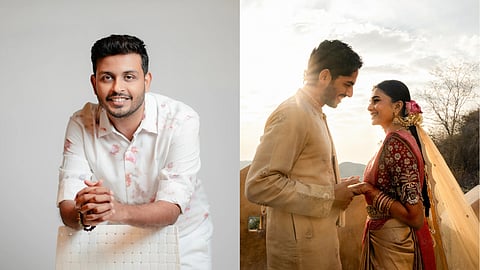

You can't ask Sabareesh Sankar to name the one wedding he's lensed and loves. That's beyond difficult for the young photographer who's become a name to reckon with. Having charted up success in India and abroad, he loves every single one.
For Sankar, his path has come full circle, first observing and picking up little nuances of the trade from his famous father, Venugopal Themadath, then hopping onto a completely different career and finally coming back to home ground—to get back into photography, and so successfully.
The co-founder and creative director of SDS Studio (1983) now carries the baton forward, as he captures stunning stories of what happens between the poses—the laughter after a joke, the way couples naturally look at each other, those quiet pauses and more. Manifest gets behind his lens, over an interesting chat...
Sabareesh Sankar (S): Every wedding leaves me with something to take back, especially because I intentionally photograph only a limited number of weddings each year. That allows me to invest my time in building genuine relationships with every couple rather than simply documenting another event. For me, those relationships are what ultimately shape the photographs.
It's difficult to pick just one because every wedding I've photographed over the past year has left a lasting impression on me in its own way. But if I had to choose one, it would be Akshay and Sujana's wedding in Udaipur.
From our very first conversation, I kept telling them that great photographs aren't created only by beautiful locations or beautiful décor—they come from trust and interaction. The more we understand each other before the wedding, the more naturally the story unfolds in front of the camera. They completely embraced that philosophy.
Sujana is someone who pays attention to every little detail. Everything—from the timelines to the colour palette and the overall guest experience—was thoughtfully planned. That level of planning made a tremendous difference to the way we could photograph the wedding. Because everything ran on time, we were able to make the most of the beautiful morning light for their couple portraits, and every key moment unfolded exactly when it needed to. It wasn't about creating perfect photographs through planning alone—it was about creating the opportunity for real moments to happen naturally, without feeling rushed, and that helped us tell their story in the most authentic and beautiful way possible.

What stayed with me the most, however, happened after the wedding.
While she was flying back to the US, Sujana sent me a heartfelt message. It wasn't just about how much she loved the photographs or the films. She reflected on the entire journey—from our very first call to the last day of the celebrations. She mentioned the little things my team and I did throughout the wedding, the care we took, and how valued and comfortable they felt during those few days.
As an artist, that kind of appreciation means more than any compliment about a photograph. It tells me that the couple cherished the experience just as much as they appreciated the final images. That's always my goal—to create an experience where people feel seen, understood, and cared for, because I truly believe that the best photographs are created when there's a genuine human connection behind the camera.
That wedding reminded me why I choose quality over quantity. When you invest in people, the photographs naturally become more meaningful.
(SS): I think it has evolved tremendously over the last decade, and I've had the privilege of witnessing that transformation closely because I grew up watching my father photograph weddings long before I entered the industry.
Years ago, it was common for photographers to meet the bride and groom for the first time on the wedding day. The focus was naturally on documenting the ceremony, the portraits, and the important family photographs. Those images are still incredibly valuable, but I believe today's wedding photography has become much more personal.
Today, it's less about photographing a wedding and more about documenting people. We spend time getting to know the couple long before the celebrations begin. We understand who they are as individuals, their families, their relationships, and the little things that matter to them. By the time we arrive at the wedding, it doesn't feel like we're working with clients—it feels like we're photographing the wedding of friends.
That changes everything.
When there's trust, people stop performing for the camera. The smiles become genuine, the emotions become honest, and the photographs begin to reflect not just what the wedding looked like, but what it actually felt like.
I often say that a wedding photographer has the privilege of seeing moments that even the couple and their families may never notice in real time. During those three or four days, they're completely immersed in the celebrations. Someone is laughing in a corner, a parent quietly watching their child from a distance, grandparents exchanging a glance, siblings sharing a private joke—these are the moments that often go unnoticed. Our role is to preserve those fleeting emotions so that years later, when they open an album or watch their wedding film, they don't just remember the events; they relive the feelings.
In many ways, wedding photography has shifted from documenting occasions to preserving memories and emotions.
Social media has certainly accelerated visual trends, and in many ways, that's been a positive change. It has opened doors that simply didn't exist before. Having started my journey in Kerala and now being based in Bangalore, I never imagined I'd one day be photographing weddings across India and around the world. Social media has made that possible by allowing people to discover our work beyond geographical boundaries.
At the same time, I don't believe we should create photographs simply to satisfy an algorithm or chase what's trending. Trends change every few months, but meaningful photographs don't.
For me, the responsibility of a wedding photographer is to portray people as they truly are—not as someone the internet expects them to be. The images should still feel honest ten or twenty years from now, when the couple sits down with their children and turns the pages of their wedding album.
If a photograph can still make them smile, pause, or even bring tears to their eyes years later, then I believe it has done its job. That's the kind of work I aspire to create.
(SS): For me, the unscripted moment is at the heart of wedding photography.
One of the first questions couples often ask me is, "How much of the wedding do you script?" My answer is always the same—I don't believe in scripting emotions. Instead, I believe in understanding people.
Long before the wedding, I spend time getting to know the couple. I want to understand who they are, how they met, why they've chosen to get married the way they have, and even why they've chosen a particular destination or venue. Every decision has a story behind it. Some couples feel connected to the mountains, others to the beach. Understanding those choices helps me understand the people behind them.
But when it comes to emotions, I don't think they can ever be scripted.
A candid moment doesn't happen because a photographer directs it. It happens because people forget the camera is there. Our job is to create an environment where they're comfortable enough to be themselves and then remain patient enough to observe what naturally unfolds.
I often say that observation is the greatest strength a wedding photographer can have. Cameras will continue to evolve, technology will keep improving, but no piece of equipment can replace the ability to notice a fleeting glance, a reassuring touch, an unexpected burst of laughter, or a quiet tear before it disappears. That comes only from being fully present.
Even during couple portraits, while we may give gentle direction, I'm never looking for perfectly posed photographs. I'm looking for what happens in between the poses—the laughter after a joke, the way they naturally look at each other, the quiet pauses, and the little imperfections that make the moment feel real. Those are often my favourite frames.
I enjoy creating editorial portraits, and I believe they have an important place in every wedding story. But if I had to choose the photographs that matter most, it would always be the unscripted ones, because they carry something that can never be recreated.
Years later, couples rarely remember how perfectly they stood. They remember how they felt.
If a photograph can bring back that feeling with complete honesty, then I believe it has fulfilled its purpose.
Photography has been a part of my life for as long as I can remember. I grew up watching my father photograph weddings, so the camera never felt like something unfamiliar—it was simply a part of our everyday life. Watching him work taught me something that still guides me today: wedding photography is as much about people as it is about photographs.
The idea of SDS Studio, however, began much later. Around 2010, when I had just started my Chemical Engineering degree, I began noticing a shift in the way weddings were being photographed.
It was no longer just about documenting ceremonies—it was becoming a way of telling stories and preserving emotions. That transformation fascinated me.
I found myself drawn not just to photography, but to understanding people, building relationships, and finding meaningful ways to tell their stories.
After graduation, I joined Infosys, where I spent three and a half years. Those years taught me discipline, professionalism, and the importance of building systems—lessons that have been invaluable in running a creative business. But alongside my full-time job, I continued photographing weddings whenever I had the opportunity.
Over time, it became clear where my heart truly belonged. In 2017, I made the decision to leave my corporate career and dedicate myself fully to building SDS Studio.
If there's one person who has inspired this journey the most, it's my father. More than photography itself, he taught me how to connect with people, how to earn their trust, and how to make them feel comfortable in front of the camera. Those lessons continue to shape the way I approach every wedding.
Today, that remains the foundation of SDS Studio. We don't just document celebrations—we invest time in understanding people and telling their stories with honesty, emotion, and authenticity. For me, that's what has always made this journey meaningful.
Absolutely. In many ways, I feel like my life in photography began in the darkroom.
Some of my earliest memories are of spending time in my father's studio, watching rolls of film being developed and photographs slowly come to life. Back then, it was simply part of everyday life for me. I didn't realize I was learning—I was simply observing.
Over the years, I've been inspired by many photographers, but the most valuable lessons I inherited from my father had very little to do with cameras.
So yes, growing up in that environment gave me a priceless first-hand education. It wasn't just about learning photography—it was about learning how to understand people. And I believe that has shaped me far more than any camera ever could.
I often hear stories of people leaving the corporate world because they didn't enjoy it. My journey was quite different.
I genuinely value my time at Infosys. In many ways, it shaped me just as much as photography did. It taught me professionalism, discipline, accountability, and the importance of building systems that allow people and businesses to grow. Those lessons continue to influence the way I lead SDS Studio today, and I'll always be grateful for that experience.
Even while I was working at Infosys, I continued photographing weddings on weekends and during my free time. Thankfully, most weddings took place over the weekends, which allowed me to balance both worlds.
Over those three and a half years, it became increasingly clear that photography had stopped being something I simply enjoyed doing. It had become the place where I felt most connected—to people, to their stories, and to myself.
Leaving Infosys wasn't about walking away from one career. It was about walking towards the place where my heart truly belonged.
In 2017, I made the decision to join SDS Studio full-time because I wanted to give it everything I had.
Looking back, I don't see my journey as moving from engineering to photography. I see it as bringing the best of both worlds together. Engineering taught me how to think systematically. The corporate world taught me how to build and lead a professional organisation. But storytelling gave me a purpose that felt deeply personal, and photography became the medium through which I could bring those stories to life.
Together, those experiences have shaped not just the photographer I am today, but also the storyteller and entrepreneur behind SDS Studio.
(SS): For me, the process begins long before I ever pick up the camera.
It starts with conversations. I spend time getting to know the couple—not just as clients, but as individuals. Whenever possible, I also like spending time with their families; knowing the family dynamics beforehand helps me understand the flow of the celebrations much better.
As the wedding approaches, I spend a lot of time pre-visualising the event. We discuss timelines, colour palettes, décor, lighting, and the overall flow of the celebrations. If possible, I visit the venue. Even if I've photographed there before, every wedding is different. The season changes, the light and décor change, and every couple brings a different energy to the space.
If something unexpected happens—a delay, a change in weather, or even rain—I encourage the couple to embrace it rather than worry about it. Weddings are beautifully unpredictable, and that's part of what makes every celebration unique.
Over the years, I've realised that what truly makes a difference isn't what happens on the wedding day alone—it's everything that happens before it.
That's why I believe wedding photography isn't just about documenting a single day. It's about preparing so well that, when the day finally arrives, I can be fully present, allowing the story to unfold naturally while focusing entirely on creating meaningful photographs that will stand the test of time.
(SS): I don't think it's easy—and that's exactly what makes it meaningful.
For me, visual imagery and honest emotion should never compete with each other. They should complement one another. A beautiful frame may capture someone's attention, but it's the emotion within that frame that gives it a lasting place in their memory.
I'm naturally drawn to beautiful light, thoughtful compositions, and meaningful details because they help elevate a story visually. But I've never believed that visual beauty alone is enough. If a photograph or a film looks beautiful but doesn't make you feel anything, then it has only done half its job.
Some of the most meaningful moments also aren't technically perfect. They're imperfect, unexpected, and deeply human. A quiet pause before a ceremony, a parent holding back tears, an uncontrollable laugh, or a moment of silence between two people—those are the moments that stay with us because they're real.
That's where I believe the balance lies. The visuals invite you into the story, but it's the emotions that make you stay.
Whether it's a single frame or a ten-minute wedding film, my hope is always the same—that years later, people won't just admire how it looked. They'll remember exactly how it made them feel.
To me, that's when visual storytelling has truly done its job.
(SS): Absolutely. Wedding photography has changed tremendously over the last four decades, and I've had the privilege of witnessing that transformation from a unique perspective. I grew up watching one generation of photographers, and today, I'm fortunate to be part of another.
When my father started, photography was about preserving moments. There were limitations in technology, every frame was carefully considered, and weddings were documented with a very different pace and approach. Today, we have incredible cameras, drones, cinematic filmmaking, AI-powered tools, and endless creative possibilities. Couples are also far more involved in every aspect of their wedding, so naturally their expectations from photography and filmmaking have evolved as well.
Recently, I also feel we're beginning to come full circle. I'm seeing more photographers—and more importantly, more couples—going back to what truly matters.
Sometimes I look at photographs made in the 1980s and 1990s and realise how beautifully they documented weddings. They may not have had today's technology or the reach of social media, so many of those photographs never received the recognition they deserved. Yet they possess an honesty and simplicity that still feels incredibly relevant.
I think there's a lot my generation can learn from that. Innovation is important, and every generation should find its own visual language. But timelessness is something we should never lose sight of.
For me, carrying forward four decades of tradition is about taking the values that have always mattered, embracing the possibilities of today, and creating photographs and films that will still feel meaningful decades from now.
To me, that's the true evolution of wedding photography.
(SS): I think today's global clientele has certainly raised the benchmark, but not necessarily in the way most people imagine.
It's not just about creating more luxurious photographs or cinematic films. It's about creating work that feels deeply personal and intentional. Many couples deeply value the creative process itself. They understand that photography and filmmaking are collaborative art forms and together we build something that's stronger than either perspective alone.
As an artist, that's incredibly fulfilling.
I also don't believe serving a global clientele means moving away from our roots. In fact, I think it's quite the opposite. The more international the audience becomes, the more they appreciate authenticity.
I wanted to create a studio where creativity and professionalism could coexist. Creatively, we've evolved tremendously over the years. We've embraced new technologies, refined our visual language, expanded our filmmaking approach, and had the opportunity to tell stories across different cultures and countries.
I've also always encouraged everyone at SDS Studio to remain curious. The wedding industry evolves constantly, and I believe growth comes from learning continuously.
But despite everything that's changed, one thing has remained exactly the same; the values on which SDS Studio was built.
If I look back at the last few years, I don't think the biggest transformation has been in the photographs or films we've created. It's been in the way we've evolved—becoming more intentional, more collaborative, and more thoughtful in everything we do.
For me, that's what leadership really means. It's about respecting the legacy you've inherited while having the courage to evolve it for the next generation.
If we become better storytellers for every couple, every brand, and every person who trusts us with their story, then I believe we're moving in the right direction.