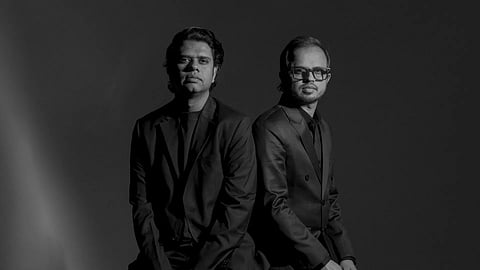

Some people document weddings, and then some turn them into a narrative that people will want to listen to. Rajesh Satankar and Sachin Patidar, the founders of Knotting Bells, belong to the latter. With their wedding photography and filmmaking brand, they have created not just a brand but an evolving archive of human connection, culture and fleeting emotion. The duo started Knotting Bells in 2014 and have since approached weddings as deeply personal, lived experiences where every glance, ritual and every pause carries a meaning.
Rajesh, with his background in social anthropology, brings a sense of stillness and sensitivity to the way moments unfold, allowing stories to emerge organically. While Sachin, shaped by his early years in the film industry, adds rhythm and narrative flow, crafting films that feel immersive yet honest. Together, they strike the perfect balance between observation and storytelling. A testament to their excellence in the field, their work has travelled across countries and cultures over the years. But what has remained unchanged has been the intent, that is, to capture weddings as memories in their most unfiltered and raw form and make them immortal in the most human way possible.
Manifest: What was the exact moment when you realised weddings were more than just events—they were stories worth documenting?
Rajesh Satankar: I started my journey learning fashion photography under Jatin Kampani sir, where I was working as an assistant and understanding the craft in a very structured, stylised way. Around that time, I got an opportunity to work on a wedding, and that experience completely shifted my perspective.
That’s when I truly understood the difference between fashion and wedding photography. Fashion is controlled, curated, and can be recreated. But wedding photography is raw, unpredictable, and deeply emotional. It’s not just about telling the story of a couple or a family, it's about capturing real moments as they unfold, moments that will never happen again. What drew me in was how personal and intimate it felt.
There are no retakes, no second chances; you have to be fully present, constantly aware, and ready to capture something meaningful at any given second. There’s an adventure in that unpredictability, and a responsibility that keeps you on your toes.
That energy, that connection stayed with me. I realised this is what truly resonated with me as a storyteller. And since then, there’s been no looking back. It’s been over a decade now of capturing weddings and telling stories that matter.
M: Rajesh, how did your background in anthropology reshape the way you see and capture Indian wedding rituals?
RS: Coming from a background in anthropology, the study of people and human behaviour, we've always been deeply drawn to emotions, relationships, and lived experiences. Weddings, in many ways, became a natural extension of that. It’s one of the rare spaces where you get to witness some of the happiest, most meaningful moments in people’s lives, almost every day. There aren’t many professions that offer that kind of emotional access, and it’s incredibly rewarding. That foundation also pushed us towards documenting stories more thoughtfully, and even towards writing, helping us build a deeper connection with the narratives we capture and the relationships that exist within them.
M: Sachin, coming from Bollywood, what did you have to unlearn to start telling real, unscripted wedding stories?
Sachin Patidar: Coming from a Bollywood background, one of the biggest shifts was unlearning the need for control. On a film set, everything is designed: the light, the space, the timing; it's all structured and scripted.
Weddings are the complete opposite. They’re raw, real, and entirely unscripted. Moments unfold without warning. You’re constantly navigating unpredictability, whether it’s light, space, or emotion, and yet, you have to deliver every single time. That transition taught me to rely less on control and more on instinct to stay present, adapt quickly, and trust the moment as it happens.
M: When you started Knotting Bells in 2014, what was the one belief you were absolutely stubborn about?
RS and SP: When we started Knotting Bells in 2014, one belief we were very clear about was staying true to our style. We didn’t want to follow trends or do what everyone else was doing just to fit in. We believed in telling stories in a way that felt honest, real, and personal to us. That meant taking our time, focusing on
moments over setups, and building a certain kind of storytelling that people could connect with. Even today, that belief hasn’t changed, to create work that feels true to us, and in turn, true to the people we’re capturing.
M: Wedding photography can sometimes feel repetitive—how do you keep each story feeling fresh and personal, even after 500+ weddings?
RS: That’s the beauty of wedding photography; while it may seem repetitive from the outside, it never truly is. We may return to the same locations multiple times, but every wedding brings a unique story of different people, emotions, cultures, and an energy of its own. Every couple and every family adds something new, making each experience distinct. At a technical level, some moments can feel familiar. But that’s exactly what pushes us to keep evolving. We constantly go back to our sources of inspiration, books, cinema, and everyday life to reimagine how we tell each story. That process keeps the creative energy alive, allowing us to create something fresh, personal, and meaningful every single time.
M: How do you strike a balance between being invisible observers and still capturing emotionally powerful moments?
SP: Striking that balance comes down to being present and understanding people. We see ourselves as observers first, letting moments happen naturally without interfering. The idea is to stay low-key, so people feel comfortable enough to be themselves. At the same time, capturing strong emotions needs instinct, knowing when to step in, when to step back, and when to sense what’s about to happen. It’s always a balance between being invisible and being aware. And over time, this instinct becomes the base of how we tell stories that feel real, personal, and honest.
M: Has there ever been a wedding that changed the way you approach your work? What shifted after that?
RS and SP: More than a single wedding, we believe it was the phase of COVID that truly shifted things for us.
Post-COVID, there was a noticeable change: celebrations became larger, more intentional, and far more experiential. The way people started investing in weddings reached a different scale altogether, and it transformed how the industry operates. We feel grateful to have witnessed and been a part of that evolution. At the same time, there have been certain weddings that have significantly shaped our journey and given our brand both visibility and direction, like Hina Khan & Rocky Jaiswal, Rubina Dilaik & Abhinav Shukla, and Suyyash Rai & Kishwer Merchant. These experiences not only gave us scale but also helped refine our vision as a brand.
M: In an industry that often leans towards highly curated and staged content, how do you protect authenticity?
SP: We do have a certain style that we follow, and for us, it’s always about a vibe check with the couple. We naturally connect with people who understand and resonate with our way of working and that makes a big difference. When that alignment is there, the entire process becomes much smoother and collaborative. It allows us to create more honestly, because there’s trust, comfort, and a shared vision from the start.
M: What does a “perfect shot” mean to you today—and how has that definition evolved over the years?
RS: For us, a perfect shot is technically strong, aesthetically pleasing, and emotionally present. Composition matters, and we do pay attention to details. At the same time, we also understand that we are just the creators in that moment. The real definition of a “perfect shot” comes from the couple's feelings when they see it. If it makes them happy, it automatically becomes perfect for us.
While styles, equipment, and creative approaches keep evolving, what never changes is the reaction, the smiles, the emotions, and the joy couples feel when they see their photos for the first time.
M: How do you build trust with couples so they let their guard down in front of the camera?
RS: Building trust is not a mechanical process; it happens naturally over time. You won’t connect with everyone, and often the first call itself tells you if the vibe matches. For us, it starts with being authentic in how we present ourselves and in our work. When you’re honest with your craft, it reflects, and people can sense that. At the same time, building that confidence is important. We usually connect multiple times before the wedding, share ideas, and work on moodboards together. By the time we’re actually there, it doesn’t feel like strangers working together; it feels like we truly understand their vision and can bring it to life.
M: Knotting Bells feels like a collective, not just a company. How do you nurture individuality within your team while maintaining a consistent visual language?
RS and SP: Photography, especially in the wedding space, is a deeply creative and collaborative process. In India, weddings often require larger teams, sometimes 8 to 10 people and each individual brings their own perspective and way of seeing. As a brand, it becomes important for us to establish a clear visual language and sensibility that everyone aligns with. At the same time, we don’t believe in restricting individuality. It’s about guiding the team to understand the Knotting Bells approach, while still allowing them the space to interpret moments through their own lens. That balance between consistency and creative freedom is what helps us deliver work that feels cohesive, yet rich with diverse perspectives.
M: What are the biggest misconceptions people have about wedding photography and filmmaking?
RS and SP: One of the biggest misconceptions about wedding photography and filmmaking is that it’s just about showing up and capturing what’s happening. In reality, it goes far beyond that. It requires constant awareness, anticipation, and the ability to make creative decisions in real time often under unpredictable conditions. There’s also a perception that everything can be “fixed” in post-production. But the truth is, the foundation of a strong image or film is built in the moment through light, composition, timing, and emotion. What’s often overlooked is the importance of building a genuine bond with the couple.
Understanding who they are, their dynamic, and what matters to them allows us to tell their story more honestly and meaningfully. Without that connection, the work can feel surface-level but with it, the storytelling becomes far more personal and real.
M: How do music, travel, and culture influence the way your stories unfold visually?
SP: At its core, we believe the language of art is universal; only the medium of expression changes. Whether it’s painting, music, or photography, the emotion it evokes remains the same. As photographers, the more we see, experience, and explore, the more we’re able to bring into our work. Music, for instance, plays a huge role being musically aware deeply influences how we approach wedding films, shaping their rhythm, mood, and overall cinematic vision. The same applies to photography. Exposure to different cultures, locations, and spaces constantly inspires us to create something new. It pushes us to think beyond the obvious and evolve our storytelling. Without that exploration without stepping outside our usual world it’s easy to feel creatively limited. For us, that continuous intake of experiences is what makes wedding photography feel complete and ever-evolving.
M: What has been the most challenging phase in your journey as founders and what did it teach you about building a creative business?
RS and SP: We truly believe that the journey has been guided with a lot of grace. There’s immense gratitude for every person we’ve crossed paths with and each one has played a role in shaping who we are today as Knotting Bells. While there haven’t been specific challenges that define our journey, phases like COVID were undeniably tough. But even in those moments, we’ve always chosen to stay optimistic. For us, every challenge comes with a learning curve. It’s about adapting, growing, and finding perspective—and that mindset has helped us move forward, stronger each time.
M: Looking ahead, how do you see the future of wedding storytelling evolving and where does Knotting Bells fit into that vision?
RS and SP: Every wedding season brings with it new learnings. Trends evolve, and so do the expectations of couples which keeps us constantly adapting. If we look back at 2015–16, deliverables were largely focused on printed albums and highly saturated imagery. Today, the aesthetic has shifted towards more muted, timeless tones. At the same time, there’s a growing appreciation for nostalgia—with couples gravitating towards analogue film, embracing photographs that are captured as they are, without the possibility of heavy edits. That constant shift is what keeps the process exciting. It pushes us to keep learning, keep evolving, and most importantly, stay relevant while still holding onto authenticity.
