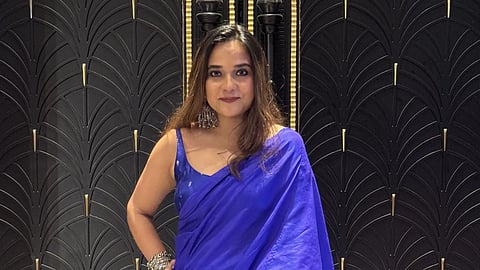

In a landscape where luxury weddings often follow a set pattern and familiar formulas, DB and Spaces make a niche of its own with its deeply personal celebrations that are equal parts immersive and emotionally resonant. Led by Dakshita Bhatla Gangola, DB and spaces is an Uttarakhand-based wedding planning and design house that seeks to redefine how couples and their guests perceive modern Indian luxury.
Rooted in the hills she calls home, Dakshita’s journey into the wedding industry was not shaped by legacy networks or metropolitan advantage, but by instinct, storytelling, and an unwavering commitment to authenticity. What began as a passion project for Dakshita took a steep flight upwards in just a few years and evolved into one of India’s most trusted names in the world of wedding planning and designing. With several honours and national acclaim, including the recognition at the WeddingSutra Influencer Awards, DB And Spaces has become synonymous with celebrations that are thoughtful and place emotion, personality and immersive guest experience at the heart of every wedding.
Manifest: You began your journey in Uttarakhand, away from the traditional luxury wedding hubs. What first drew you to wedding design as a form of storytelling, and how did those early beginnings shape the philosophy behind DB And Spaces?
Dakshita Bhatla Gangola: For me, life has never unfolded in half measures. It’s been a spirited ride- vivid, intentional and driven by a quiet fire to create beauty with meaning. The calling to design and plan weddings arrived with a personal milestone: my own wedding. What began as a bride’s eye for detail soon transformed into a full-time pursuit of crafting memories for others.
The real high has always been the journey itself. Whether it was during the time in architecture, where the days were about dreaming up structures and the nights were about planning the spaces or in a corporate setting, absorbing every lesson the boardroom had to offer - I have always met the moment with all my whole self. Every phase has been a crescendo.
Today, as the founder of DB And Spaces, I lead with intention- to outdo myself daily, to build something better than yesterday. The present is alive with purpose, and the future? It’s simply a reflection of the consistency I strive for, day in and day out. Because when you’re building dreams for others, the only way forward is to stay high-spirited, hands-on and endlessly inspired to create more.
M: Building a wedding design house from the hills to becoming one of India’s most trusted names is no small feat. At what point did you realise DB And Spaces was no longer just a passion project but a defining creative calling?
DB: There wasn’t a dramatic moment where everything suddenly changed. It was quieter than that.
I had already spent years building myself before DB And Spaces even existed. I studied Architecture at eighteen, learnt how to think in scale and structure, and later stepped into corporate management where I understood systems, teams and business. I have always done things fully, never halfway. Whatever I choose, I go all in.
The real shift happened during my own wedding. When I came back to Uttarakhand to marry a mountain boy, something felt different. Planning that week did not feel like a task. It felt natural. I was obsessing over fabrics, lighting, menus, the way the mountains would frame a ceremony, and I was not tired. I was energised. I realised I was not just planning an event. I was designing an experience.
After that, my friends trusted me with their weddings because they had seen what I had created. Those first few celebrations were intimate and emotional. I cared deeply, maybe too deeply, about every single detail. Slowly, without me announcing it to myself, this stopped being something I was trying.
It became the way I think. The moment I began building a team, shaping a design language, and seeing clients trust us with their biggest days, I knew it was no longer a side passion. It was what I was meant to build.
DB And Spaces was not born out of a strategy. It was born out of alignment. I recognised it as a calling the day I realised I could not imagine doing anything else with this much conviction.
M: Your work feels deeply immersive and emotionally layered. How do you translate a couple’s personality and love story into a spatial, sensory experience rather than just a beautiful setup?
DB: For us, it always begins with knowing them. Not just their favourite colours, but their story. What shaped them? What moves them. What they never want to see on their wedding day. The no-nos matter as much as the dreams.
Architecture has trained me to design for the end user, not for applause. So when we translate love into space, it becomes deeply personal. If a couple has travelled through Europe and feels connected to that memory, we might reinterpret a mandap through modern Roman pillars, not as a trend, but as a reflection of a place that changed them.
If they describe their love as fluid, effortless, wind-like, we avoid rigid symmetry. We design forms that move, drapery that breathes, structures that feel like they are unfolding rather than standing still.
But none of this comes from guessing. It comes from listening. From understanding their rhythm, their comfort, and their boundaries. A wedding should not feel decorated. It should feel like you are walking inside their love story.
M: Having grown up in Uttarakhand, how has the landscape, culture and rhythm of the hills influenced your design sensibility and aesthetic language?
DB: It was only after my wedding in Uttarakhand that I truly felt what the mountains do to you.
There is a silence in the hills that stays with you. A kind of strength that doesn’t need validation. When you stand there, surrounded by something so vast and ancient, you automatically become softer. More aware. More careful.
That changed the way I design. The mountains don’t need decoration. They need respect. And when you respect a place, you don’t try to overpower it. You work with it. You let the sky be part of the ceiling. You let the wind move through your fabric. You choose tones that sit gently against the landscape instead of fighting it.
Uttarakhand taught me restraint. It taught me that scale can exist with sensitivity. That grandeur does not have to be loud. That beauty feels strongest when it belongs.
Even today, whenever we design in the hills, we carry that same feeling. A quiet responsibility. A promise that whatever we build will honour the land it stands on.
Because when nature gives you that kind of backdrop, you don’t compete with it. You rise gently beside it.
M: Is there a particular wedding you’ve designed that holds a special place in your heart—perhaps one that challenged you creatively or moved you personally?
DB: Many weddings stay with me. It is impossible to choose just one, because every celebration carries a piece of someone’s life.
But I remember one moment very clearly. A bride once showed us a place that meant everything to them, the space where they had spent most of their time together. It was not extravagant. It was simply theirs. We studied it carefully and recreated that exact structure as their mandap at a destination wedding. Of course, it was layered with luxurious florals and detailing, but the soul of it was memory. When they walked into that space, it was not just beautiful. It was familiar. That feeling is difficult to describe.
Then there was a bride who wanted to dissolve into her palace backdrop rather than stand apart from it. She was not concerned about competing with the décor or being the loudest element in the room. She knew her love would shine anyway.
For her, we draped over 2000 metres of fabric across the palace façade, added floor lamps and reflective mirrors so the light would move softly through the night. It felt cinematic, almost dreamlike, but still intimate.
These are the weddings that stay. Not because of scale or flowers, but because of trust. Because someone allowed us into their story and we were able to translate it honestly.
Some designs fade with time. Some stories stay in the heart forever.
M: When you begin conceptualising a wedding, where does the process start for you—with the couple’s story, the destination, cultural rituals, or an instinctive visual direction?
DB: For me, it never starts with just a visual. It starts with alignment. The couple’s story and the destination have to speak to each other. You cannot create beaches in the mountains. You cannot force a desert mood into a forest. The landscape has its own language, and the story has its own rhythm. My job is to make sure they belong together.
Once that alignment is clear, everything becomes more honest. The emotion of the couple, the cultural rituals, the mood they want to hold, all of it begins to sit naturally within the destination instead of fighting it.
From there, I move into space planning. Guest count is not a logistical detail for me; it shapes the entire experience. Will the ceremony feel intimate or expansive? Will the energy feel contained or flowing? The scale of the venue must hold the number of people comfortably. If a space cannot breathe with the guest count, the design will never feel right, no matter how beautiful it is.
So the process is layered. Story and destination first. Then space and movement. And only after that do visuals start to take form.
Because a wedding should not just look good. It should feel right in the place it stands and for the people it is created for.
M: What kind of conversations do you have with couples before you begin designing? What are the insights you look for that help you create something truly personal rather than trend-driven?
DB: Before we begin designing, we don’t start with décor. We start with conversations.
We ask how they met, what part of their journey feels defining, and whether there’s a memory or location they want reflected in the wedding. We ask them to describe their relationship in one word and how they want that word to feel in space. Intimate. Expansive. Playful. Grounded.
We talk about their personal preferences in depth. What they love. What they are tired of seeing. What they absolutely do not want. We explore aesthetics, but through emotion. Do they lean toward timeless or current? Minimal or layered? Rich textures or softer palettes? Do they want dramatic lighting and scale, or something understated and elegant?
We also discuss guest experience. How do they want their guests to feel from arrival to farewell? Do they want mingling and movement or calm and structure? How important are rituals, traditions, or personal vows? Are there heirlooms, quotes, music, or cultural elements that must be woven in?
At the same time, we study practical alignment. Guest count. Venue scale. Flow of movement. A space must hold the number of people comfortably and feel intentional, not forced.
What we are truly looking for are emotional cues. Repeated words. Shared values. The moments when their energy shifts while speaking. That is where the real brief lies.
M: Could you walk us through the journey of planning and designing a high-profile influencer wedding—from the first meeting to the final guest experience?
DB: For us, whether it is a celebrity, an actress, or a digital creator, the first thing we remind ourselves is this. When they sit across from us, they are simply our bride and groom.
Their families are like any other family. Protective, emotional, excited. They want their children to have the most beautiful beginning. So the first meeting never feels intimidating. It feels warm. It feels like trust, because they are placing one of the most important days of their life in our hands.
With weddings like Surbhi Jyoti’s, Aashna Hegde’s, or Sejal Kumar’s, the brief was never about spectacle. It was about making it memorable. About creating something that would feel timeless years later.
The layers, however, are different. There is far more coordination. Beyond planning and design, there are bridal stylists, content teams, photographers with large audiences, PR alignments, and sometimes brand integrations. Every frame matters. Every angle is documented. So we plan not just for the guest experience, but also for how the wedding will live on digitally.
Even with all those layers, the core remains the same. We begin with their story. We align the destination with their personality. We design spaces that photograph beautifully but feel even better in person. We ensure the flow is seamless so nothing feels staged or stressful.
There is also a deep sense of collaboration. These brides trust their teams completely. Stylists, makeup artists, and content creators bring their own strength, and that synergy elevates the outcome.
By the time guests arrive, the experience should feel effortless. From hospitality to ceremony to after party, everything moves naturally. The world may be watching, but for them, it should still feel intimate.
Because no matter how many followers or cameras are involved, at the centre of it all are two people beginning their life together. And that is what we protect the most.
M: You were entrusted with the weddings of creators like Aashna Hegde and Sejal Kumar. What are the unique expectations and pressures that come with designing celebrations for public figures?
DB: Designing for public figures definitely comes with pressure, and it is something the entire team feels.
With creators like Aashna Hegde and Sejal Kumar, the expectations were layered. It was not just about planning a wedding. Multiple teams were working alongside us. Bridal stylists, content creators, photographers, and PR alignments. Everyone had a role, and everyone was working closely, often in real time.
The expectation was always to create something deeply personal. Just because they are public figures does not mean the wedding becomes a performance. In fact, it becomes more important that it reflects who they truly are. At the same time, their audience connects with them emotionally, so the celebration naturally carries a larger narrative. It will be seen, shared and remembered beyond the guest list.
That is where the balance comes in. We focused strongly on their journey with their partners. The design was never built around virality. It was built around meaning. We maintained extremely clear timelines and constant communication with all teams involved. Site updates, layout changes, lighting discussions, entry sequences, everything was shared transparently, so there were no surprises.
Many ideas are always discussed in such weddings, but what truly matters is execution. That is where the real pressure lies. Translating vision into reality, on time, without chaos, while ensuring the couple feels calm and protected.
In the end, the pressure becomes manageable when you remember that this is still a wedding. Two people, one commitment. If we protect that core and execute with precision, everything else aligns.
M: DB And Spaces was among the most awarded brands at the WeddingSutra Influencer Awards. How did that recognition impact your journey—both creatively and professionally?
DB: For two years in a row, we applied. We showed up. We travelled there with hope. We sat in that room, listening to names being announced, watching peers walk up to the stage. And each time, we returned with a quiet promise to ourselves. Next year.
It was never just about décor. Or design. For us, it was about planning and design together. The way we build structure behind the scenes. The way we hold timelines, logistics, guest experience, and emotion with equal importance. So, when we applied, we were presenting not just beautiful images, but the entire ecosystem we create around a wedding.
By the third year, when our name was finally called, it felt deeply personal. It felt earned. It felt like the industry had acknowledged both our creativity and our discipline. The sleepless nights. The spreadsheets. The site visits. The production rehearsals. The emotional labour. All of it.
Creatively, it gave us the courage to keep trusting our own voice. To design spaces that are immersive and intentional, not trend-driven. Professionally, it strengthened our credibility. Clients saw us not just as designers, but as planners who can execute at scale with precision.
But what stays with me most is the journey. Showing up consistently. Improving every year. Refining both our planning systems and our aesthetic language. Not giving up when recognition did not come immediately. Sometimes growth is not loud. It is steady. And when recognition finally arrives, it does not feel like luck.
M: Luxury weddings today are less about opulence and more about experience. How do you ensure that every element—from décor to guest flow—feels immersive and intentional?
DB: Luxury today is not about excess. It is about intention. For us, the keyword is customised and personalised. Opulence does not have to scream. It can sit quietly in the details.
We begin with the guest experience. From the moment they arrive, they should feel seen and valued. A seamless check-in, a warm welcome, thoughtful room drops, hospitality that anticipates needs before they are spoken. When guests feel cared for, the experience already feels elevated.
Then every function must carry a part of the couple’s story. Décor is not isolated. It speaks. It can be as intimate as custom coasters with their pet’s paw prints, or as grand as a mandap conceptualised around the idea of infinite love. It can be reflected in the colour palette, the textures, the lighting, even the way the entry unfolds.
We are constantly thinking about flow. How guests move from one space to another. Where conversations naturally form. Where the energy builds and where it softens. Immersion is created when nothing feels abrupt or disconnected.
Even giveaways are curated thoughtfully. Not just luxurious, but meaningful. Something guests will remember, not discard. When every element carries intention, from the smallest detail to the largest structure, the wedding stops feeling like an event. It feels like a world built around two people and everyone they love.
M: Destination weddings, especially in nature-rich locations like Jim Corbett or Mussoorie, come with their own design language. How do you work with the environment rather than overpower it?
DB: Destination weddings in places like Jim Corbett or Mussoorie demand humility first, creativity second. These landscapes already have scale. The mountains, the forests, the mist, the riverbeds. You cannot compete with that. You have to collaborate with it.
Having worked across multiple cities before building here, I understood what can be delivered sensitively in the mountains and what should never be attempted. We consciously filled that gap. Bringing the polish and precision of city-scale production but executing it in a way that respects the terrain, the wind pressure, the light, the access limitations, and the natural palette.
For us, story and destination must align. You cannot create beaches in the mountains. The couple’s narrative has to sit honestly within the landscape. If they are grounded and intimate, the design leans softer. If they are bold, we interpret scale without blocking the view. The mountains must remain visible. The sky must remain part of the ceiling.
We also design with movement in mind. How the wind will flow through drapery. How sunlight will hit the mandap at a certain hour. How guests will move across lawns without disturbing the natural rhythm. Guest count shapes space planning deeply, because a venue must breathe with the people inside it.
Restraint becomes powerful here. Instead of overpowering nature with heavy décor, we layer thoughtfully. We enhance vantage points. We frame views. We let reflective surfaces capture the landscape rather than replace it.
In nature-rich destinations, design is not about adding more. It is about knowing when to stop. Because when the mountains are your backdrop, the most luxurious thing you can do is honour them.
M: What has been the most demanding or unexpected design brief you’ve received so far—and how did it push you to evolve as a creative leader?
DB: One of the most defining briefs we’ve received was not demanding in the traditional sense, but extremely particular.
The couple knew exactly what they did not want. They were clear about scale, tone, proportion, even how they wanted the wind to move through the space. Every element had to feel intentional. Nothing ornamental for the sake of it. Nothing that looked “done before.”
That kind of precision pushes us.
When a client is that particular, you cannot rely on formulas. You cannot fall back on safe design references. You have to sharpen your thinking. We revisit proportions. We rework layouts multiple times. We question symmetry. We study how light will fall at a particular hour. We test materials, textures, and heights. The margin for “almost right” disappears.
It pushes us to evolve as creative leaders because we have to hold both vision and flexibility at the same time. We guide the team with clarity, align vendors to a very tight aesthetic language, and ensure that perfection does not compromise practicality.
Those briefs stretch us in the best way. They demand depth. They demand patience. They demand conviction.
And every time we come out of one of those weddings, we realise we have raised our own standard.
M: Today’s couples want deeply personalised celebrations. How does DB And Spaces balance individuality with timelessness, ensuring the wedding doesn’t feel trend-led or dated years later?
DB: Personalisation and timelessness are not opposites. The balance comes from what we choose to personalise.
Trends usually sit on the surface. Colours of the season. A certain floral style. A viral entry idea. If we design only around that, the wedding will always feel dated later.
So, we begin deeper.
We personalise through story, not fashion. Through meaning, not momentary aesthetics. A mandap inspired by a place that changed them. Custom details that reference their shared memories. A ceremony layout that reflects how they actually connect. These things never go out of style because they belong to them.
At the same time, our structural language remains timeless. Proportion, scale, symmetry or intentional asymmetry, material quality, lighting depth. Architecture has trained us to think long term. Good spatial planning and thoughtful composition will always age well.
We also practice restraint. Even when we experiment, we anchor the design in neutral foundations and elevate through layered detailing rather than overwhelming themes. That way, when they look back ten or fifteen years later, they see themselves. Not a passing trend.
For us, the question is simple. Will this still feel like you a decade from now? If the answer is yes, then we know we have found the balance.
M: Finally, what advice would you give to couples who want their wedding to feel emotionally authentic and memorable—not just visually spectacular?
DB: In the middle of wedding planning, it is very easy to get lost in the material side of it all. Shopping lists. Trousseau fittings. Packaging details. Guest logistics. Travel plans. Mood boards. Calls. Meetings. Budgets.
Everything becomes about doing. My advice to couples is this. Pause.
Before you decide on the flowers or the outfits, sit together and remember why you are doing this. Talk about your first conversations. Your awkward beginnings. The moment you knew this was it. Those memories are the real foundation of your wedding.
In our planning and design meetings, we intentionally bring the focus back to emotion. We ask about their journey. Their firsts. Their struggles. Their quiet victories together. Because when couples get busy, they sometimes drift into execution mode. We gently pull them back to meaning.
A wedding that feels authentic is not built by adding more. It is built by remembering more.
If you hold on to your story, everything else falls into place. The décor will have depth. The rituals will feel real. The guests will sense something genuine.
Visual spectacle fades. Emotion stays. And years later, what you will remember is not the scale. You will remember how it felt.
