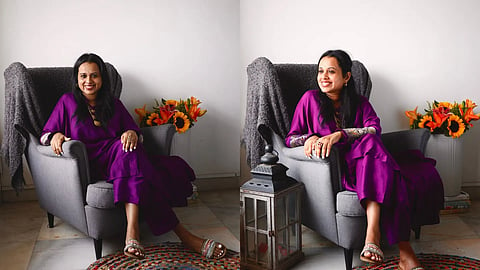
A civil engineer by degree, Ranjani Iyengar, the founder and creative force behind Pink Whistle Man, carved out her own niche and her own space in the world of bespoke invitations and stationery. With a background in software engineering, her career has moved fluidly across UI/UX and corporate marketing, offering her experiences that shaped her understanding of structure, communication and visual language.
Ranjani’s shift toward independent designing began at the time when she designed her own wedding stationery. The process sparked her deep interest in storytelling through tangible design. What was initially a side project soon grew into a full-time practice. In the present times, Pink Whistle Man is widely recognised for its layered narratives, material exploration and the detail-led execution, with their projects spanning weddings and personal commissions. Ranjani believes in continuously learning and evolving herself through different programmes, allowing her work to grow beyond convention whilst staying rooted in emotion and intent. Today, her work has become one of the most celebrated in the industry. From Radhika Merchant’s wedding invitation to projects with Alanna Pandey, Jaydev Unnadkat, Luv Ranjan, Bejoy Nambiar, and Vaibhavi Merchant, each collaboration has been its own masterclass in detail, time pressure, and pushing creative boundaries.
Manifest: What first drew you to design as a form of storytelling, and how did those early experiences—engineering, software, and corporate marketing—shape the way you approach creative work today?
Ranjani Iyengar: Design has always been an integral part of my life, as far back as I can remember. Growing up, I was drawn to different forms of painting and creative expression. As a child, I would customise jewellery using fishnets, create and sell perfumes in my neighbourhood, and design my own packaging for them.
My time in engineering and software companies introduced me to the world of digitising art and opened up new avenues in user interface design. It also helped me bring creativity into more structured spaces, like enhancing presentations and internal communications. Over time, the blend of logic and creativity began to truly resonate with me and shape the way I approach design today.
M: You once balanced a full-time corporate career with a growing passion project. What finally gave you the confidence to take Pink Whistle Man full-time, and how did that shift change your relationship with creativity?
RI: While I was balancing both, Pink Whistle Man was more of a hobby, with relatively low stakes. I was experimenting with ideas for friends and family.
Once I moved into it full-time, the pressure to establish trust became much greater. I realised that you are only as good and as reliable as your most recent work—a belief that continues to drive me today. It pushes me to keep upskilling, constantly reinvent myself, and remain completely open to learning new skills, much like a fresher.
M: Pink Whistle Man was born from designing your own wedding stationery. How did that deeply personal moment alter the way you understood emotion, ritual, and storytelling through paper?
RI: Designing something with such deep emotional value was an unparalleled experience. Although I had already spent three years working in design and marketing within corporate communication, this process sparked something entirely different in me.
The joy of creating something tangible and watching it come to life from a conceived idea felt incredibly rewarding. Starting with a blank slate and discovering what we wanted the invitation to represent was exciting. The research that went into selecting paper, textures, and materials was also extremely informative and enriching.
M: Your work feels rooted in nostalgia yet informed by global perspectives. How did you arrive at this blend of personal memory and contemporary design language?
RI: Since I’ve never been formally trained in design, I tend to lead with feelings—how a design makes me feel, how certain fonts or colours resonate emotionally with me. I don’t rely on theoretical knowledge to guide my work. While I enjoy learning new design skills, I don’t restrict myself to rules.
When I begin creating, I try to understand what the client is feeling and how those nuanced emotions shift when they speak about details that truly matter to them. This often helps form a bond with the client, allowing me to draw from their experiences in a deeply personal way.
M: Do you have a personal favourite project or invitation suite—one that holds a special story, challenge, or emotional memory for you?
RI: There are so many personal favourites. One that stands out from the recent past was a wedding we worked on for a Jamaican–Indian couple, where the journey with the family lasted nearly a year. They had an incredibly chic sensibility and a strong eye for detail, yet were also some of the most relaxed people I’ve worked with.
They truly embodied what weddings should stand for—eating well, loving deeply, and making merry. The entire process was fun and exciting, and we ended up creating many products that were playful and full of joy.
M: When you begin designing stationery for milestone celebrations like weddings, where does the process start—with the couple’s story, cultural cues, or your own instinct?
RI: The process varies each time and doesn’t follow a fixed structure. One constant, however, is informal dialogue with the couple, which sets off my instincts. Their likes and dislikes naturally begin to emerge.
I usually let these conversations simmer for a week or two, until a theme that truly excites me begins to take shape.
M: What kind of insights do you look for when speaking with couples or families before translating their story into a tactile design narrative?
RI: Emotions are intangible and difficult to contain in a single solid form. I pay close attention to metaphors within their stories and enjoy incorporating idioms or phrases that capture the essence of the couple. The more verbal the narrative becomes, the easier it is to associate it with tangible references that can shape the concept.
M: Could you walk us through the journey of creating a high-profile wedding invitation—from the first conversation to the final printed piece?
RI: Our initial conversations are largely listening-centric until the client begins to trust our ability to deliver. Once that trust is established, we’re able to expand our vision and ideas together.
In the majority of high-profile weddings we’ve worked on, we’ve used new and unconventional materials beyond paper. We push boundaries while recommending ideas and collaborating with artisans from different parts of the country to begin sampling concepts. In most cases, the final piece is a combination of several elements, assembled as individual units into a cohesive whole.
M: Your work often balances tradition with experimentation. How do you honour cultural rituals while still pushing creative boundaries?
RI: There is always a fine line when respectfully blending rituals with new ideas. For example, one of our wedding themes was Poetry in Motion, where each ritual and function was interpreted through art forms inspired by famous vintage poems.
M: From Radhika Merchant’s wedding to collaborations with filmmakers and artists, your projects often come with immense expectations. What are the unique pressures—and rewards—of working at that scale?
RI: The pressure of working on larger-than-life weddings is immense. I’ve noticed that whenever we work under extremely intense deadlines, projects, and requirements, the process can be deeply uncomfortable—but the outcome is transformative.
The level of metamorphosis that occurs during these projects feels like compressing a five-year design degree into a single month. The learnings, pitfalls, challenges, and the need to think on your feet and find solutions all happen at a rapid pace. Necessity truly becomes the mother of invention, pushing us to learn and create things we might never have attempted otherwise. While it comes with its share of stress and sleepless nights, the result is incredibly rewarding.
M: Design plays a central role in shaping how weddings are experienced long before the day itself. How do you see Pink Whistle Man reimagining that pre-wedding narrative for today’s couples?
RI: Invitations often become the first step in the wedding-planning journey. They sometimes end up setting the foundation for the overall design language—informing décor choices and, at times, even influencing outfits.
M: How do you approach destination or cross-cultural weddings differently, especially when multiple traditions and audiences come together in one celebration?
RI: I don’t see a clear distinction in how we approach cross-cultural weddings. India itself has so many micro-cultures, and we treat every wedding and couple with the same level of attention, focusing on micro traditions as well as the couple’s individual personalities and emotions.
M: What has been the most unusual, demanding, or unforgettable design brief you’ve received so far—and how did it push you creatively?
RI: Most of the time, we work with very well-informed clients who are deeply versed in design, have a strong appetite for experimentation, and are highly aware of existing trends. They often come to us with briefs that aim to push the envelope. This has led us to create invitations such as Letters from an Orange Tree, a Time Machine invite, a Frozen Garden Box, and a Sculpted Box, to name a few.
More recently, one client wanted something three-dimensional and completely unseen. We decided to create a sculpted box, which pushed us to explore and figure out highly unusual elements in a creative way.
M: Today’s couples seek deep personalisation rather than templates. How does Pink Whistle Man translate individuality into something timeless rather than trend-led?
RI: At Pink Whistle Man, individuality always comes before trends. We begin by listening—understanding the couple’s emotions, stories, and the nuances that matter most to them. Rather than relying on templates or what’s currently popular, we translate these personal narratives into tactile ideas, materials, and forms that feel authentic to the couple.
By grounding each design in emotion and meaning, the work naturally becomes timeless, because it reflects who they are—not a momentary trend.
M: Finally, what advice would you give to couples who want their wedding stationery to feel meaningful, memorable, and truly reflective of who they are?
RI: I would say—look around and get inspired if you like, but don’t let that bind you. Be open to creating something personal, without inhibitions. Couples who come in with a sense of surrender to the process often end up with the best results.
It’s also helpful to do some background research on the designers you’re approaching, so you can build trust from the very beginning.
