
Few fine-dining establishments can lay claim to creating upwards of 2,300 dishes over the course of just five years. Even fewer possess the conviction and creative stamina to rebuild their menu over and over again (sometimes weekly, often monthly), with subtle tweaks or entirely new ideas. "Change is the only thing which is constant here," chef Johnson Ebenezer states. At the helm of this philosophy is mother nature. Beyond the perimeter of the kitchen lies an expansive farm that he and his team of talented young chefs often peruse to discern exactly what ingredients they’d be working with that day. A dish that once dressed in the bright red of a tomato could take an orange turn if carrots seem particularly fresh that week. This operating system has lent the establishment the reputation of being one of India’s most distinctive dining experiences.
Now in its fifth year, Farmlore didn't begin as a restaurant. Entrepreneur Kaushik Raju first imagined a space where food could tell stories back in 2012. But it wasn't until chef Johnson Ebenezer joined him in 2019—bringing on chefs Mythrayie Iyer and Avinnash Vishaal—that the concept, then called Lore, took shape. Back then, the team would design custom menus for birthdays and anniversaries. Then Covid arrived and they all began spending a lot of time on Raju's family farm, getting acquainted with its fruit trees and vegetable beds. The land revealed itself to be the narrative and Farmlore—a splice of "folklore" and "locavore"—opened right there in July 2021.
The cuisine-agnostic, multi-course space does not import ingredients, choosing to let seasons and the surrounding region guide the menu. This, Raju believes, points to something larger. "With shrinking access to nature, clean air and pesticide-free produce, nature itself is becoming the ultimate luxury.” But the greater achievement, he insists, belongs to the kitchen. "The produce may have been harvested minutes before it's cooked. And when you've probably eaten the same ingredient the day before at home, elevating that local produce into something that feels luxurious…that credit goes to Chef Johnson and the team."
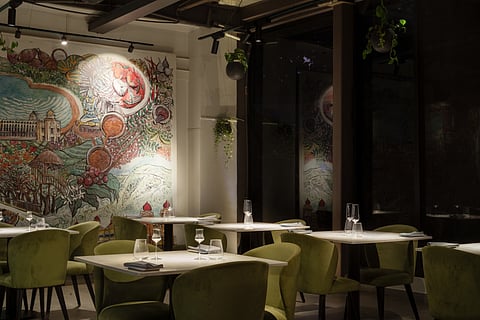
Despite being housed in an expansive 37 acre farm in Bengaluru’s outskirts, the dining experience here is surprisingly intimate. The restaurant seats just 18 guests in a cosy room that’s separated from its verdant surroundings by floor-to-ceiling windows. Fixtures remain neutral and chic, perhaps to let the food do the talking. The one exception to this is a large, colourful mural covering an entire wall that’s dedicated to the culture of Karnataka.
Outside, guests can walk through the farm to spot jackfruit, mulberries, coconut trees, mangoes, and an assortment of unique citrus fruits. A solar-powered hydroponic system and a vertical farm keep the footprint down while maximising the harvest, a testament to the establishment’s commitment to sustainability. And if you go off the paved path a bit, you’ll spot Hallikar cows, known to yield high-fat milk that makes for quality butters and ice-creams. Chickens roam freely, and depending on the season, as much as 80 per cent of the produce finds its way directly from the farm onto the plate.
If you look closely enough, you’ll find a story in every corner. And when you can’t, the staff is happy to jump in with one of their own. Johnson recalls the restaurant's struggle with growing corn, only for squirrels to repeatedly steal the harvest before it reached the kitchen. “We had to safeguard the corn,” he added, revealing that the team learnt to anticipate their furry competitors, harvesting the crop just in time. Somewhere along the way, that small frustration evolved into a fun course on the menu.
I got to take a peek at the kitchen as well, which has the old and new working in harmony. Meals are cooked with mango wood over Kannagi, the restaurant's wood-fired oven named after the fiery heroine of the Tamil epic Silappatikaram, and Anjaneya, its live-fire grill. A few steps away sits a fermentation room lined with meticulously-labelled jars of everything from miso to fermented millets. A rotary evaporator extracts delicate aromas that add an “oomph” to the plate while a large glass fermentation vessel affectionately named Aavai enables the staff to push the boundaries of what a kombucha can taste like.

Farmlore's special anniversary menu condenses some of its most iconic plated moments into 10 courses. Dinner begins, as it has for many over the years, with ants. A nod to the Indigenous culture of the Western Ghats, where red weaver ants have long been part of local cuisine. They sit pretty on a crunchy meringue with a fiery, tangy “Chigli” chutney. Paired with it is a refreshingly tart Jamun Bon Bon and an umami-rich milk preparation in a baby bottle. The latter urged us diners to abandon all formalities about fine-dining that we may have brought with us to the table.
Restaurant manager Nash paired the opening with a glass of Bisol Jeio Rosé Prosecco, explaining that its notes of wild strawberries and raspberries echo the fruit-forward notes of the bites, while its minerality and acid cuts through the umami.
Next came Mutta Puffs, a playful reimagining of the beloved South Indian bakery staple. Growing up in Bengaluru, I'd lost count of the number of flaky egg puffs I'd eaten between lectures and post-exam afternoons. Needless to say, this elevated, delicate dance of egg, curry espuma, and crispy buckwheat was quite heartening and nostalgic.
Ducks & Roses paired aged duck with rich Mandya butter, while floral gulkand cut neatly through all the richness. Nash suggested a pour of Matías Riccitelli Hey Rosé, whose notes of plums, summer berries, hibiscus and orchard fruit echoed the floral elements of the dish.
Then came one of the menu's most thought-provoking courses. Inspired by a visit to Kochi's beaches, Seataphor transforms a sobering environmental reality into something striking. Red mullet sits between two sauces: one a creamy coconut white, the other a vivid spirulina blue evoking the sea. A translucent sheet resembling crumpled plastic—ingeniously crafted from potato starch—rests delicately on top, while sea grapes and an inky splash symbolise an oil spill. The message is impossible to miss: save the ocean. It’s paired with a Krsma Sauvignon Blanc with notes of grapefruit and pomelo and green pear. Nash states that its acid balance “cuts through the creamy sauce and accentuates the fish's crisp, flaky texture.”
Mudde came in next. For anyone raised in Karnataka, this dish requires little introduction. Here, however, the everyday staple is elevated into something quite elegant. A perfectly smooth ragi sphere sits at the centre of the bowl before creamy saaru is poured around it. A vibrant karamani chutney coats the sides, encouraging diners to gather a little with every spoonful. Deeply comforting, it was one of those dishes that compelled me to tip the bowl just enough to savour every last drop.
An Interlude of lemon, cauliflower, Devanahalli chakota and green peas cleansed the palate, its refreshing flavours drawing collective "oohs" and "aahs" from the table.
Next, the showstopper, LOL. In it, an umami-packed "leather" made from tomato lycopene is draped over a delicately cooked lobster from Rameshwaram. This is bathed in a rich, coconut-based gassi and served alongside a fluffy rice cake built purely to mop up whatever sauce was left on the plate (if at all). Nash reaches for Bindi Sergardi Chianti here, pointing to its ripe red cherries, tomato leaf and baking spice notes that naturally amplify the savoury, umami-rich profile of the dish.
And then came the biryani. Sunday is served every eponymous day of the week and is a tradition passed on from chef Johnson’s father. Made with Bannur lamb, fragrant Gobindobhog rice, aubergine salna and patchadi, it manages to be deeply comforting and decidedly elevated.
It's matched with Bodegas Roda Sela.
Desserts are a grand affair at Farmlore. First up, Pineapple Republic, featuring a Vazhakulam pineapple ice-cream, shaved frozen yoghurt, and a pandan sauce that’s poured over it all tableside. Every bite was fresh, delicately sweet, herbaceous, and delightfully textural.
Kala Thean followed. A straightforward celebration of Hallikar milk, honey, and seasonal blossoms. Sweet and unfussy, it lets the produce speak for itself. Nash pairs this with an Otima Tawny Port with notes of raspberry, cherry, dried fruit and caramel.
And then came the hot chocolate and crisp stroopwafels. Complete, with Trippy Gummy Bears filled with peated Indian whisky and gin. Inspired by the film Ted, they're playful, unexpected, and prompt plenty of laughter around the table. A fitting way to end an experience that never took itself too seriously, despite the precision behind every plate.
Kaushik sums it up, "If there are two things I'd like people to take back, it's a feeling of pride in our rich history of flavours, and a sense of escape into our little world — which we've reimagined, whether it's the oasis in a bustling city, or the creativity in how we build our menus."
Address: Survey No:67, Mohan, Raju Layout, Bagalur, Sathnur Village, Bengaluru, Karnataka