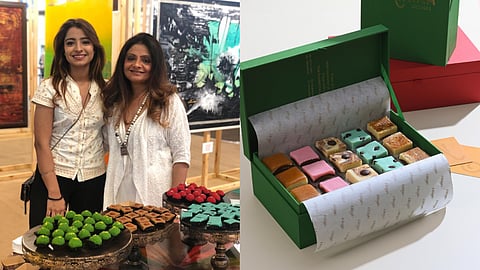

For generations, mithai has been India's edible language of celebration. A box of laddoos announced exam results, promotions, weddings, births and festivals. Every Indian family has memories wrapped in silver foil and fragrant with cardamom, saffron and ghee. Between temple offerings, grandparents' kitchens and neighbourhood halwais, sweets became less about dessert and more about emotion.
Yet, somewhere along the way, mithai seems to have lost its aspirational appeal.
As younger Indians gravitated towards macarons, tiramisu, artisanal chocolates and French patisserie, traditional sweets—deeply loved—yet increasingly absent from modern gifting conversations. Wedding hampers became filled with imported confectionery, luxury teas and gourmet chocolates, while the humble barfi quietly retreated to festive obligations. Delhi-based luxury sweet label Nihira was born from one simple question: What if Indian mithai could become aspirational again? Founded by Subha Aggarwal along with her daughter Arshya, the brand has carved a niche in the premium wedding sweets from alcohol-infused laddoos and fusion barfis to beautifully curated hampers designed around a wedding's theme, Nihira blends heritage with contemporary luxury.

For Subha Aggarwal, the answer wasn't about replacing tradition. It was about reframing it.
"We realised gifting and consumption of mithai were declining," she recalls. "The West was producing avant-garde desserts that felt exciting and accessible, while mithai was increasingly being labelled 'boring'. We wanted to bring Indian sweets back into conversations with a fresh perspective."
With that idea, they've collaborated with global luxury houses and built an entirely new category around liquor-infused mithai.
Aggarwal believes mithai occupies a unique place in India's collective memory.
"Whether it was stealing a motichoor laddoo after a family pooja or grandparents expressing love through sweets, these are memories that stay with us. You can take the Indian out of mithai, but you can't take mithai out of the Indian."
Rather than abandoning those memories, Nihira chose to reinterpret them. Its portfolio includes whisky-infused laddoos, red wine confections, tiramisu barfi, lavender pistachio sweets and floral-inspired creations that feel equally at home in a luxury boutique or a wedding trousseau. The objective was never novelty for its own sake.
"It has to feel familiar and unexpected at the same time," says Aggarwal. "When someone sees a tiramisu barfi or a red wine laddoo, they're intrigued. That curiosity opens the door for them to rediscover Indian mithai."
Interestingly, weddings were never part of Nihira's original business plan. "We didn't wake up one day and decide we wanted to be in the wedding business," Aggarwal laughs. "It happened organically."
One celebration led to another, referrals followed, and today luxury weddings have become one of the brand's strongest business verticals.
A key reason is how Indian weddings have evolved and where every detail forms part of a carefully curated narrative.
"Mithai is no longer just something you include because tradition demands it," she explains. "Today couples want every element to reflect who they are." Instead of one standard festive box, Nihira designs bespoke collections inspired by the couple's personalities, the destination, the wedding aesthetic and functions. "Our role isn't just to create sweets. It's to become part of someone's story," says Aggarwal.
That level of personalisation has transformed mithai from a ceremonial necessity into an extension of wedding design.
Luxury consumers today rarely buy products alone. They buy stories. And Aggarwal believes confectionery is no different.
"People rarely remember what was inside a gift," she says. "They remember how it made them feel." For Nihira, the experience begins long before anyone tastes the sweets.
The colours, textures, craftsmanship, packaging and opening ritual are all considered part of the narrative. "We don't see packaging as something that simply holds the mithai. It's part of the storytelling."
Every collection begins with a conversation. Sometimes the inspiration is a couple's love story. Sometimes it is architecture, a destination wedding or the identity of a luxury brand.
When every detail works together, the box itself becomes memorable.
Nihira's clientele spans industrial families, destination weddings, celebrity circles and globally exposed business households. Aggarwal says they all seek one thing - originality. And no two weddings receive identical collections from the brand.
"The biggest challenge isn't scale," Aggarwal says. "It's maintaining complete customisation at scale." Destination weddings add further complexity as they ensure the mithai arrives exactly as envisioned.
Perhaps Nihira's most striking achievement lies in taking mithai beyond traditional celebrations.
Over the years, the brand has worked with international luxury houses including Chanel, Gucci, Christian Dior and Burberry, translating each brand's design language into bespoke Indian confectionery experiences. For Aggarwal, these collaborations represent something much larger than corporate gifting.
"For a long time, mithai was seen as nostalgic but rarely luxurious." Working alongside global fashion houses challenged that assumption.
"We've never diluted Indian mithai to make it relevant. We've simply presented it with the imagination, craftsmanship and confidence that luxury already understands." It is an important distinction. Rather than westernising Indian sweets, Nihira has attempted to elevate them on their own terms.
Destination weddings have become another unexpected ambassador. International guests encountering mithai for the first time often arrive with preconceived notions. Aggarwal enjoys watching those assumptions disappear. "Alcohol-infused mithai has been one of the most striking shifts, it’s not something we’re “experimenting” with, it’s something we’ve truly built a category around, whether that’s whisky-infused mithai, red wine laddoos or other spirit-led creations that completely change the way people look at Indian sweets.”
Unexpected flavour combinations make the unfamiliar approachable. A tiramisu barfi feels recognisable to European guests. A whisky laddoo sparks curiosity. A floral pistachio confection bridges East and West effortlessly. "I've always believed mithai had global appeal," she says. "It simply needed to be introduced differently."
Another shift quietly reshaping the luxury mithai market is wellness. Consumers increasingly want indulgence without excess. Aggarwal says they have deliberately kept the mithai lower in sugar and also offer sugar-free variations, date-based sweets and an extensive range of premium dates and Khaleeji-inspired gifting.
Indian weddings are becoming increasingly personalised. Luxury gifting is moving from products towards experiences and Aggarwal believes mithai has entered a new chapter. "Wedding mithai is no longer a ritualistic add-on, but a part of the celebration."
She's sure changing the conversation around what Indian sweets can represent!