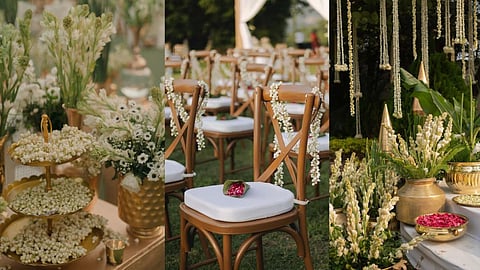

In the ever-evolving landscape of Indian wedding décor, floral choices have always been a testament to changing sensibilities. From grandiose, Western-inspired installations
to deeply rooted Indian aesthetics, the pendulum swings between the contemporary and the traditional. Today, however, the resurgence of one flower is defining the mood—the singular, dramatic burst of mogra.

At the heart of this shift lies the melifluous serenity and fragrant radiance of mogras—an enduring symbol of Indian traditions. “Mogra is a timeless choice when it comes to Indian celebrations —the equivalent of a classic white shirt in your wardrobe,” explains Archana Raniwala, founder of boutique floral company Bloom Barn. From bunches of fragile buds stacked together in brass bowls to delicate strings this monochrome blossom tied together—mogras aren’t merely aesthetic choices, they are a return to legacy.
You May Also Like: Blooming Love: Flowers in Indian Wedding History
“It’s something you can reinvent every season. It’s indigenous, easily available, and has a beautiful scent.”But beyond its versatility, it is also a “flower of memories”, notes Sakshi Gupta, floral designer and founder of Phool Stories. “Earlier people used it for ornaments in their gajras. Brides today have seen their grandparents wearing them in weddings, and have grown up seeing them in their houses in the summer. At night when the flower bloomed, it would fill the house with its smell. That nostalgia is what people are after in their weddings.”
Mogras are deeply woven into Indian culture, symbolising purity, love, and devotion. Believed to blossom spontaneously to the sound of Krishna’s flute in Vaishnav traditions, the mogra is outlined as one of the pushpa panchamrita—or the five sacred blooms of India. Kalidasa’s poetry and ancient love stories celebrate their intoxicating fragrance as a metaphor for romance, while their delicate strings have long been a bridal adornment, their spiralling contours, and supple petals signifying beauty and auspiciousness.
You May Also Like: Floral-Themed Gifts To Get If Your SO Adores Flowers
“Indian flowers never went out of fashion,” asserts Raniwala. “But the way we use them is changing. Weddings today marry Indian sensibilities with international influences.” Brides are not just looking to Bollywood’s grand celebrations for inspiration but drawing from global references—the floral theatrics of the Met Gala, the understated elegance of Milanese soirées, and the sculptural artistry of modern installations.
A recurring theme? “The rise of dheris, with mountain-like piles of mogras. They are simple, elegant, and the perfect illustration of minimalism—something most couples look for in their weddings today,” says Gupta. Founder of Bling Mushrooms, wedding architect Prieti Jain also adds, “Whenever I am working on grazing tables, mogras are my go-to florals. You can easily scatter them in abundance, they are easy to source sustainably, and their presence just elevates the setting altogether.”
You May Also Like: These Local Flowers Are A Staple In Indian Weddings
If there’s one defiant, emerging trend, it’s the power of abundance. “The singular flower in multitudes is winning right now,” observes Devika Narain, founder of Devika Narain & Company. “A cascading explosion or a mound— florals are no longer scattered accents. With clients we are now seeing either an entire ceiling filled with floral strings, or a floor covered in buds and petals. There’s a profusion to everything now.”
In an age of maximalist wedding expression, flowers are no longer just décor—they are statements, emotions, and heirlooms reimagined. Another emerging trend noted by Narain is the resurgence of stringed floral arrangements. “Flowers like these are delicate to string, making every garland an art form,” she notes. Couples Raniwala has worked with have gone as far as to use strings of mogras, to create floral curtains for guests to pass through. “You can also use these strings to form a dense canopy for the bride’s entry,” muses Raniwala.
You May Also Like: These Artists Can Turn Your Wedding Into A Floral Dreamland
Raniwala further expounds a host of examples for floral installations she has worked on — with the mogra as the centrepiece. “Besides scattered splashes or dheris, you can also put it in urlis like floating candles with water and line a walkway. You can use tall jars with candles and add mogras to them.” And to top it off, there is of course the flower’s ornamental potential. “We have used them as floral corsages or bracelets, placed atop a plateau for guests to come and wear from. This extends the decor experience to the guest and adds a personal touch to it.”
This story appears in Manifest India’s Issue 02. Subscribe here for more stories like this.