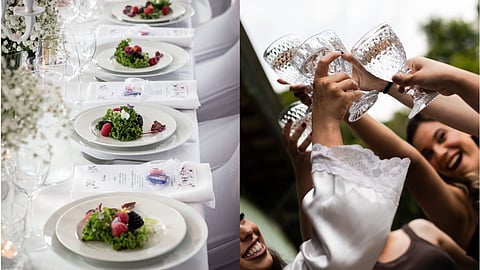

Abundance at the wedding is not a by-product of the celebrations, it is in itself, the celebration. Shaadi functions are usually larger-than-life and exude grandeur. So, any move to short-change it from the guest list to the dishes, will not go down well. But today, a lot of folks are going in for a ‘zero-waste’ wedding where they are not scaling down the festivities, but bringing about repurposing the excesses, so that the abundance is still celebrated—just not as as waste the following morning.
Several wedding planners across Mumbai, Delhi and Bengaluru are hopping on to this trend. If you are planning to tie the knot soon, take a look at these top ways to have a zero-waste wedding.
The waste issue begins with overestimation of the guest count, not a failure to serve hospitality adequately. Contemporary planners correlate guest data with regional food habits—one group may have different requirements in the morning and in the evening—not to add an additional 20% of people ‘just in case’. Remember, generosity will stay intact; assumptions will not.

The traditional buffet table with a spread of 40 dishes may look royal, but it may also add up to a waste, with guests preferring to sample the food. Here, a smaller, edited menu with live and plated stations makes more sense and this can be planned ahead.
This is when a real revolution takes place. The Robin Hood Army, which redistributes food in almost twenty Indian cities, runs the programme 'Extended Guest List' with couple’s registration for the immediate pick-up of food after the event. There is a similar project 'Meals With Love' by Feeding India which is operating in over 40 cities. What used to be an embarrassing midnight activity has become a regular discussion that wedding planners now bring up during the first vendor meeting.
A lot of waste emanates from the wedding decor. It may be a good idea to swap the usual materials with items made of jute, cane and bamboo that are natural and can be recycled.
Flowers, curtains and other materials that used to be thrown away after the event now are considered as inventory. Bengaluru and Goa based Panigrahana Weddings has built a whole concept around this idea of a ‘planted mandap’ with living potted trees instead of cut flowers, which then are distributed among guests or replanted back in the venue.
Marigold and roses that are wasted during the wedding events are collected by municipal composting centers, and in Bengaluru's case, by collectives such as Hasiru Dala, now listed as a regular vendor besides the florist and catering agency.
Ornate invitation cards in boxes have started to give way to elegant digital invitations, used for the purpose of save the date and logistical planning, with only a single printed invitation kept for close family—a limited edition of invitations, made on handmade or seed paper, rather than hundreds of copies for the recycling bin.
Those plastic gift boxes with little souvenirs are out of fashion for a lot of today's environmentally-friendly clientele. These are being replaced by seed packets, potted plants or local products that guests can consume.
Have water stations at the wedding with reusable steel cups instead of bottled water, cloth napkins instead of paper, reusable crockery for small functions. These are also effective changes to make.
Your intention may be firmly in place, but do not try to replace everything at one go. Draw attention to one eco-friendly step like a composting station for flowers or a printed note about the partner in the food donation program placed next to the buffet. It works better than ambitious plans to make a dozen ideas come to life.
While these may seem like you are paring down, it does not reduce the Indian wedding in spirit. In fact, the zero-waste trend simply calls for more mindfulness and for a planner to work towards making a better change. These tips leave guests too, talking about the wedding with appreciation.