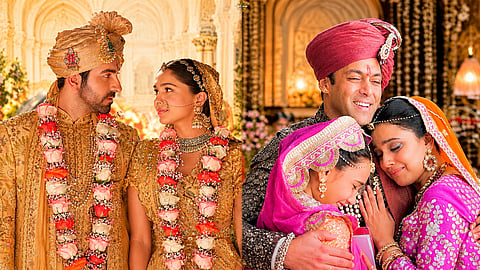

He's the man who made you laugh, cry and live through every moment on screen, as if it were real! And now, filmmaker Sooraj Barjatya, who gave us hits like Maine Pyar Kiya, Hum Aapke Hain Koun...! and Vivah is all set with his next, Yeh Prem Mol Liya, with Ayushmann Khurrana and Sharvari, which will release on November 27th.
As we await his latest oeuvre, which is sure to whip up emotions—some new, some old—we peek into Sooraj's rich repertoire of storytelling and how his wedding films unfold in a rich blend of colour, music and deeply human moments. They make for a metaphor for how culturally rooted rituals build bonds between families, from the little cherished traditions that make for fun to touching moments; he's made them all unforgettable in mainstream Hindi cinema. From the joota chupai to the vidaai, here is how Sooraj Barjatya gave Indian wedding rituals the cinema flourish.
The film which wwas a huge success, follows Prem and Poonam from engagement to marriage, and its rituals are quieter than the spectacle of Hum Aapke Hain Koun..! The ring ceremony fixes the match. Haldi purifies and blesses the bride and groom in their separate homes. Sangeet and mehendi bring lighthearted fun to the waiting period, while the wedding itself seals a promise already made in small, everyday moments. Vidaai then gives that promise its deeply emotional climax: Poonam leaves one home to build another. It's a classic Barjatya film, where the rituals reflect a slowly growing emotional union.
Maine Pyar Kiya begins not with a wedding, but with the seeds of trust. Suman's father leaves her in the care of Prem's family due to work obligations. Suman and Prem fall in love in that shared household, through ordinary days rather than grand ceremonies. In Barjatya's earliest love story, family is built on choosing to take responsibility for one another, from hospitality to loyalty, from shared meals to lively conversation.

The ritual of joota chupai is ever popular as it reveals changes in the family dynamics in a lovely way. In this custom, the bride's sisters steal the groom's shoes during the wedding and ask for money in exchange. In the film, a musical number accompanies the ritual, a negotiation interwoven with fun, comedic moments. The lightheartedness emerges from the bride's family teasing the groom, encouraging laughter, and creating closeness. Post the film, joota chupai came to be regarded as an important part of the rituals that build a feeling of familial togetherness.
The beloved rituals may be seen in a palace, but their meaning carries the same emotion just as anywhere else. In the film's ending, Prem Dilwala, returns to his family and the prince's family accepts him. Everyone then joins in a grand celebration to express their happiness.
Barjatya's point is deliberate. A palace can have bigger thalis, bigger crowds, and bigger chandeliers, but the ritual is the same as in Vivah or Hum Aapke Hain Koun..! (1994): welcome the guest, bless the couple, feed the family, forgive, and choose unity over pride.
Starring Ayushmann Khurrana as Prem Mishra and Sharvari as Purva Solanki, the film releases in theatres on 27 November 2026.
Its title draws on a Rajasthani wedding custom in which the groom, arriving at the bride’s home with the wedding procession, touches the toran at the doorway with his sword and vows to take responsibility for her household. Here, that symbolic promise becomes a real decision: Prem moves into Purva’s household, sharing the responsibility of caring for her family because she is its sole caretaker. The film frames that choice not as defeat or comedy, but as partnership, a modern reading of an old vow.
The magic of Barjatya’s wedding rituals on screen isn’t just the music and colour. It’s the way very human characters slowly weave a tapestry of love, respect, and honour, and a shared interest in enriching each other’s lives.