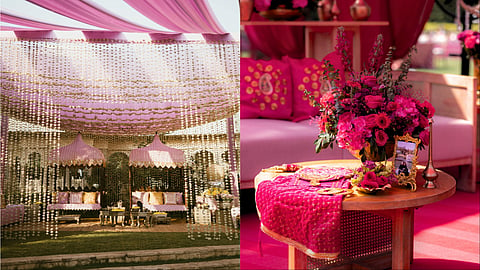

There was a time when you could not imagine ethnic evening wear and wedding lehengas without the shimmer and charm of gota patti! The centuries-old embroidery is synonymous with elevated dressing, on chiffon and georgette, lending a royal signage to heavy outfits. Now, that grandeur is moving from couture to wedding decor, making for a transition whose time has come.

At the onset of the festive and social season, we're seeing shimmering buntings and gota strings and balls, ornate backdrops as well as embellished jhoolas and upholstered furniture, blowing up on the wedding scene. Those flattened zari threads in gold and silver add just the right sheen to the shaadi atmosphere. Of course, the other big advantage here is how gota patti, being a textile, is more durable.
We got prominent names in wedding decor—experiential wedding designers Shashank & Yashi of Alora Decor and artistic director Anika Dhawan of Rani Pink—to share more about this trend and why its so popular. Over to them…
Shashank & Yashi (S&Y): Gota patti is a traditional Rajasthani embroidery technique. Metallic ribbon and gold/silver zari appliquéd onto fabric in floral and paisley motifs that has moved off bridal lehengas and onto the decor canvas itself.
Backdrops, hangings, and even furniture upholstery now carry that same hand-embroidered richness. The trend emerged as brides started wanting decor that felt as couture and personal as their outfits, not just florals and drapes so designers began borrowing craft traditions straight from the loom.
For our brides, it became an ode to nostalgically simpler times, while still letting the richness of Indian festivity shine through!
(S&Y): Traditional decor leans on flowers, fabric drapes, and lighting for texture. Gota patti adds a layer of handcrafted embellishment. It has dimension, shimmer, and intricacy that reads almost like jewellery for a space. It’s extremely popular right now, especially for sangeet and mehendi, because it photographs beautifully and gives a space a rooted, heartfelt identity that’s distinctly Indian.
Anika Dhawan (AD): We’ve experimented with gota patti almost as a material rather than treating it purely as embellishment.
We’ve hand-woven silver and gold gota to create entire wall panels and used the craft almost like upholstery. We’ve made thousands of individual gota flowers and built them into large-scale textured surfaces. We’ve created intricate laddu-like forms by individually piercing pieces of gota into larger sculptural balls, and made long tassels combining different shapes and textures of gota flowers.
We’ve also suspended endless strings of gota from trees so that they move with the air and catch the light, and stitched hundreds of pieces together to create enormous gold canopy ceilings. There is something particularly beautiful about gota when it moves—it changes constantly with daylight and even a gentle breeze.
For me, the interesting part is taking something everyone thinks they know and changing its proportion or construction. Gota doesn’t necessarily have to be the finishing detail. It can become the wall, the ceiling, the installation, the textile or even the architecture of the space. That’s what we have always done at Rani Pink.
(S&Y): Most requested today are gota patti backdrops paired with a swing or jhoola for mehendi because brides want a photography corner thats ‘built like a set’ for that one iconic photo moment.
For the Haldi: Gota patti umbrellas, thrones, and marigold-gota hybrid backdrops.
For the Mehendi: Gota buntings, jhoolas (swings), and courtyard-style hangings.
For the Wedding/reception: We recommend subtler applications, like gota borders on mandap drapes, cushion covers, welcome signage.
It takes anywhere from 4–10 days depending on scale. The embroidery itself is time-intensive since it’s largely handwork, so we pair those with pre-embroidered panels and customise or assemble on-site rather than embroidering from scratch for every project.
It is a mix of handcrafting intimate objects to enhance guest experience, and premade for elements that create grandeur and scale.
(AD): Gota patti has been a constant part of the visual language of Indian weddings—through clothing, textiles, decoration and the objects that surround a celebration. So I don’t necessarily see its presence today as a trend or a revival. What has changed is the way a new generation wants to engage with craft.
GenZ couples are much more interested in knowing why something is being used and what it brings to a space. They want tradition, but through a modern lens. There is less interest in using craft simply to make a wedding look fuller, bigger or more ostentatious. Instead, there is a move towards using it with intention—taking one material or technique and finding a new expression for it.
At Rani Pink, we’ve worked with gota patti for years, but we’ve always tried to change its scale, texture or application. Sometimes it becomes architecture, sometimes a surface, sometimes something incredibly light like its almost floating. I think that is where its relevance for a new generation lies—gota patti remains recognisable, but the way you experience it feels completely new.
(S&Y): Fortunately, Gota patti is fairly durable since it’s fabric-based. But we reinforce stitching at stress points, use breathable mounting so it doesn’t wilt or sag under humidity, and do a pre-event and touch-up pass before each function to fix any loose threads or displaced panels.
(S&Y): Yes! That’s actually where it gets interesting. We layer gota patti with fresh marigold or trailing florals for texture contrast, use it against sheer fabric drapes so it doesn’t feel heavy, and pair it with warm contemporary lighting (fairy lights, lanterns) rather than traditional diyas alone. The trick is restraint; let gota patti be the hero element and keep everything else minimal so it reads elevated, not cluttered.
(AD): Absolutely, but I think it is most beautiful when it is handled very delicately.
I would almost make the structure of the mandap disappear. Imagine very fine wooden pillars, with an intricate canopy of hand-stitched gota flowers floating above them. The flowers could be connected loosely enough for sunlight to filter through, so throughout the ceremony there is this changing play of shadow, light and gold across the space.
Rather than making the gota heavy or overly ornamental, I would let it behave almost like a fluid textile—softly draped over the structure, moving slightly with the air and creating the feeling of a little courtyard beneath it.
That, to me, is a contemporary way of working with an old Indian craft. You still recognise the craft, but the final expression feels light, quiet and completely of the present.