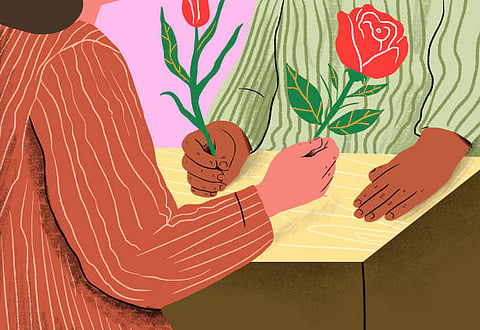

Love isn’t always an instinct. Sometimes, it’s an education. One that is often imparted by tools and resources developed by the world’s foremost minds and accessible at the click of a button—from quizzes that test compatibility to questions that spark intimacy. We reached out to psychologists and couples who tried these tools to decode the lessons in love they offer.

Love languages can spark an entirely new understanding of your partner. Developed by Gary Chapman in the book The 5 Love Languages: The Secret to Love That Lasts, it delineates the way individuals prefer to express and receive love: acts of service, words of affirmation, quality time, receiving gifts, and physical touch. Without knowing how your partner perceives love, it’s difficult to recognise a genuine bid for connection. “We’ve been together for so long and thought we knew everything about one another, but the results were eye-opening!" says Ahaana Khosla, a beauty editor and founder of trends platform Foresight Forum, who tried the test with her husband, Shehan Minocher. “Most of our love languages overlapped, but one didn’t: mine is words of affirmation, while his is acts of service. So now I try to make sure I do little things that perhaps I once saw as chores but now see as signs of love. And he knows that sometimes I need a little extra reassurance.”
Contemporary resources, designed to build connections, often reveal truths that can disrupt the pattern of relationships. They also expose insecurities, vulnerabilities, and gaps that perhaps lay hitherto hidden.
“There’s something deeply intimate, and a little unsettling, about laying your emotional wiring bare through a digital quiz,” says author and gender rights activist Meghna Pant. “But once we began, it didn’t feel clinical at all. It felt human. We found ourselves laughing, pausing, even debating — not about who was ‘right’ but about how differently we experience love, needs, and fears. It opened a portal into conversations we hadn’t thought to have, simply because life kept us too distracted to dive deeper. The insights didn’t just help us understand each other better — they helped us extend more grace to one another.”
Pant and her husband of 10 years, Sahil Kanuga, approached 'The 5 Love Languages', as well as '36 Questions That Lead to Love' — a series of personal questions developed by a team, led by psychologist Arthur Aron, to encourage closeness. In a paper published in 1997, they write: “When individuals feel more Understood by a close other, they also feel as though life makes more sense with this person, and this, in turn, leads them to identify with that specific relationship more.” Notably, Mandy Len Cantron went on to marry the acquaintance with whom she tried the questions — a journey she documented in a 'Modern Love' column for The New York Times.
“Take them seriously enough to engage, but not so much that the process becomes performative or stressful,” says psychologist Arpita Mirchandani. “Think of them as a starting point — a springboard into deeper conversations, not substitutes for emotional work. Consistency and intention matter far more than just completing a quiz or score.” Besides, buzzwords and declarations can often oversimplify nuanced conversations about love and intimacy: the viral "Orange Peel Theory", for instance, which judges a partner’s willingness to perform small acts of service, like peeling an orange, has been critiqued for its potential to foster miscommunication and distrust.
“In long-term relationships like ours, where we have been married for 20 years, exploring new facets in our personalities can be like a refresh button. Life can get pretty monotonous on a daily routine with children, to it helps to reconnect,” says beauty and fashion influencer Shrima Rai. Together with her husband, she tried the Gottman Relationship Checkup, a clinical resource that scores a relationship’s strengths and challenges and provides specific recommendations for intervention. With 480 questions designed to be used by a clinician, it’s a true commitment.
This story appears in Manifest India’s Issue 03. Subscribe here for more stories like this.