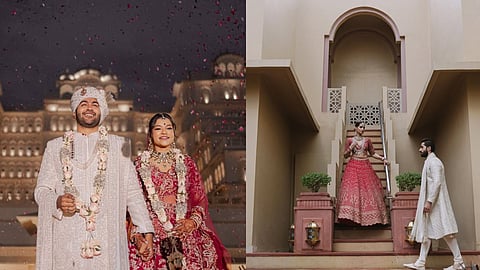
Weddings have always been an extravagant affair, continuously evolving with newer, grander trends, and so has the wedding storytelling. Ever since technology came into the picture, it has greatly taken over weddings in the form of reels and wedding films and even drones, and now, technology, in wedding narratives, is taking a step further with artificial intelligence (AI) and augmented reality (AR). However, while these tools have altered how people revisit their memories and plan, capture, and relive their weddings, the essence of filmmaking and the emotion behind it remain untouched.
Industry experts like Nitin and Shanaya of Nitin Arora Photography and Aditya Mahagaonkar of WhatKnot Photography share how they are navigating this new shift in storytelling where algorithms and artistry co-exist.
“Five years ago, everything — from planning to editing — was manual. Now, AI helps us plan smarter and save time,” says Nitin Arora, founder of Nitin Arora Photography, as he recalls how the rise of AI and AR changed the way wedding films were planned, shot or edited from five years ago. “We use it to pre-visualise lighting, plan frames, and even create moodboards that give our couples a clear idea of the look and feel we’re aiming for. Earlier, we spent hours putting them together manually — now we can build personalised, story-based boards in minutes.”
His co-founder, Shanaya Arora, adds, “AR has also changed how we share ideas. Couples can actually see how a décor setup or frame will look before the shoot. It’s made communication much smoother and ensures everyone is aligned creatively.”
At WhatKnot Photography, Aditya Mahagaonkar notes that AI has been significant and has revolutionised the backend process. “Five years ago, our post-production was labour-intensive — manually keywording thousands of images, colour-correcting frame by frame, organising deliverables. Today, AI handles much of that grunt work. We use AI-powered culling tools to pre-select the sharpest shots, automated tagging to organise our workflow, and smart editing software that learns our style and applies baseline corrections”
He explains that AI has freed up the team to focus on what actually matters—being present with the couples, crafting the narrative, and refining the creative touches that make each wedding unique. “On the planning side, AI helps us analyse shot lists, predict timeline bottlenecks, and even train new team members through simulated scenario planning. But when we’re on the ground shooting? That’s still pure instinct, human connection, and years of experience reading a room,” he shares.
While technology has made the process of wedding filmmaking efficient, both teams agree that it cannot replace human intuition. Shanaya states that AI definitely helps with speed and structure, but it can’t feel emotions. “Our work has always been about capturing what’s real — not perfection through filters.”
Nitin echoes the thought, “Technology should support your vision, not lead it. The authenticity of a wedding story comes from emotions that unfold naturally — and that’s something no software can script.”
“AI is a tool, not a replacement. At WhatKnot Photography, we use it strictly for data-heavy tasks—culling thousands of images, basic colour correction, organising footage. The real creative work—the storytelling, the artistic grading, the narrative flow—that’s all done by our human team. And honestly, this shift has been empowering for our photographers and editors,” Aditya highlights how the jobs of photographers and editors are becoming more brain-intensive than task-intensive.
“Instead of spending hours sorting files, they’re making creative decisions, experimenting with styles, connecting with clients. The risk of dilution comes when photographers lean on AI to generate a “look” rather than developing their own visual language. We’ve seen this in the Indian wedding space—everyone using the same presets, the same automated glow, and suddenly every wedding looks identical.” He shares that at WhatKnot Photography, their creative vision is still entirely human. While AI helps the team execute faster, it can’t tell which moment to capture or how to frame a bride’s quiet emotion during the pheras. Aditya reiterates that such an intuition can’t be automated.
When asked if they had experimented with AI or AR-based wedding content like interactive albums or immersive videos, Nitin shared that at Nitin Arora Photography, they have started integrating AI into how couples experience their memories. “For example, when they receive their photo albums, they can simply scan their face, and AI automatically identifies and gathers all the photos they appear in. So instead of manually scrolling through hundreds of pages, they get a personalised collection in seconds. It’s made the whole process more efficient and enjoyable.”
Seconding Nitin, Shanaya shares that AI is definitely helping reduce hassle for both the filmmakers as well as their clients. “But even then, it’s not about replacing human creativity — it’s about improving how couples experience their memories. The heart of it still lies in emotion and connection.”
Aditya also agrees that AR and AI-powered albums are definitely the future, but nothing beats the physical touch of a printed album. “The aesthetic, the weight of it in your hands, the ability to flip through pages with your parents or grandparents—that sensory connection is irreplaceable.”
He explains that digital experiences are impressive, but they lack the intimacy of gathering around a coffee table with family and reliving moments together. “That said, we’re preparing for what’s coming. AI-powered designing on the back end will be mainstream in a few years—tools that auto-suggest layouts, optimise photo placements, and speed up the album creation process. At WhatKnot Photography, we’re already testing these internally, but we’re ensuring our designers maintain the final creative say. The technology will make us faster, but the emotional curation. That stays human.”
Editing with Efficiency, Filming with Soul
AI has changed how post-production teams' function. “AI helps us with sorting, colour correction, and stabilising shots, which saves a lot of time. You can play a lot more with your editing style now because AI takes care of the repetitive groundwork,” Nitin says. However, Shanaya highlights that having a unique visual style matters the most. “Anyone can use AI, but not everyone can make a film feel emotional and unique. That’s where your personal touch, experience, and instincts come in. Editing isn’t just about speed — it’s about soul.”
Similarly, WhatKnot Photography uses AI for efficiency but remains wary of over-reliance. “ biggest game-changer for us has been AI-powered facial recognition galleries,” says Aditya as he ponders over the role that AI-powered editing tools play in the post-production process. “After a wedding, we can deliver personalised galleries to different family members—parents get all their photos, the bride’s best friend gets hers, the groom’s brother gets his. It’s made client delivery so much smoother and more personalised. Beyond that, we use AI for baseline tasks—noise reduction, initial organisation, cataloguing—but the creative heavy lifting is still manual.” Aditya mentions that on the operations side, AI helps filmmakers manage timelines, auto-generate social media snippets, and streamline client communication. “It’s saved us hours every week, which means more time spent perfecting the final product.”
Even in an AI-driven era, couples continue to value timeless cinematic storytelling. Shanaya shares that couples love films that look grand but feel real. “Couples today want stories that reflect who they truly are — raw, emotional, and timeless — not overly processed or tech-heavy experiences,” Nitin adds.
Aditya, seconding Nitin and Shanaya, agrees that cinematic storytelling is still king. “Couples want films that feel like Bollywood productions—sweeping drone shots, emotional slow-motion sequences, rich colour palettes. AI/AR requests are rare and usually surface during our requirements gathering phase. That’s when we sit down with couples, understand their expectations, and sometimes introduce them to AI-enabled aspects they hadn’t considered—like real-time highlight reels or same-day social media edits. We don’t push technology for technology’s sake. We listen first, then suggest what genuinely adds value.” He adds that most couples benefit from AI without even realising it—faster delivery, more organised galleries, smoother workflows. But what they’re really asking for is emotional, authentic storytelling. “The tools just help us deliver that better and faster.”
Both studios agree on one non-negotiable: authenticity. Nitin states that for him, the line is very clear. “AI should never change what was felt in that moment. If it helps us improve lighting, colour balance, or composition, that’s great. But once you start tweaking expressions or re-creating moments that didn’t happen, it stops being real. Weddings are about emotions that happen once — they’re not movie retakes.”
Shanaya adds, “We don’t chase perfection — we chase honesty. If a frame feels slightly raw but carries emotion, we’ll keep it that way. Because when a bride looks back at her film, she shouldn’t see a flawless version of herself — she should see a real one, full of love, chaos, and truth. That’s what makes storytelling timeless.”
In consonance, Aditya, when asked where he draws the line between enhancing a moment with AI and altering its authenticity, states that if it is very simple- if AI changes the memory, they don’t do it. “We’ll use AI to improve technical quality—sharpening an image, balancing exposure, removing sensor dust—but never to fabricate or fundamentally alter what happened. We won’t AI-generate a smile that wasn’t there, change the colour of an outfit, or erase a family member from a frame. Indian weddings are emotional, imperfect, and real.” He shares that these little details are what make them worth documenting. “If a couple looks tired during the reception because it’s 2 AM and they’ve been celebrating for six hours, that’s part of their story. We’ll make them look their best, but we won’t make them look like someone else. Authenticity is our brand promise at WhatKnot Photography, and AI will never compromise that.”
Looking ahead, both Nitin and Shanaya and Aditya see immersive storytelling as the next chapter in wedding cinematography. “I think the next big leap won’t just be in visuals—it’ll be in experience.” Nitin believes that couples will plan and visualise their entire wedding through virtual setups before it even happens. AI will help them see the décor, light, and movement in advance—so the actual day feels like a well-rehearsed dream. “But the beauty will still depend on how we, as filmmakers, capture what’s unscripted.”
Meanwhile, Shanaya presses that the future isn’t about replacing human creativity—it’s about deepening it. “Imagine re-living your wedding not just by watching it, but by feeling it—like stepping back into that space through immersive storytelling. I think that’s where we’re headed — emotion-driven experiences powered by technology, not controlled by it.”
Aditya highlights that in India specifically, he believes that the next leap will be hybrid experiences—virtual attendance for elderly relatives who can’t travel, AI-assisted live streaming with automatic highlights generated in real-time. “Fully immersive AR feels too niche for our market right now. Indian couples want real priests, real family, real chaos. We believe technology should enhance reality, not replace it.” He adds that AI-powered storytelling will evolve, “imagine rough cuts generated while you’re on your honeymoon, which we then refine—but the wedding day itself will stay rooted in authentic human experience.”
Despite all the tech advances, at the heart of it, all three photographers agree — emotion remains untouchable. Shanaya reaffirms that no algorithm can understand what it feels like when a father sees his daughter as a bride for the first time, or when two people lock eyes in the middle of all the chaos. “You can recreate visuals — but not vibes.” While Nitin states that the human instinct, when you know you have to hit record because something magical is about to happen, that can’t be programmed. “AI can calculate, but it can’t care. And that’s what storytelling is about — caring enough to see beauty in imperfection.”
While concluding, Aditya also agrees that the couple’s raw emotion and the filmmakers’ ability to witness and honour it is something that AI can’t sense. “AI can’t sense when a mother is about to cry during the bidaai, or when a groom steals a private glance at his bride amidst the chaos. It can’t feel the weight of a father’s silent pride or a grandmother’s blessing.” He adds that the instinct to capture these fleeting moments comes from being human, not from an algorithm. “From a client perspective, the trust and comfort they feel with us can’t be replicated either. They let us into their most vulnerable moments because we’ve built a relationship, not because we’re operating the best camera or using the latest software. AI can help us work smarter, but it will never replace the empathy, cultural understanding, and human connection we bring to every wedding we document.”
