
The Indian wedding ecosystem was a dependable loop: a decked-out banquet hall, velvet drapes, vibrant mogra strands in the background, a choreographed routine on whatever song is trending or the ever-dependable Kajra Re [Bunty Aur Babli], and maybe a cousin with a DSLR and a passable knowledge of words like ‘aperture’ and ‘white balance’. Post the wedding, there would be the requisite family gathering to pore over the thick wedding album (the practice evolved from physical albums to watching the photo dump from the photographer on a TV or laptop screen), and ooh and aah at the well-intentioned yet stilted poses by the bride and groom. If many of you find yourself agreeing to the aforementioned breakdown of an average Indian wedding hoopla, then you’d also be left wondering why we don’t see this more often. The answer, dear readers, is a pair of weddings that changed everything.
In the last decade, two ceremonies, one starring cricket royalty and Bollywood glamour and the other starring, well, Bollywood itself, singlehandedly increased the usage of the words ‘bridal entry songs’ and ‘pastel everything’ in the Indian wedding lexicon. Virat Kohli and Anushka Sharma’s 2017 Tuscan wedding proved that an intimate getaway could be impossibly chic, while the grand wedding sequence in Ayan Mukerji’s Yeh Jawaani Hai Deewani (2013) convinced us that every mehendi needed a palace, fairy lights, and ideally, Ranbir Kapoor brooding over his life choices in the background.

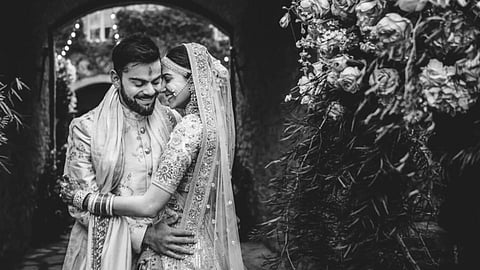
Virushka, a portmanteau of Virat and Anushka’s names that sounds like a Russian savoury item, descended in blush-toned Sabyasachi and expert cinematography, and suddenly half the country was actively Googling “How much does an Italian vineyard cost?” Their wedding was a masterclass in how minimalism could look more expensive than maximalism. It wasn’t just a shaadi; it was a tectonic shift in how millennials would henceforth choose to get married. “What this changed for millennials and the generations to follow was the flavour of authenticity and intimacy.” Rhea Dewan, Founder and Creative Director of The Serendipity Co., a luxury wedding and events studio, adds, “People began envisioning and dreaming of weddings with only their closest family and friends in attendance, escaping the layer of formality and dread that typically comes with large-scale weddings.”
Mumbai-based wedding planners, The Shaadi Squad, took on the behemoth task of planning the wedding of two of the most beloved figures in India in just about four months in Italy. Devika Narain & Co.’s decor turned the 800-year-old Borgo Finocchieto villa in Tuscany into a dreamland. The team at Stories by Joseph Radhik managed to capture the poignant moments of pure bliss and love between the couple and their loved ones beautifully, giving future brides the exact references to show to their wedding photographers.
But, credit where credit is due: YJHD walked so Virushka could float down the Tuscan aisle. The movie can be the spiritual predecessor of Aditi’s (played by Kalki Koechlin) wedding in Udaipur, which handed India a crash course in wedding aesthetics. Aside from being a plot device in Ayan Mukerji’s narrative, the wedding ended up flipping the script on wedding planning and decor. Every frame was a moodboard: vibrant, lightweight lehengas, poolside mehendi, choreographed emotion lit by fairy lights. Wedding planners still whisper reverently about 2013: the year ‘wedding photography’ died and ‘wedding films’ were born.
“When YJHD’s wedding played out on screen, it was emotional magic,” recalls Vishal Punjabi, Founder of The Wedding Filmer, the award-winning videographer responsible for capturing the reel wedding and Virushka’s Italian nuptials. “It wore its chaos on its sleeve, longing, joy, misunderstandings, friends hugging too hard. That sequence didn’t just look beautiful; it felt like someone’s actual memory. That’s why both remain timeless, not because they were big, but because they told the truth beautifully.”
Together, these two weddings changed the vocabulary. Out went the OTT decor and generic banquet backdrops. In came curated Pinterest boards, carefully thought-out colour palettes, aerial shots, and brides who moonlighted as creative directors. Suddenly, the groom’s role was no longer just showing up; he too had to endure (coordinated) outfit changes, moodboard discussions, and multiple dance rehearsals to get the sangeet choreography down pat.
If Virushka’s Italian nuptials whispered “you can do understated and still look like royalty,” YJHD’s Udaipur wedding shouted “every friend group deserves a palace reunion”. Between them, they democratised aspiration. “It was a complete game-changer for wedding photography and videography, decor and fashion. It was the spotlight moment for pastel lehengas, detail-oriented European decor laden with exquisite florals instead of big structures and traditional mandaps,” says Rhea, adding, “YJHD, in contrast, was the big-fat Indian wedding, extravagant in terms of location, luxury, decor and even entertainment. It definitely created a niche for palace weddings in Rajasthan that has now become mainstream.”
Anushka Sharma’s solo entry to a cover of the folk song Din Shagna at her wedding became a template for brides to put their own spin to, for their weddings, in the years to follow. “Some of these trends have now become clichés, but surely the wedding industry is nothing like it was before these two weddings—more destination weddings, more wedding planners, and more destination exploration,” says Rhea.
“They also became weddings that allowed people to think outside of the box and break away from norms, leading to a lot of innovation in the space.” Aside from unconventional wedding colours and intimate celebrations, wedding photography and videography underwent a major change. “People started focusing on documentation of authentic moments, which is what they connected with the most, with the wedding pictures that were shared, photos that evoke emotion and heartfelt emotions,” says Shivali Chopra, Senior Creative at Stories by Joseph Radhik.
“Over the last 15 years, I’ve quietly shifted wedding films from being just recordings of rituals to becoming cinematic love stories. That’s the evolution these weddings symbolised,” says Vishal, “Weddings used to be about checking boxes with mainly trendy designer lehengas and jewellery. Now they’re about storytelling. Couples arrive with poems, songs, memories; they ask, ‘Can you make us feel this every time we watch?’” Weddings and documenting these weddings went from being more about the family to highlighting the couple getting married. Everyone wanted a moment like Aditi’s haldi, with her friends playfully covering her in turmeric or Virat and Anushka’s unabashed joy captured at their mandap. Marriages may still be made in heaven, but weddings? Thanks to these iconic game changers, they’re storyboarded, colour-graded, and forever bathed in golden hour light.