
Weddings are (usually) an extravagant affair, marking the union of two people with pomp, celebration, and plenty of emotion. But when the bride or the groom is adorned with a crown, the stakes-and the chaos-are often magnified. Royal weddings, bound by centuries of tradition and watched by millions, can stray from being majestic to being outright bizarre.
From sugar sculptures to sword-beds and karaoke spectacles, history is full of strange wedding processions. Royal weddings that are usually the pinnacle of protocol have shown in the past that weddings are not just rituals and customs followed in a disciplined fashion, but performances, scandals, trends, and a lot of chaos rolled into one.
Here’s a look at some of the most unusual, dramatic, and downright bizarre royal weddings the world has ever seen.

George, Prince of Wales (later King George IV) famously married his cousin, Princess Caroline of Brunswick, in 1795. Like many royal marriages around that time, it wasn't a love union. Caroline had money, and George needed assistance paying off some bills (£630,000, to be exact). On the day of his wedding, he bellied up at the altar.
George had cried out, "I am not well," upon first seeing his bride. He had asked her for a glass of brandy. From there, it became worse. Clutching the glass, too tipsy to stand unassisted- reportedly sobbing whilst two dukes had to hold him up at the altar. During the event, he even broke down in tears. It’s safe to say Prince George IV gave wedding day nerves a whole new meaning.
At his wedding to Marie de' Medici, Henry IV took the concept of grandeur to another tooth-aching level. Among the several extravagant displays, he brought with himself a life-size sugar sculpture of himself mounted on a horse, showcasing his regal stature in the most bizarre yet delicious way possible. But it didn’t end there. The entire banquet was also made of sugar, turning the feast into an edible fantasy land. This display, while whimsical, was also a very clear indicator of his status and a calculated flex of wealth and power. Imagine attending a royal reception with all the fancy decorations, and then someone takes a bite of the chandelier.
The proxy marriage between Anne of Brittany and Maximilian of Habsburg, the future Holy Roman Emperor Maximilian I, took place in 1490, and Wolfgang von Polheim was present. Maximilian married Anne of Brittany by proxy in a spectacular Spanish-Italian ceremony. In keeping with the symbolic meaning of the proxy wedding, His stand-in, Polheim, was completely armoured when he slept with Anne on the wedding night, except for his right leg and hand, with a sword between them.
If history is to be believed, the phrase "Royal Kiss… to the Wrong Person" refers to King Edward II of England, who kissed his and his favored companion, Piers Gaveston, which deeply offended his new queen, Isabella of France. In February 1308, Edward II, was caught engaging in lavish affection, including giving kisses, on Gaveston during his wedding ceremony. That mix-up takes “we interrupt this wedding for personal reasons” to a royal level!
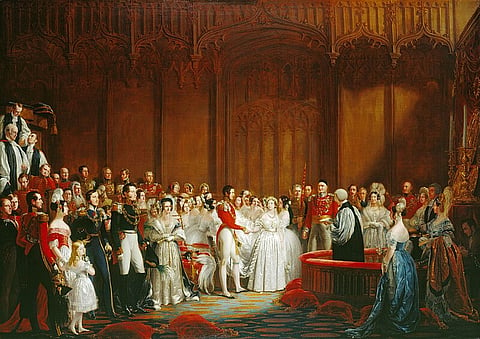
When Victoria wed Prince Albert, Somerset farmers gifted a colossal 500 kg cheese embossed with the royal coat of arms—and even composed a ditty to celebrate it. The Queen received the "Great Pennard Cheese," a half-ton block of cheddar created from the milk of 700 cows, but she didn't like it when it was fresh. As a result of a legal battle, it was eventually used as animal feed.
In 1736, Princess Augusta puked immediately after the wedding because she was tired of having to marry Prince Frederick. When Augusta botched up her wedding vows, Prince Frederick, elder son of King George II and the heir to the British throne, is said to have given her an angry roar in her ear. The prince was nowhere close to being charming. The princess, in addition, allegedly pleaded with her mother, Queen Caroline, saying, "Please don't leave me." According to Royal Babylon: The Alarming History of European Royalty, the poor Danish princess was just under 17 years of age and had never met her considerably aged groom.