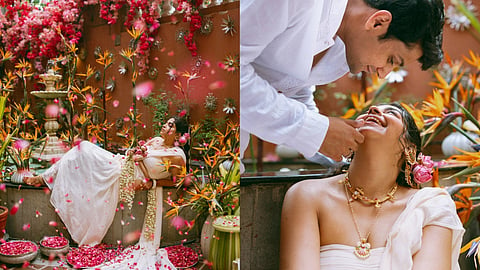

There are pretty weddings and then there are pretty weddings that stay in the mind forever. Designer Fuhaar Jhabak’s wedding ceremonies could have been something an artist imagined! Each one seemed as though it was etched with beautiful brushstrokes, from the brides’ dreamy, Shakuntala-inspired haldi that looked like it stepped out of Raja Ravi Varma’s painting, a Regency-style bridal shower with pearls and hydrangeas, and a haveli that made for a heritage backdrop at the wedding.

The wedding designer who’s a maximalist by heart, would not have it any other way as she tied the knot with Shreyansh Jain in a home court style wedding with the coolest décor, heirlooms and 40 guests.
Fuhaar takes Manifest into the colour, style, love and laugher that framed every wedding function of the couple that once shared classrooms, tiffins, and literally grew up, together!
Fuhaar Jhabak (FJ): Our story is quite literally a school-love story. We’ve known each other since nursery and were each other’s first crushes, which feels almost too filmi to be true! Growing up in the same classrooms, sharing tiffins, stories, and the kind of friendship only childhood can create. Somewhere in those years, we quietly became each other’s first crush. What started as a childhood friendship grew into 26 years of knowing, growing up and being there for each other.
After all those years of friendship, we finally asked each other if we should get married this January. And then, in true us fashion, we didn’t spend years planning it — within four months, we were married!
I’m a wedding designer by profession, so weddings have always been a huge part of my world, while he is into business. I think that made our wedding even more interesting because I had spent years designing weddings for other people, and suddenly I was designing my own.
(FJ): Our wedding was an intimate one-and-a-half-day celebration. The most special part was the intimacy of it all. We wanted it to feel less like an elaborate production and more like a family coming together at home to celebrate two people they love.
There was something incredibly beautiful about being surrounded only by our closest family and friends, in an old haveli, with everything feeling warm, familiar and love filled. For us, that intimacy was more special than anything grand or extravagant could have been.
Even the groom’s welcome wasn’t designed around grandeur. As his family arrived in Ahmedabad, we welcomed them into the haveli with a small cultural gathering that felt warm, local, and personal.
(FJ): Yes, we did. We got married on the terrace of a century-old haveli in Ahmedabad, so instead of bringing a wedding setup into the space, I wanted to make the space feel like our home — if our home had a slightly dramatic, very Indian, very maximalist personality!
For us, a wedding is ultimately about how it feels rather than how it looks. We wanted people to walk in and feel comfortable, connected and part of something personal. The haveli gave us exactly that feeling — it had history, character and warmth, and almost felt like we were inviting everyone into our own home for the most important celebration of our lives.
Shreyansh and I are both quite bold, we love colour, we love old things, we love experimenting. So red felt like the most natural choice. We wore red. We filled the space with red. And then we built an entire little world around it.
There was no traditional mandap. Instead, a bindu made with kumkum and sindoor became the centre of it all. Old haveli pankhas became the backdrop. Trees grew through them. Mogra, mokara orchids and tiger orchids spilled through the space. Hand-worked pomegranates hung overhead, surrounded by maple leaves. Vintage furniture, brassware, antiques, old props and royal pankha signs found their way into the room.
Everything was intense. Deep reds, old textures, flowers, brass, wood, little details everywhere.
(FJ): Yes, we actually decided to be the hosts and emcees at our own welcome dinner, which became one of the most fun parts of the wedding!
We wanted to personally welcome everyone rather than have someone else speak on our behalf. And because we’ve known each other for so long, there was no shortage of inside jokes, roasting and banter.
It became a very candid glimpse into our relationship for our families — lots of laughter, teasing and stories, and a chance to show everyone our chemistry in the most unfiltered, witty and personal way. It felt less like an emceed event and more like we were simply having a conversation with the people we love.
(FJ): Our haldi ceremony became one of the most meaningful moments of the wedding. Instead of arriving to bowls of readymade paste, our friends and family sat together in the courtyard, crushing fresh turmeric, multani mitti, rose petals, and fragrant ingredients with their own hands.
Before the ceremony even began, everyone had already become a part of it. Their hands, laughter, conversations, and blessings quite literally became our haldi.
We sat on the ledge of an old fountain while everyone surrounded us, covering us in haldi and flowers. Inspired by Shakuntala, I wore a simple white draped sari with minimal temple jewellery and delicate lotus motifs painted on my face. It felt less like recreating a bridal trend and more like stepping into an old painting—earthy, serene, imperfect, and deeply intimate.
I’ve always been fascinated by Raja Ravi Varma’s paintings, Indian culture and the way women were portrayed in traditional Indian art. For my Haldi, I wanted to create something that felt less like a conventional bridal look and more like a painting or a poem come alive.
I imagined myself in a pond, wearing a simple white draped sari, with very minimal jewellery and an overall Shakuntala-inspired mood. I wanted the look to feel soft, feminine and almost suspended in time — like I had stepped out of a Raja Ravi Varma painting.
The evening before the wedding wasn’t a conventional sangeet either. We called it Rangmanch.
Instead of sitting back while performances happened around us, we became the hosts of our own celebration. Having grown up loving theatre and public speaking, it felt natural for us to stand on stage together, welcoming every guest ourselves.
We anchored the evening, roasted our families, handed out humorous awards, shared heartfelt toasts, told stories from our childhood, and celebrated everyone who had played a role in bringing us here. It became less of a performance and more of a collective memory-making exercise.
(FJ): Our wedding was very personal and deliberately unconventional. We began with a court signing, followed by our pheras, but there was no traditional pandit-led ceremony.
Instead, we curated our own set of rituals. We took some elements from the wedding traditions and combined them with rituals and ideas that we created ourselves — things that felt relevant to our relationship and meaningful to us.
We had two celebrants who conducted the ceremony in a poetic, musical form, which made it feel incredibly intimate and emotional. Every ritual was thoughtfully tweaked rather than followed simply because it was tradition. We wanted to understand what we were doing and why we were doing it, and make the ceremony feel like ours.
(FJ): The post-wedding morning was incredibly special because it was the first time my family was seeing me as a married woman.
I wanted to honour that moment in the most beautiful and meaningful way, so I went all in with sindoor and 16 shringaar. I layered myself in all the traditional forms of shringaar — it was maximal, feminine and celebratory, but also deeply emotional because of what that moment represented.
The post-wedding celebration itself carried the same spirit as the rest of our wedding — joyful, intimate and full of people we love. It felt like the perfect transition from the emotion of the wedding into the happiness of being married.
(FJ): I absolutely love jewellery, but I didn’t want to wear the typical bridal jewellery just for the sake of it. I wanted every piece to feel like an extension of my personality.
I’ve always loved flowers, nature, animals and little birds, and my personality is naturally quite maximalist, so I wanted the jewellery to reflect that. I layered coloured gemstones — rubies, emeralds and coloured diamonds — instead of restricting myself to a more traditional bridal palette.
There were little unexpected details too. I wore a tiny bird as an ear cuff, and my necklace had little flamingos and butterflies. I loved the idea that the jewellery wasn’t just about looking bridal; it had little stories and characters hidden within it.
I had an intimate mehendi, which was heirloom inspired. For this, I wore my mom’s 35-year-old wedding lehenga and bangles in my hair bun.
(FJ): Yes, we did. We travelled to source several of our outfits, and that process was an important part of the wedding for us.
Because I work in weddings and design, I’m naturally very particular about details, textiles, craftsmanship and how something feels rather than simply how it photographs. So, sourcing became part of the experience — discovering pieces, meeting people, looking at fabrics and finding things that felt ‘authentically like us’.
(FJ): I would describe it as “a 26-year-old love story, celebrated like a house party in a haveli.”
The most offbeat part was probably the fact that we didn’t follow the conventional wedding script. From hosting our own welcome dinner and emceeing it ourselves, to designing our own wedding rituals and having no pandit, we kept asking ourselves, “Does this feel like us?” — and then doing exactly that.
The whole wedding was a little bit unconventional, a lot maximal, very personal and full of humour. It was less about putting on a perfect wedding and more about creating a celebration that felt like the two of us.
(FJ): Absolutely. Food is a huge part of how we celebrate, and we wanted the menu to feel as personal and indulgent as everything else.
We wanted our guests to experience food that felt generous, nostalgic and delicious rather than simply having a menu designed to tick the boxes of a typical wedding. Since the wedding was intimate, food also became another way of making everyone feel at home — the kind of meal where you sit around a table, keep talking, go back for seconds and completely lose track of time.
For us, that is what a wedding feast should feel like: abundant, comforting and full of memories.
Looking back, I think the defining feature of our wedding wasn’t any single outfit, ritual, or aesthetic. It was participation. No one attended as a spectator. Every person present helped create something—whether it was making our haldi, narrating our ceremony, laughing through Rangmanch, signing our court marriage as witnesses, or simply surrounding us with love.
And perhaps that’s fitting for two people whose story never relied on grand gestures to begin with. We simply grew up together, found our way back to each other after years apart, and celebrated our marriage in the same spirit—with honesty, warmth, and the people who have always been home.