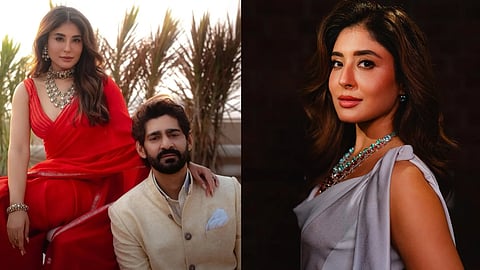

Earlier this week, Kritika Kamra married Gaurav Kapur in an intimate ceremony that felt perfectly in sync with the way the couple has always chosen to live their story — quietly, thoughtfully, and without excess noise. Together, they carry an ease that makes their partnership feel less like a spectacle and more like something steady, lived-in, and deeply certain. It was only natural that the wedding itself, and everything around it, reflected that same sense of intention.
For Kritika, that intention extended to what she wore. Instead of following a single bridal narrative, she found herself drawn to two pieces that held meaning long before the wedding day arrived — a handwoven Chanderi sari from her mother’s label Cinnabar, and a vintage Christian Dior gown from John Galliano’s era, each rooted in memory, craft, and personal history. The contrast between them felt striking, but for her, the connection was instinctive.
In this digital exclusive with Manifest, the actor speaks about dressing for herself instead of the moment, choosing pieces with past lives, and why the most personal decisions often make the strongest statements.
You chose two dramatically different looks — a handcrafted sari and a vintage Dior gown. What drew you to this contrast for your wedding?

Honestly, I wasn’t trying to make a statement. I just wanted to feel like myself, which is harder than it sounds when everyone around you has an opinion about what a bride should look like.
The sari was never even a question. It’s from my mother’s brand, it’s Chanderi, it’s home. That felt instinctive.
The Dior was more personal than people might realise. I did my college project on Galliano and spent months completely obsessed with his work — the references, the construction, the audacity of it. So wearing him on my wedding day felt strangely full-circle. And I loved the idea of something old, something new. The gown already had a life before me. I just got to add my chapter to it.
Do you see these two outfits as representing different sides of your personal style?
Not really. The common thread wasn’t an aesthetic, it was a feeling. I’m always drawn to things that have a story — a craft behind them, a history, a reason to exist beyond just looking pretty.
The sari is my mother’s work, something I’ve watched closely my whole life. The Galliano gown is something I fell in love with years ago and never forgot. On paper they have nothing in common, but both gave me the same instinctive feeling — that this means something. That’s really all the logic there was.
Weddings come with strong expectations around what a bride should wear. How important was it for you to stay authentic to your own aesthetic?
Completely. There’s so much noise around what a bride is supposed to look like, and I just had no interest in dressing for that. A wedding is such a personal day — when I look back at those photographs, I want to recognise myself.
Both looks came very naturally because of that. I wasn’t searching for the “right” bridal outfit. I was just looking for what felt true.
Your sari came from Chanderi, created by traditional artisans through your mother’s brand. What did that mean to you on such a personal day?
It was never even a decision — it was always going to be Cinnabar. My mother has poured everything into that brand, into those artisans, into keeping that craft alive.
Wearing her vision of me on my wedding day felt like the most natural thing in the world. I didn’t design it or ask for anything specific. I just trusted her completely. Supporting the craft was part of it, of course, but more than anything, it was my mother dressing me for my wedding.
Your Dior gown was vintage — a piece with its own past life. What appealed to you about wearing fashion history on your wedding day?
Choosing vintage almost felt like a quiet refusal of the whole bridal industrial complex — the idea that everything has to be new, made just for this one day.
A vintage piece already has a life. It isn’t waiting to mean something, it already does. That felt far more romantic to me. And there’s a confidence in not following the script. It felt like the right energy to bring into a marriage.
Many brides worry their wedding outfit will only be worn once. Was rewearability something you considered?
Absolutely. I couldn’t imagine putting that much thought into something I’d wear once and then lock away in a box. The sari will be worn again, styled differently, for different occasions — that’s the beauty of handloom, it never really has just one life. And the vintage Dior was never meant to sit in a garment bag. That’s the whole point of vintage. It has already lived one chapter, and it will live many more.
Rewearability wasn’t an afterthought, it was part of the decision from the start.
Do you think bridal fashion is moving toward more conscious choices — vintage, heirloom, craft-led pieces?
It already is. Brides are asking very different questions now. It’s not just about the dress, it’s about where it came from, who made it, and whether it will last beyond the day.
Vintage, heirloom, craft-led pieces — all of that is having a real moment, but I don’t think it’s a trend. It feels like a shift. People are more conscious about what they invest in and what they want those choices to say about them.
And a wedding feels like a very meaningful place to start.