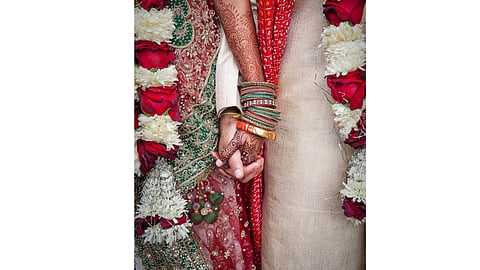

When wedding planner Vedika Mohan and fashion entrepreneur Omair Warsi tied the knot, the celebrations unfolded across Delhi and Jaisalmer. The ceremonies took place in February last year. It began with a dhol night at home. There was a court wedding and a vows ceremony, followed by a reception for 600 people in New Delhi, and, finally, a two-day celebration at Suryagarh, Jaisalmer. But its emotional core was rooted in the three generations of women in the
Mohan family.
There is Vedika’s mother, Vandana Mohan, who is the founder of The Wedding Design Company. Vandana’s company has spent decades planning some of the most iconic celebrations in modern Indian memory, including Deepika Padukone and Ranveer Singh’s wedding in Italy and Parineeti Chopra and Raghav Chadha’s engagement party in Delhi. But when it came to her daughter’s wedding, she had to step into a different role.
“For the first time in my life, I wasn’t the planner, just the mother. What made it special was the warmth. Friends were bringing homemade kheer and carrot cake. Someone was making besan barfi to send to the in-laws. Someone else made mulled wine on a winter evening. It was about community and love. That made it unforgettable. Everything else — the mood boards, the brief, the vision — belonged to Vedika. But that was also the difficult part: to listen instead of jumping in with ideas,” she says

What helped her let go? Vedika’s clarity. A sense of confidence in her choices that she inherited from her mother and grandmother. Vandana’s own wedding in December 1983 had been unconventional in some ways. She was 20; her husband, Vikram Mohan, was eight years older. “Everyone had evening weddings back then, full of twinkling lights and fanfare. But I chose a daytime ceremony and a high-tea reception. I used to model, so I just wanted good lighting, or maybe I was trying to save on the lighting budget,” she laughs. Vandana eschewed red for cream and gold, which was approved only by her progressive grandmother. They married in a garden surrounded by marigolds, music, and family. They honeymooned in Shimla.
She met her husband through a family wedding her mother had helped orchestrate. He was the groom’s brother. “We met at a party in Delhi. I was in college, and he was working in Calcutta. I went back and told my friends, ‘I think if I ever get married, it’ll be to him.’ Of course, they all laughed. He extended his stay in Delhi, began dropping by for chai, and once he returned to Calcutta, we started writing letters and making the occasional sneaky phone call. When rishta conversations began at home, I knew I had to speak up. It took some convincing. I was very young, and the eight-year age gap raised a
few eyebrows. But my mind was made up. And love and behold, we were married,” she recalls. Her mother’s story was similar. She met her army officer husband while visiting her aunt in Dehradun. He was nearly 11 years older. They,
too, had an afternoon wedding. It was a simple ceremony held at home in Chandigarh, and the bride wore a blush pink sari.
Their honeymoon was in Manali. That sari remains with the family, carefully folded in soft white mulmul. “My mother is vibrant and vivacious, with a deep love for music and art. My father would drive down to Chandigarh to meet her. My grandfather was initially reluctant about the match, but eventually came around,” she remembers.
And then there’s Vedika, creative director at The Wedding Design Company. Vedika grew up watching not just weddings, but the women behind them. When it was her turn, she chose scale but also soul. There were dholkis played by Vedika’s father, a kaleidoscope-themed lunch, and lots of family and friends singing Punjabi tappes, just like it was at Vandana’s wedding. “No big DJs or performances. Just joy,” remembers Vandana.
The celebrations reflected the values of a couple raised in different faiths — Vedika is Hindu, and Omair is Sikh-Muslim. “We asked them to choose between a nikah, a gurudwara ceremony, or a Hindu wedding. But they chose none. They didn’t want to privilege one side over the other,” explains Vandana. In their own way, they created a mosaic of meaning: kaliras without the chura ceremony and a nearly four-hour-long baraat without pheras.
The clothing followed its own script, too. There were no lehengas. Instead, Vedika picked designers who’ve shaped her style or been part of her life. Abhinav Mishra designed a hot pink mirrorwork sharara that was fitting, as she had been the muse for his first-ever lehenga. Gaurav Gupta, a close friend of Vedika’s, created a sculpted red gown. Sureena Chowdhri crafted a velvet piece for the dhol night. And a pearlembroidered ivory skirt set, paired with an almost six-foot veil, was made by Delhi-based Seema Gujral.
Yet it was the family heirlooms that anchored the bridal outfit. Vedika wore Vandana’s bridal necklace and earrings, and repurposed her wedding dupatta for the court ceremony. A cuff that belonged to her great-grandmother, two gold bangles gifted by her nani, and kadas borrowed from her masi completed the look. For her trousseau, she turned to her mother’s collection of Banarasis, Kanjivarams, and shawls. “These are pieces I no longer wear. She got new blouses stitched and wore them to other family weddings. We didn’t want to go overboard with shopping, so we reused and restyled what we already had,” says Vandana. Even the invitation reflected Vedika and Omair’s story; it featured their Shih Tzus,
their shared love for the sand and the sea, Asian food, Chelsea Football Club, and fashion. A relationship, illustrated on paper.
These choices — intentional or intuitive — were shaped by a broader family philosophy. Vandana remembers her childhood home as one that resisted the pull of rigid rules. “My father valued sentiment over ceremony. Whether at a mandir, dargah, or gurudwara, it was always about the intent. But we had our own family rhythms: things like always saying ‘namaste’ in the morning and learning the Gayatri Mantra not for prayer but as emotional grounding. That became a tradition we
passed down,” she says.
Vedika’s wedding was a culmination of all that had come before. And at the centre of it was Vandana’s mother, who led from the front. “My husband’s parents are no longer with us. My mother is the eldest. She tied the first kalira on Vedika’s
wrist in Jaisalmer. She welcomed guests, oversaw gifts, and even distributed saris and kurtas to relatives. She insisted on dancing at the sangeet and became friends with everyone, including Omair’s dadi, who comes from a Bhopali family. It was all very old-school and special,” says Vandana.
There’s something about weddings, especially those of grandchildren, that softens even the most traditional elders. Boundaries blur, expectations loosen, and what remains is pure affection. “At my wedding, my parents made most of the
decisions. But with Vedika, my mother was more open, more joyful. It was beautiful to watch,” she adds.
Needless to say, Vedika’s wedding has also changed how Vandana now approaches work: “It has made me more compassionate. You can’t understand the intensity of emotions until you experience them first-hand. But I always ask every client: is this what your children want?” Because the wedding landscape — and women — have changed. “Brides still want
their Padmaavat moment, but only for a day. The rest is practical, sometimes selffunded. Families co-host. Guest lists are lean. And yes, now and then, the Sabyasachi lehenga wins even after a bride swears she won’t wear one,” she says. But through all this, one thing remains unchanged: the importance of family. “This generation, despite their careers, social lives, and everything else, makes space for the people who matter. And that’s the most beautiful evolution of all.”
This story appears in Manifest India’s Issue 03. Subscribe here for more stories like this.