
Grey stone, open skies, and the stillness of a temple that feels untouched by time.
Set against this quiet, almost meditative landscape in the foothills of Nandi Hills, fashion designer, Stuti Vora, and businessman, Dhrumil Nishar, chose to begin their new chapter on February 6 2026 not with spectacle, but with intention.
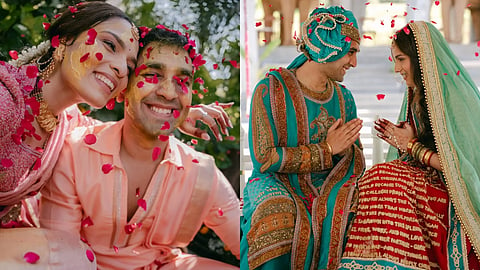
What followed was a wedding built on meaning rather than momentary grandeur — where khadi replaced silk, a blessing dupatta carried handwritten notes from friends, and a striking red-and-teal palette cut through the stone like something both regal and deeply personal. Even the smallest details held weight: a mother applying her daughter’s mehendi, sacred symbols woven into garments, and a veil inscribed with a Krishna mantra.
Nothing here felt incidental. Everything was felt.

A month after their wedding, Stuti and Dhrumil look back on the journey that led them to a deeply personal South Indian temple wedding.
Manifest: Your wedding was rooted in tradition, yet very contemporary in its design language. When you began planning, what was the vision you wanted to stay true to?
Stuti: From the very beginning, we wanted the wedding to feel spiritual, sacred, and intentional. It was important for us to celebrate in India and honour our roots in a way that felt authentic to who we are.
Dhrumil: Choosing a temple-style setting allowed us to create something timeless and grounded, rather than just a destination celebration.
M: You chose a temple wedding in South India, which is quite different from the usual destination format. What drew you to that setting?
S: When we first visited Amitarasa in Bangalore, we felt an instant connection to the space. There was a calm, almost spiritual energy in the foothills of Nandi that stayed with us.
D: The hand-carved stone, the open architecture, and the simplicity of the surroundings shaped the entire mood of the ceremony. It made everything feel intimate, sacred, and incredibly real.
M: Your wedding wardrobe stood out for its use of khadi, handcraft, and the red-and-teal palette for the pheras. Why was it important to bring conscious design into such a personal moment?
S: Khadi has always been meaningful to me because my mother introduced me to its history and significance. It is the fabric of freedom, and I wanted to wear something that carried that emotion on such an important day.
I also always knew I wanted to be a red-and-teal bride. Red symbolised tradition and auspiciousness, while teal reflected individuality and balance. Even Dhrumil wore a teal angrakha achkan instead of a sherwani, so both our looks felt personal rather than conventional.
M: Many of your outfits were designed by your mother, Jesal Vora. What was it like being dressed by family for such an important moment?
S: It made the entire experience deeply emotional. My mother knows me better than anyone, so every outfit felt like an extension of who I am. One of the most special moments was when she surprised me with a hand-embroidered bridal chaddar that included a letter from my parents and my twin brother. It was far more meaningful than any traditional accessory.
M: One of the most touching details was the blessing dupatta with handwritten messages from friends. How did that idea come about?
S: The idea came from my mom, and it instantly felt right. My closest friends have been part of our journey since school, so having them write their blessings directly onto the dupatta made it incredibly personal. Wearing it felt like carrying their love with me as I walked into the ceremony.
M: The wedding carried strong symbolism — from sacred geometry to the Krishna mantra on your veil. Why was it important that every detail held meaning?
D: We didn’t want anything to exist just for decoration. Our wedding logo combined the Trinity symbol and the Celtic knot, representing love, trust, and friendship — the three pillars of our relationship.
S: My veil had a Krishna mantra embroidered into it, and my mehendi was applied by my mother herself. Even the décor included kumkum handprints to honour the people who shaped our journey. Every detail was meant to reflect intention, not just aesthetics.
M: You’ve known each other since school. Did that long journey change the way you approached the wedding?
S: Definitely. Because we’ve grown together for so many years, we were very clear about what we wanted the wedding to represent. It wasn’t about trends — it was about celebrating our bond and the life we’ve built together.
D: Yes, every decision felt natural because we already knew what mattered to us.
M: Looking back now, what was the one moment that felt the most real to you?
S: Walking down the steps at Amitarasa for the varmala, with my long veil behind me, felt surreal. It was the moment when everything we had imagined finally became real.
D: For me, it was during the pheras and the kanyadaan. During the pheras, I kept thinking about our eight-year journey together. And during the kanyadan, seeing Stuti emotional for the first time made the moment unforgettable.