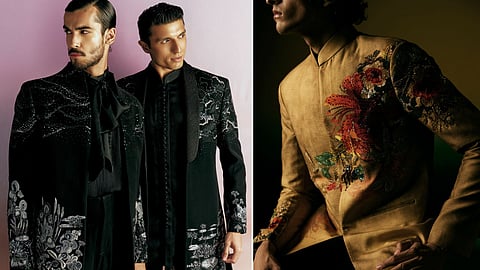

Florals have always been an intrinsic part of Indian textiles. They bloom across Kashmir’s Kashidakari embroidery, as almond blossoms and iris scrollwork stitched in satin thread. In Uttar Pradesh, bakhiya, the shadow-play stitch, makes an appearance in Chikankari through floral patterns. Punjab’s Phulkari is synonymous with geometric motifs, while Bengal’s Kantha embroidery is known for its intertwined floral grids.
Karnataka’s Kasuti embroidery stylises lotuses and jasmine garlands in coded patterns, passed down through generations. In Parsi Gara, the flower is nearly encyclopaedic, rendered in satin stitch with precision. And this season, this motif has made its way into menswear. At the FDCI India Men’s Week in Jaipur earlier this year, many designers incorporated floral accents and motifs.
Varun Bahl’s Whispers of Spring opened with sheer white kurtas and harem pants in silk organza, embroidered with watercolour-hued florals and light sequin work. The collection drew inspiration from Emily Dickinson’s poetry, and the visuals spoke in soft resham tones, familiar to Chikankari and Pahadi thread traditions. Arjan Dugal’s Vintage 2030 collection brought a sharper visual proposition. Brocade trousers were styled with velvet jackets overlaid with floral zardozi, and in one look, a floral bib peeked through the structure. Dugal blended tailoring with embellishment, using traditional Japanese motifs and dense Indian handwork to create pieces that felt grounded yet graphic, anchored by flashes of red socks that punctuated the formality with intent.

Vivek Karunakaran’s jasmine-appliquéd garments stood out for their context. Inspired by the Tirukkural, a classic Tamil text—his collection referenced the way flower-sellers in Tamil Nadu measure garlands-appliqué jasmine flowers trailed from wrist to elbow—stitched onto cream-toned silk and organza. Madras checks appeared not as print, but as textured stitchwork. The restraint of colour—vanilla, ecru, scarlet—made the florals feel precise and purposeful.
Florals also appeared through print in Hyderabad-based Anushree Reddy’s debut menswear line. Her kurtas, layered with sherwanis, carried oversized bloom motifs placed more assertively borrowing visual codes from her bridalwear, but scaled and styled for a more masculine frame. Mahima Mahajan brought in butterfly and floral motifs in luminous fabrics, using the gleam of the surface to hold the embroidery in place.
In Shantnu Nikhil’s Mirage, florals emerged in asymmetrical silhouettes and flowy, wide-legged pants, softening the angularity of their usual cuts. JJ Valaya, on the other hand, wove them into his long-established couture language. Sherwanis and bandhgalas were layered with signature shawls, where florals appeared as part of intricate threadwork, refined and unmistakably in Valaya’s vocabulary. Earlier this year, at the Lakmé Fashion Week 2025, the floral story extended into tailoring. Rahul Mishra’s AFEW, inspired by Rousseau’s dreamscapes, presented embroidered botanicals on sharply cut jackets and trousers. The detailing remained quiet, allowing the shape to hold. Abhichiq’s Ciao, referencing Sicilian summers, worked hand-block printed and hand-embroidered florals into artisanal, easy pieces, which were playful but grounded in Indian textile craft. Across all these collections, the flower was neither a flourish nor a flashback. It was built in, stitched, placed, printed, or appliquéd into the garment’s logic. Some referenced poetry, some fused futurism, while some leaned towards classicism. But in every case, the floral was a deliberate part of how the garment was shaped.