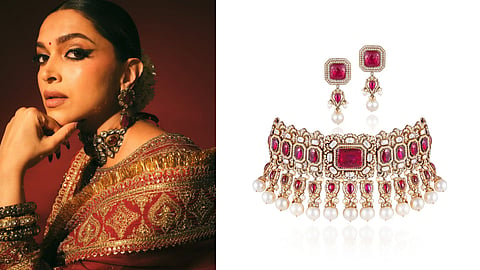
Bold, blood-red, and steeped in legend, ruby is far more than a gemstone. It’s a symbol of power, protection, and passion that has mesmerised civilisations for centuries. Once revered as the ratnaraj, the king of precious stones, in ancient India, the ruby has always carried a mystical allure. With its fiery hue and storied past, it remains one of the most evocative emblems of love and strength across history.
Ancient cultures treasured rubies as they mirrored the redness of the blood that flowed in the veins of humans. To them, this meant that rubies held the power of life. According to legends, Burmese soldiers prized the ruby as their signature stone and believed it granted invulnerability in battle. The belief was so strong that soldiers would embed rubies surgically in the vulnerable areas on their bodies, like shoulders, chest or the upper arms. Soldiers in India and China would also adorn their armour with rubies to take advantage of their perceived protective properties.

History is rife with anecdotes of monarchs who decked their crowns with rubies, believing that the crimson hue would darken in the face of danger and warn them ahead of time. It’s no surprise that rubies have been the mainstay of royal coffers for centuries. Some of the most famous rubies in the world, therefore, have lore tied to royals, like the famed Black Prince’s Ruby. One of the most famous and oldest crown jewels of England, this iconic ruby is not technically a true ruby. Despite what its supremely cool name might suggest, the Black Prince’s Ruby is actually a red spinel. It’s easy to confuse the two as they’re both gemstones with a distinct red hue. This spinel dates back to the 14th century and has been with the British monarchs since the Spanish king Peter of Castile gifted it to the ‘Black Prince’ Edward of Woodstock in 1367.
The ‘ruby’ currently sits at the front of the Imperial State Crown of the British royal family and is considered one of the world’s largest uncut red spinels, weighing 170 carats. While the Black Prince’s ruby might not be the real deal, his descendant, Queen Elizabeth II’s Burmese Ruby Tiara, is as real as it gets. In 1973, the monarch commissioned the royal jeweller, Gerard & Co., to create a tiara using the 96 rubies from a necklace she had received as a wedding gift from the people of Myanmar in 1947. She also dismantled, much to the dismay of jewellery purists around the world, a diamond tiara and necklace set given to her by the Nizam of Hyderabad for the new ruby and diamond tiara. The rose pattern in rubies on the new tiara represented the Tudor rose.
One of India’s most extravagant royals, Maharaja Bhupinder Singh of Patiala, was known for his collection of luxurious cars, paintings, and jewels. The king’s famous Patiala Necklace was the single-largest order placed to the French luxury jewellery house, Cartier, to date. In 1931, the king commissioned the jewellery house to create a ruby-and-diamond choker, using his family’s heirloom jewels, as a gift to his wife, Maharani Yashoda Devi. The stunning ruby jewellery piece contained 292 rubies and 132 natural pearls. In 2019, a restored version of the choker was auctioned by Christie’s for $975,000 as part of the ‘Maharajas and Mughal Magnificence’ sale.
Around the time the King of Patiala was setting staggering records with Cartier, the Maharaja of Nawanagar in Gujarat was not far behind. The royal family of Nawanagar, particularly Maharaja Ranjitsinhji, was particularly fond of rubies. The king enjoyed a close relationship with Jacques Cartier, of the house of Cartier. In his 1934 biography of the royal, journalist Roland Wild wrote how the king’s obsession with the right tint of rubies evolved over the years. “If there was one precious stone about which it was possible not to agree with the late Maharaja, it was regarding the best colour for rubies. He liked them with a tinge of purple, and his early purchases reflected this taste, but later he changed somewhat his opinion and bought some stones of the pure crimson which keeps clear of purple,” he wrote. When his adopted son, Maharaja Digvijaysinhji, succeeded the throne, he also inherited the love for precious gemstones from his predecessor. The new king, too, was a patron of Cartier and commissioned several jewellery pieces, including the stunning Art Deco-inspired necklace that was crafted using 116 Burmese rubies collected by his father. In the 1950s, the necklace was returned to Cartier and was sold to a private collector. It resurfaced in 1966, when American socialite Gloria Guinness showed up at Truman Capote’s legendary Black and White Ball in New York City.
Rubies have played a major role in some of the most heartwarming love stories over the years. Legendary Hollywood actress Elizabeth Taylor was as famous for her love life as she was for her obsession with precious gemstones. In 1957, during a vacation in the French Riviera, the actress’s third husband, Mike Todd, gifted her a ruby-and-diamond bib necklace. Taylor described the moment in her 2002 book, Elizabeth Taylor: My Love Affair With Jewellery. “I was in the pool, swimming laps at our home, and Mike came outside to keep me company,” she wrote. “He was holding a red leather box, and inside was a ruby necklace, which glittered in the warm light. It was like the sun, lit up and made of red fire.” She continued, “First, Mike put it around my neck and smiled. Then he bent down and put matching earrings on me. Next came the bracelet. Since there was no mirror around, I had to look into the water. The jewellery was so glorious, rippling red on blue like a painting. I just shrieked with joy, put my arms around Mike’s neck, and pulled him into the pool after me.” After she died in 2011, the necklace was sold at a Christie’s auction, as part of her estate sale, where it fetched $3.8 million.
The then-crown prince of Denmark, Frederik X, met and fell in love with public relations expert Mary Donaldson in a nondescript bar in Sydney while attending the Summer Olympics in 2000. Reportedly, the prince had kept his royal identity a secret from Mary in the initial stages of their meeting, only making their romance novel-esque love story all the more special. When the time came to pop the question to his lady love, the future king picked out a ruby-and-diamond ring to propose. Some years down the line, King Frederik X updated the queen’s engagement ring by adding two more diamonds on either side of the rubies.
More recently, Taylor Swift gave a masterclass in monochromatic styling at the Grammys this year, when she paired deep red rubies by Lorraine Schwartz with her crimson Vivienne Westwood gown. The centrepiece of her suite of 60 carats of ruby jewellery was a thigh chain bearing a ‘T’ charm. While the ruby ‘T’ peaking from under her gown could have been her own initial, her fans noted that it could also have been a potential nod to her boyfriend, Travis Kelce.
With coloured gemstones among the top jewellery trends of 2025, it is no wonder that ruby has become a red carpet favourite. At the Cannes Film Festival this year, Aishwarya Rai Bachchan stunned in a Manish Malhotra sari, paired with jewellery from the designer’s fine jewellery label that featured over 500 carats of Mozambique rubies and uncut diamonds.
The Ambani ladies broke out some of the most stunning ruby pieces to accompany their couture creations during Anant Ambani and Radhika Merchant’s wedding. Isha Ambani paired her Abu Jani Sandeep Khosla ensemble with a diamond-and-ruby layered set for her brother’s gol dhana ceremony—the same one that she wore for Akash Ambani’s wedding in 2019. For her sangeet ceremony, Radhika borrowed a ruby necklace from her mother-in-law Nita Ambani’s collection to go with her gold Manish Malhotra lehenga.
Whether nestled in regal heirlooms or reimagined in modern, headline-grabbing masterpieces, the ruby remains an enduring symbol of opulence and passion. Its saturated crimson hue, steeped in history and mystique, continues to seduce discerning collectors, connoisseurs, and romantics alike. In a world where trends shift swiftly, the ruby holds its ground by being bold, brilliant, and utterly timeless.