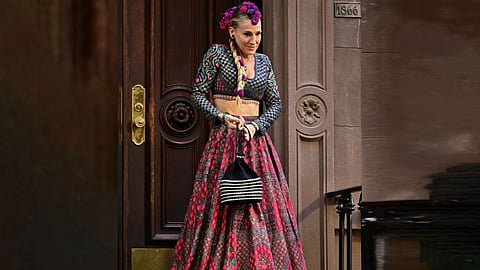

The traditional accessory has gone from an androgynous status symbol to a hot fashion piece. What's more, its popularity seems to increase further with each passing day. What makes a hit handbag? Snapshots of A-listers carrying it, a big-budget Netflix show and a centuries-old history. The potli, a classic Indian drawstring pouch, has all three.
In July 2024, Kim Kardashian and Khloe Kardashian carried a matte gold embroidered potli for Anant Ambani and Radhika Merchant's wedding.

The Kardashian moment is just one example of how it became a part of global pop culture.
In 2012, Kate Moss attended Vladimir Doronin’s 50th birthday party thrown by his then-girlfriend Naomi Campbell in Jodhpur. Kate’s bag of choice at the celebration? A velvet potli by Manish Malhotra.
Vidya Balan brought this festive must-have to the Cannes red carpet a year later. In January 2022, Sarah Jessica Parker’s iconic character Carrie Bradshaw carried the traditional bag in the first season of And Just Like That.
Two months later, Oscar-winning actor Lupita Nyong’o was pictured at a wedding in Karachi with a red potli bag designed by Anita Dongre.
It’s not just celebrities who have discovered the appeal of this Indian accessory. Potli-inspired shapes are sweeping high fashion as well. On luxury resale sites like The Real Real, a burgundy-coloured velvet Prada pouch sold for $195. Prices for Jimmy Choo’s Micro Bon Bon bag, with a gold chain drawstring, start at €695.
New York-based label Judith Leiber, offers its Sparkle Net Pouch for $795, while Alaïa stocks a top-handle style priced at $1,450.
In India, the potli isn’t just an accessory. It’s the mark of heritage and opulence, as illustrated in the internationally acclaimed Netflix series Heeramandi: The Diamond Bazaar (2024).
The show’s costume designers, Rimple and Harpreet Narula, took cues from erstwhile actors and singers like Suraiya Jamal Sheikh, Noor Jehan, and Shamshad Begum to recreate an era where these bejewelled bags were synonymous with status.
Carried by both courtesans and nawabs, the potli transcends genders in Heeramandi and emerges as a small albeit shining symbol of India’s sartorial legacy. Historically, the homegrown silhouette seems to have been with us from the Vedic civilization.
Great Indian epics like the Ramayana have underscored its utility. During his 14-year exile, Rama travelled with a potli packed with essentials like clothes, medicinal herbs, fruits, and water, along with Sita and Lakshmana.
In the Bhagavata Purana, Sudama brings a humble potli of parched rice when visiting his friend Krishna.
And amongst Jains, a small bundle of vermilion-dyed fabric, known as a raksha potli or 'protection pouch', is tied to the red thread as a symbol of protection.
In pre-partition India, Qudsiya Begum, the first female ruler of Bhopal, started commissioning intricate potlis from local artisans. Some of these historic poltis, also known as batuas, are now preserved in Bhopal’s State Museum and Golghar Museum as a tribute to the royal family. In 1853, Nawab Sikander Begum used the batua as a force for good.
How? Establishing a school for embroidery and handicrafts allowed women, even within purdah, to carry on the tradition of zari work.
Since then, the potli has come a long way. Each season, designers experiment with its material, shape and size, reimagining it on the runway with fresh updates. Yet no matter the style, the best thing about the potli is that it will never date — it will be just as desirable five years from now as it was centuries ago.
This has been adapted for the web from an article published in Manifest’s December 2024-January 2025 issue that is now on stands. For more stories like this, subscribe here!