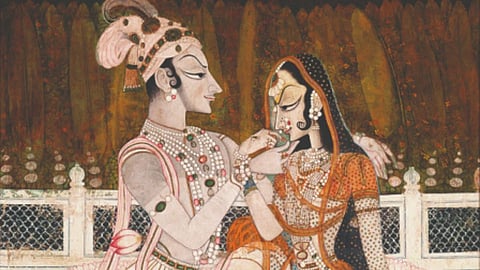

The bajuband—also known as an arm bracelet or armlet—has appeared in the visual and material culture of the Indian subcontinent for hundreds of years. Sculptural and archaeological evidence suggests that upper-arm ornaments were worn as early as the Indus Valley civilisation, with figures such as the iconic Dancing Girl of Mohenjo-Daro depicted wearing arm ornaments often cited as early examples for this form of adornment. Over time, armlets continued to surface across regions and eras, appearing in ancient sculptures, temple iconography, and later, in Gandharan and early historic art. References to arm jewellery are found in Sanskrit literature and ritual texts compiled in the medieval period, including the Viramitrodaya—underscoring the bajuband’s place within India’s ornamental and ceremonial lexicon.
Historically, these pieces were worn by both men and women, often signalling status, refinement, and authority. In royal and courtly settings—particularly during the Mughal era—armlets featured in miniature paintings and ceremonial attire, worn as symbols of prosperity and rank rather than everyday adornment.
Beyond aesthetics, the bajuband also has symbolic meaning. In traditional belief systems linked to Ayurveda and yogic philosophy, the upper arm is associated with vitality and strength through its connection to the body’s energy channels, or nadis. Jewellery historian and author Dr Usha R. Balakrishnan has noted that arm ornaments were traditionally believed to enhance strength and auspiciousness, with particular associations to feminine power and fertility—making them especially significant in bridal contexts.

While armlets were never exclusive to women, their presence in ceremonial and festive attire gradually became more pronounced in wedding traditions. Classical dance forms such as Bharatanatyam played a role in preserving and visually codifying the bajuband, embedding it within South Indian aesthetics and ritual costume. In time, the ornament found enduring resonance in bridal trousseaux across regions. Though not always formally included as part of the solaah shringaar, the bajuband has historically been worn by brides as a symbol of protection, strength, and auspicious beginnings.
As the form evolved, so did its design language. In rural and folk traditions, bajubands appeared as simple metal bands or protective talismans. In North and West India, they developed into elaborate gold armlets adorned with gemstones, becoming part of courtly jewellery traditions. In the South, the vanki—a distinctive V-shaped armlet—emerged as a household heirloom, richly detailed with temple motifs and artisanal craftsmanship. While regional expressions varied, the essence of the bajuband remained constant: an ornament that carried meaning beyond adornment.
Like many traditional jewels, the bajuband experienced periods of diminished visibility in the mid-20th century, as Western fashion sensibilities reshaped urban Indian dressing. Yet in recent decades, a renewed appreciation for heritage jewellery has brought the armlet back into focus—particularly within bridal styling, where history and individuality are once again being celebrated.
Recent high-profile appearances have further reignited interest in the bajuband’s cultural relevance. Radhika Merchant, for instance, was seen wearing an emerald and polki bajuband reportedly passed down through her maternal lineage, transforming the armlet into a symbol of family legacy. In 2024, Nita Ambani drew global attention when she styled a Mughal-era kalgi—a turban ornament believed to date back to the period of Emperor Shah Jahan—as a bajuband at the Miss World finale in Mumbai. Crafted in gold and set with diamonds, rubies, and spinels, the historic jewel’s reimagining sparked conversations around heritage, couture, and cultural reuse.
Today, contemporary designers continue to reinterpret the bajuband for modern brides—making it lighter, more wearable, and versatile through mixed metals, refined craftsmanship, and contemporary silhouettes. No longer confined to tradition alone, the armlet has become a conversation piece: one that bridges past and present with quiet confidence.