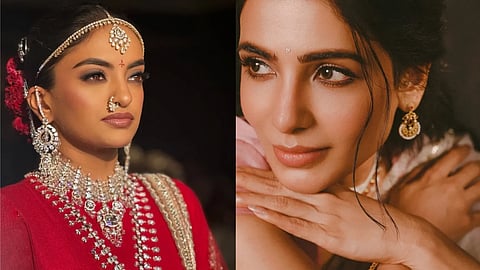
Choosing a foundation for your wedding day is less about finding the one and more about finding the one that survives it all — the heat, humidity, flash photography, tears, twelve-hour wear time, and of course, endless cheek kisses from relatives. While a makeup artist can perfect technique and skin prep, the real question often boils down to performance: Will it last? Will it separate? Will it still look like skin by midnight? Which is perhaps why more brides are turning to airbrush foundation for the big day. But is it actually better? The experts weigh in.
Airbrush foundation uses a gun-like device to spray a fine mist of makeup onto the skin, creating what celebrity makeup artist and founder of Simply Nam, Namrata Soni, describes as a more seamless, skin-like finish. “It allows the artist to build coverage only where required, so the makeup never feels heavy or overdone,” she explains. “Traditional liquid foundations, meanwhile, can appear cakey when layered excessively, particularly in bridal makeup, where full coverage and longevity are often expected.”
Celebrity makeup artist and founder of MOKAE Beauty, Sandhya Shekar, however, notes that while airbrush makeup may feel lightweight, it creates a distinctly ‘filtered’ finish on the skin. “It almost feels like a filter has been placed on your face,” she says. “It’s not heavy or thick, but it gives a perfected, seamless finish that doesn’t always look the most natural up close.”
Another key difference between airbrush and traditional foundation is durability. Airbrush formulas tend to be more sweat and water-resistant, making them especially suited to long wedding celebrations. According to Soni, while a traditional foundation can still look beautiful, it often requires more touch-ups throughout the day, depending on the weather and skin type.

No matter where you’re getting married, weather conditions play a huge role in how makeup is worn throughout the day. As Soni notes, for Indian weddings, especially outdoor or humid functions, airbrush makeup generally performs better because of its lightweight yet long-lasting nature.
“Brides are constantly moving between ceremonies, outfit changes, dancing, lights, and photography, so makeup longevity becomes extremely important,” she says. “Airbrush makeup holds up very well in heat and humidity because it is more resistant to sweat and transfer.”
While airbrush makeup may still carry the reputation of being the more long-wearing option, bridal makeup artist Mausam Gandhi believes traditional foundations have evolved significantly in terms of formulation and wearability.
“Back then, airbrush offered a smoother, more durable finish,” she explains. “But now, traditional formulas hold for a very long time and are easily blendable when touching up, too. Airbrush, on the other hand, cannot be touched up as much, so that’s a drawback for Indian humid weather.”
Shekar adds that the choice ultimately comes down to personal preference. “Some brides love a matte, perfected finish, while others want makeup that melts more naturally into the skin over time,” she says. “I’d probably play with tinted finishes so that even if the bride starts sweating, the makeup blends more naturally with the skin’s oils and continues to look natural.”
According to Soni, airbrush makeup works particularly well for brides who want a polished but lightweight finish, especially those with oily skin, since the application process is more hygienic and involves minimal direct contact with the skin.
Gandhi, however, points out that airbrush makeup’s lighter coverage may not suit those with pigmentation, texture, or active acne. “I’d use airbrush only on someone with ultra-clear skin,” she says, adding that traditional foundations offer greater flexibility and coverage for most brides.
Interestingly, Shekar takes a hybrid approach when working with textured skin. “If there are acne pits or irregular textures, I like combining traditional foundations with airbrush because it creates a more seamless finish,” she explains. “
Soni believes airbrush makeup comes into its own during high-energy events like the wedding ceremony, reception, or sangeet, where sweat resistance and a flawless flash-proof finish matter most. Traditional foundations, meanwhile, are often better suited for softer, more intimate celebrations like the haldi or mehendi.
One of the biggest pros of the airbrush foundation is its ability to photograph beautifully. The fine mist application creates a smooth, even finish on the skin that translates particularly well in flash photography and high-definition videography.
That said, Shekar believes photography results also depend heavily on the style of lighting being used. “Under editorial lighting, airbrush can sometimes look cakey,” she says. “But in more commercial-style wedding photography, it definitely photographs more seamlessly.”
She also notes one of the biggest misconceptions around bridal makeup is that airbrush is automatically superior. “There was a phase when airbrush became a huge trend, and people assumed it was better,” she explains. “But when a traditional foundation is blended really seamlessly, it can give you an airbrush-like finish anyway.”
Ultimately, both experts agree that technique matters far more than trends. “Makeup should enhance the bride’s skin and personality rather than follow a trend,” says Soni. “The technique is chosen based on what will photograph best, last the longest, and feel most comfortable throughout the day.”