
A festival that people of the Hindu community wait for, for the entire year, Diwali holds a special place in the hearts of all. While everyone celebrates this festival of lights in their own unique way, what remains unchanged is the warm emotions that one feels during the festival. While all celebrations and all ritualistic traditions of Diwali are equally special, some rituals are particularly unique and interesting.
While most of the people celebrate Diwali with firecrackers and Laxmi Puja, communities in Gujarat pull out their accounting books, not to calculate their earnings but to worship those accounting books.

On the night of Diwali, many shopfronts in Gujarat, family offices and temples hold quiet ceremonies, a practical ritual called Chopda Puja—the worship of accounting books. For business and merchant families, Diwali is not just a festival of lights, but it also marks the end of the old accounting year and the formal start of a fresh financial year. The ritual of Chopda Pujan blends people’s devotion to Lakshmi, Ganesh and Saraswat with a hope for a prosperous year for their business ahead.
This Indian custom has existed since the only records of commerce and household finances were ledgers (the “chopda”). Diwali—the festival of lights, wealth, and new beginnings—was selected as the natural time to write off old accounts, open new ones, and ask the gods for protection and profit. Over the years, the ritual developed into a practice among Indian merchants and Gujaratis who lived in western India.
Chopda Pujan usually takes place on Diwali (Lakshmi Puja) along with other important Hindu rituals. The specific time for performing the puja is determined according to the auspicious muhurat, which can be either during the evening or the pradosh (post-sunset) period. The Panchang and muhurat services give out the exact timings every year, and numerous shopkeepers do the puja in the choghadiya or ‘Labha/Shubh’ slots, seen as fortunate for business. If a family belongs to a certain sampradaya (like Swaminarayan groups), there could be community Chopda rituals at temples on the same night.
Families in Gujarat usually clean their altars and decorate them with cloth, rangoli or flowers. They light diyas as part of a welcoming ritual for Goddess Lakshmi. They arrange books, both old and new. Old ledgers are closed with thanks, and new account books or their modern equivalents (laptops, tablet folders or new physical ledgers) are placed neatly on the altar. Many people mark the first page with “Shubh-Labh”, draw a swastika or write a short invocation.
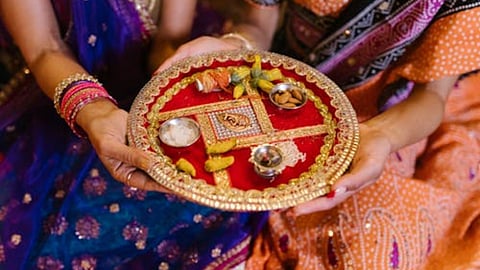
They invoked deities, idols or pictures of Lord Ganesha (remover of obstacles), Goddess Lakshmi (wealth) and often Saraswati (knowledge) are placed nearby. A kalash (pot), flowers, incense, fruits and sweets are offered. Vedic chants, Lakshmi stotras and local mantras are recited by a priest or an elder. Puja of the books is conducted. The priest or head of household applies a tilak, sprinkles holy water and sometimes ushers the first symbolic entry — names of the gods and an auspicious figure are written on the new ledger’s opening page. Coins, rice grains and betel leaves are placed on or near the accounts as offerings. Aarti is performed to the deities and the books; family members or employees touch the books and receive blessings. Prasad (sweet offerings) is distributed. Many business houses also perform a short ritual of Kuber (treasurer god) puja alongside Chopda Pujan.
A typical listing in the guides of temples and booklets of priests in Gujarati includes items like the new accounting books or their digital equivalents, kalash (pot), coconut, flowers, rice, turmeric and kumkum, coins, betel nut (supari), sweets, incense, lamp (diya), a pen for the first writing and small images/ids of Ganesha, Lakshmi and Saraswati. Temple or community lists provide more comprehensive item sets that are used in formal mahapujas.
The ritual has evolved. Many families now consider laptops, printouts, or business software backups as ‘chopdas’. In corporate and diaspora communities, temples and large mandirs conduct mass Chopda Pujans where the ledgers of hundreds are sanctified at the same time. However, the symbolism—a fresh start for the books and an invocation of ethical prosperity—remains the same.